Skip to content

On This Date in Photography: by James Mcardle

Discover photography now, through its past. Click on any date to access a long read posted that day.

15/12/201917/12/2019

December 14: Context
Date #14Did museums cause the shift to a new understanding of photography as art in the 1960s and 1970s?

Most of Australia’s state libraries and museums had, and have, photographic imagery held for its historic, educative value, such as the Melbourne Public Library’s Pictures Collection (of paintings, drawings, prints, cartoons, photographs and sculpture) started in 1859. But it was not until the late 1960s that museums in Australia began to see photography as collectible art.

The first was the National Gallery of Victoria. Its Department of Photography had been established in April 1967 and was run part-time by photographers, including fashion photographer Athol Shmith, photojournalist Les Gray and Chairman, advertising photographer Dacre Stubbs, who along with sculptor Lenton Parr, then Head of Art and Design at Prahran College, oversaw the purchase of the photography collection’s first work, Australian photojournalist David Moore‘s 1948 Surrey Hills street (purchased through the Kodak (Australasia) Pty Ltd Fund) and in 1971 the acquisition of their first international work František Drtikol‘s Nude (1939), mounted the Gallery’s first solo photographer’s exhibition by Mark Strizic in 1968 and acquired prints by 21-year-old photographer Carol Jerrems; her Alphabet assignment for her Prahran College lecturer Athol Shmith!

David Moore (1948) Surry Hills street, gelatin silver photograph, 36.4 × 33.9 cm, National Gallery of Victoria Accession NumberPH1-1969. Purchased through the KODAK (Australasia) PTY LTD Fund, 1969
František DRTIKOL (1927-1929) Nude, bromoil photograph, 21.8 × 27.5 cm, artist chop mark (in image) l.l.: COPYRIGHT / DRTIKOL PRAGUE inscribed in pencil on support l.r.: Drtikol / 1939 inscribed in ink on support reverse u.c.: F. Drtikol Praha II / Vodickr(...illeg) 7. / Czechoslavakia / "Nude" / /Pigment/ National Gallery of Victoria Accession NumberPH240-1971, Gift of C. Stuart Tompkins, 1971, © Frantisek Drtikol, courtesy of Rowena Knotková
František DRTIKOL (1927-1929) Nude, bromoil photograph, 21.8 × 27.5 cm, artist chop mark (in image) l.l.: COPYRIGHT / DRTIKOL PRAGUE inscribed in pencil on support l.r.: Drtikol / 1939 inscribed in ink on support reverse u.c.: F. Drtikol Praha II / Vodickr(…illeg) 7. / Czechoslavakia / “Nude” / /Pigment/ National Gallery of Victoria Accession NumberPH240-1971, Gift of C. Stuart Tompkins, 1971, © Frantisek Drtikol, courtesy of Rowena Knotková

In 1972 Jennie Boddington was appointed its Curator (as ‘Assistant Curator’ to the Director Eric Westbrook), and two years later the Art Gallery of New South Wales followed suit with the appointment of  Gael Newton, but the National Gallery of Australia was not to have a Curator of Photography until New Zealand-born photographer Ian North was appointed in 1980 when its building was finished.

To choose Boddington as curator was remarkable; she was a filmmaker, not a photographer nor a photo historian, identified in a 1984 Metro Magazine interview by Rosa Safransky as “one of the few women to make a living as a documentary filmmaker in Australia since the Second World War”. That was quite an  achievement; though women directed and produced commercial feature (fiction) films throughout the silent and early sound periods in Australia, there was a decline in women’s participation after that due to reduced production of Australian films generally (very few Australian feature films produced  1940s–1969) and the increasing preference by the public for Hollywood productions. The local industry did not return to health until the 1970s, when most Australian features were funded by the Australian Film Commission (established 1975) and its state government counterparts, and in the 1980s when private financing increased with Division 10BA (1981) of the Income Tax Assessment Act 1936 allowing investors a 150% tax concession on their investment at risk.

The rescue had come too late for Boddington, who after marrying early and having a son, had entered  the industry by first writing film reviews then via a job as a wardrobe assistant in the 1940s. She then trained and worked in the Commonwealth Film Unit. After her divorce in 1950 she made her own way for six years scripting, editing and directing training films for the GPO and, after the advent of television in Australia, with the ABC, before marrying cinematographer Adrian Boddington and having three more children, working under her maiden name Blackwood to produce 15  films, several of which were AFI prizewinners.

They were documentaries with subjects ranging from telephone services through the eyes of a schoolboy doing a school project; to apples for export; the story of three of the million migrants into Australia after the end of the war; Anzac, pioneering in its use of the rostrum camera; a film on the taboo subject of breast cancer, innovative in being presented as a soap opera; another on the Port of Melbourne; a bio of Sir John Monash; and others.

In 1967, Boddington decided to retire from the partnership to spend more time with her children, who before had to be looked after by domestic help, and planned to work on a novel, but her husband died in 1970. To support her three children, she moved back to Sydney where she found only part time work so returned to Melbourne.
FL15678353
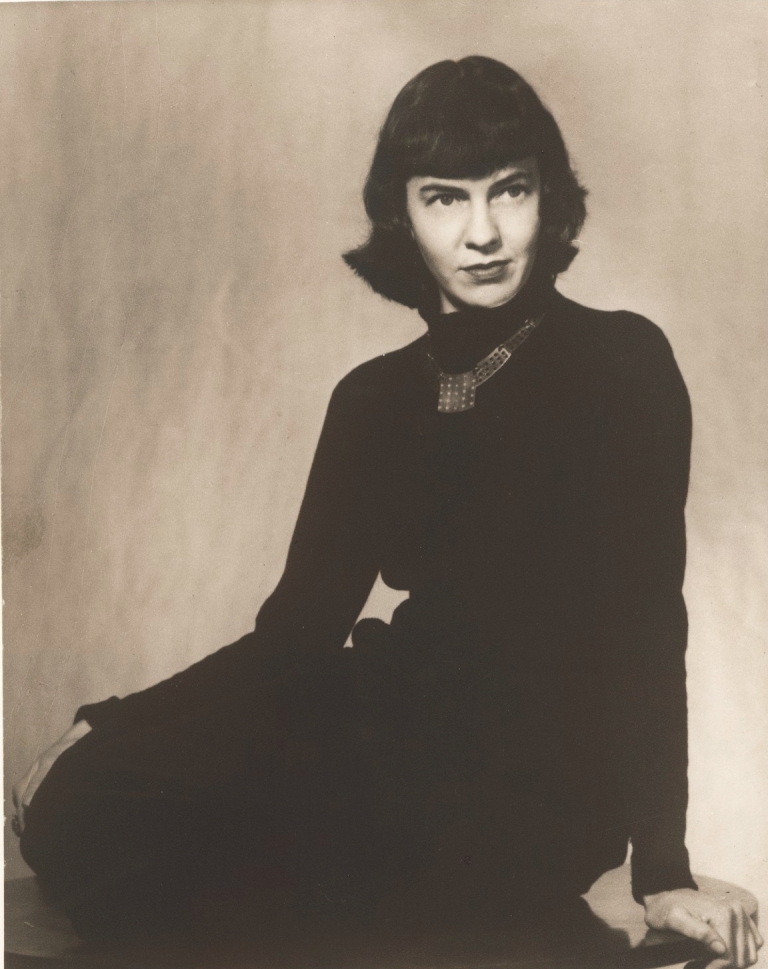
Erwin Rado (1952) Jennie Boddington, gelatin silver print, 25 x 20 cm. State Library of Victoria Accession no: H92.29/2, date 1952, and title inscribed on verso in pencil. Gift ; Ms. Jennie Boddington ; 1990.

A friend was Erwin Rado, a member of the Melbourne Film Society in 1952 when he took the portrait (above) of Jennie. Was it his recommendation as the festival’s first paid director that caused her to apply, and helped her get the job? Whatever the reasons behind her selection for the position from 53 applicants (as noted in the Minutes of the NGV Photographic Subcommittee of May 16, 1972), when others such as Gael Newton might have been more qualified, Boddington did bring with her an admiration for the documentary image, and a scriptwriter’s pragmatic ability to research and write.

As I’ve noted in the biography I wrote for Wikipedia, Boddington proved quite astute in her choice of shows for the teething NGV photography department. Her selections were not restricted only to ‘art’ photography but were inclusive of that which was of value as a medium of communication.

Historical context is needed to understand what Boddington faced as a newcomer to the scene. Lindsey Stewart writing in Hannavay’s Encyclopedia of Nineteenth-Century Photography notes that in 1968 interest in historical photography as a collectible was only just emerging, and that it wasn’t until 1971 that Sothebys had started holding regular auctions of them.  In her thesis Writing photographic history in Australia : towards a critical account, Anne-Marie Willis (currently Professor at German University in Cairo) identifies this dilemma for any curator who would challenge the orthodox Beaumont Newhall-style photo history limited to images that are distinctively photographic, aesthetic, and “Straight”; she would open a Pandora’s box full of photographs pervasive across so many fields, of such limitless subject matters, and crossing so many disciplines that their histories in photography would be obscured. The concern was that photography, newly crossing the threshold  of the museum, was in danger of being limited by a high art interest to form and print quality. That she was aware of this is evident in Boddington’s 27 February 1975 letter to the of the Australian Centre for Photography (est. 1973) complaining to its  inaugural Director Graham Howe (appointed January, 1974) that ACP’s first major exhibition had “an element of speciousness…it is self-conscious to an unfortunate degree of its “Art” content, and this is death to the vitality of photography.”

To start with Boddington devoted several exhibitions to contemporary Australian photographers, well known and the recently discovered, giving equal billing to male and female artists; among whom were Micky Allan, Jon Rhodes, Carol Jerrems, Jillian Gibb, Ruth Maddison,  Anthony Green, Merryle Johnson and David Stephenson. Her debut of Geelong landscape photographer Laurie Wilson was overblown, but her recognition in 1975 of the Prahran student Bill Henson with a solo, his first, Of Tender Years, was prescient.
EPUB001875
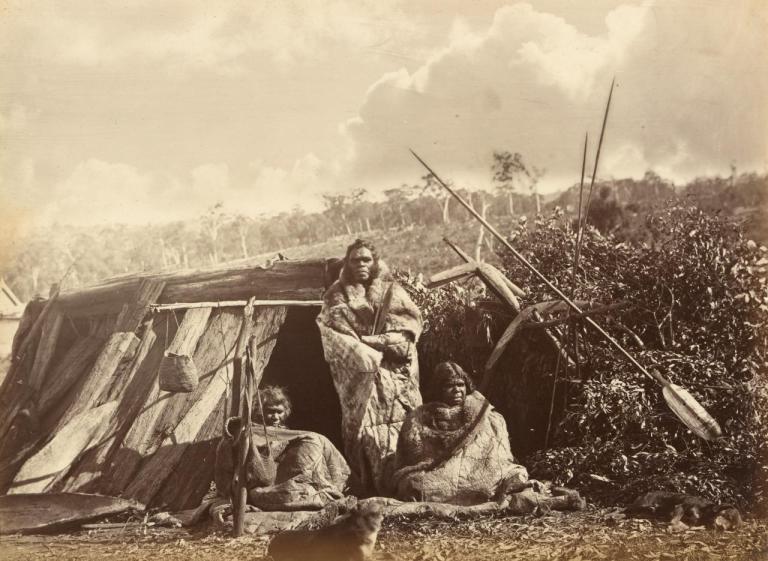
Fred Kruger (c.1880s) Victorian Aboriginals and mia mia, 20.0×27.0 cm National Gallery of Victoria. Presented by Mrs Beryl M. Curl, 1979 (PH239-1979)

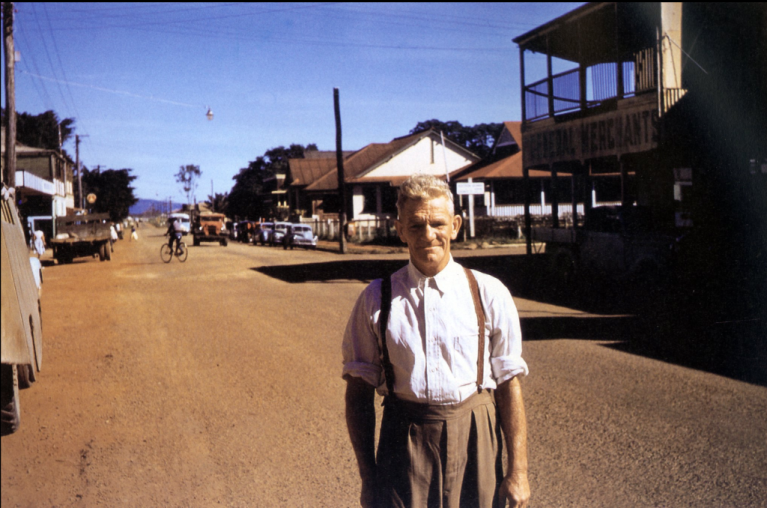
She included early Australian photography in the program and when his descendants brought Fred Kruger‘s prints and glass plates to her she not only gave them wall space in 1983 but wrote a catalogue that still stands as an authority on an important pioneer. Others on whom she wrote catalogue essays included J.W. Lindt, Herbert Ponting and Russell Hurley. When she discovered Russell Drysdale‘s use of colour photography as an aide-mémoire, in her 1987 book she reveals Drysdale’s expressive stylisation in interpretation of colour, subject matter and specific locations was derived from the previously unknown photographic imagery.

De102651
Russell DRYSDALE (1956) Avon Downs, 35mm colour transparency, National Gallery of Victoria Accession NumberPH534-1982. Gift of Lady Drysdale, 1982 © Courtesy Russell Drysdale Estate
Screen Shot 2019-12-15 at 3.35.12 pm
Russell Drysdale (July 1956) ‘Man Who Built The Street’ Proserpine, Queensland,

In 1974, John Szarkowski, Curator of Photography at the Museum of Modern Art in New York visited Australia, supported by a grant from our Visual Arts Board, to consult with the first Executive Committee of the ACP. Szarkowski’s position prioritised art photography over photojournalism, documentary, activist and conceptualist uses of the medium and, as Patrick McCaughey noted at the time, and Anne Marsh in 2010, his desire was to see art photography elevated from its realist, documentary representation of society.

When Boddington toured Europe, London and America in 1975 she of course met with Szarkowski, who influenced her decision to make acquisition of important overseas material a priority. Even her limited budget enabled the purchase of six Ralph Gibsons from his his 1977 show at Bill Heimerman‘s The Photographers Gallery, also 18 by William Clift shown there that year, five Harry Callahan works and four Robert Besanko‘s in 1978. But clearly budgetary restraints—or missed opportunity—meant that thereafter she bought only four from Franco Fontana‘s show there in 1979 while the ANG bought eight, and one each from Ian Lobb‘s and Lisette Model‘s but passing up Larry Clark, John Divola, Edouard Boubat, Emmett Gowin, Eliot Porter and William Eggleston, while the ANG and AGNSW scooped up bargains that were never to be repeated!

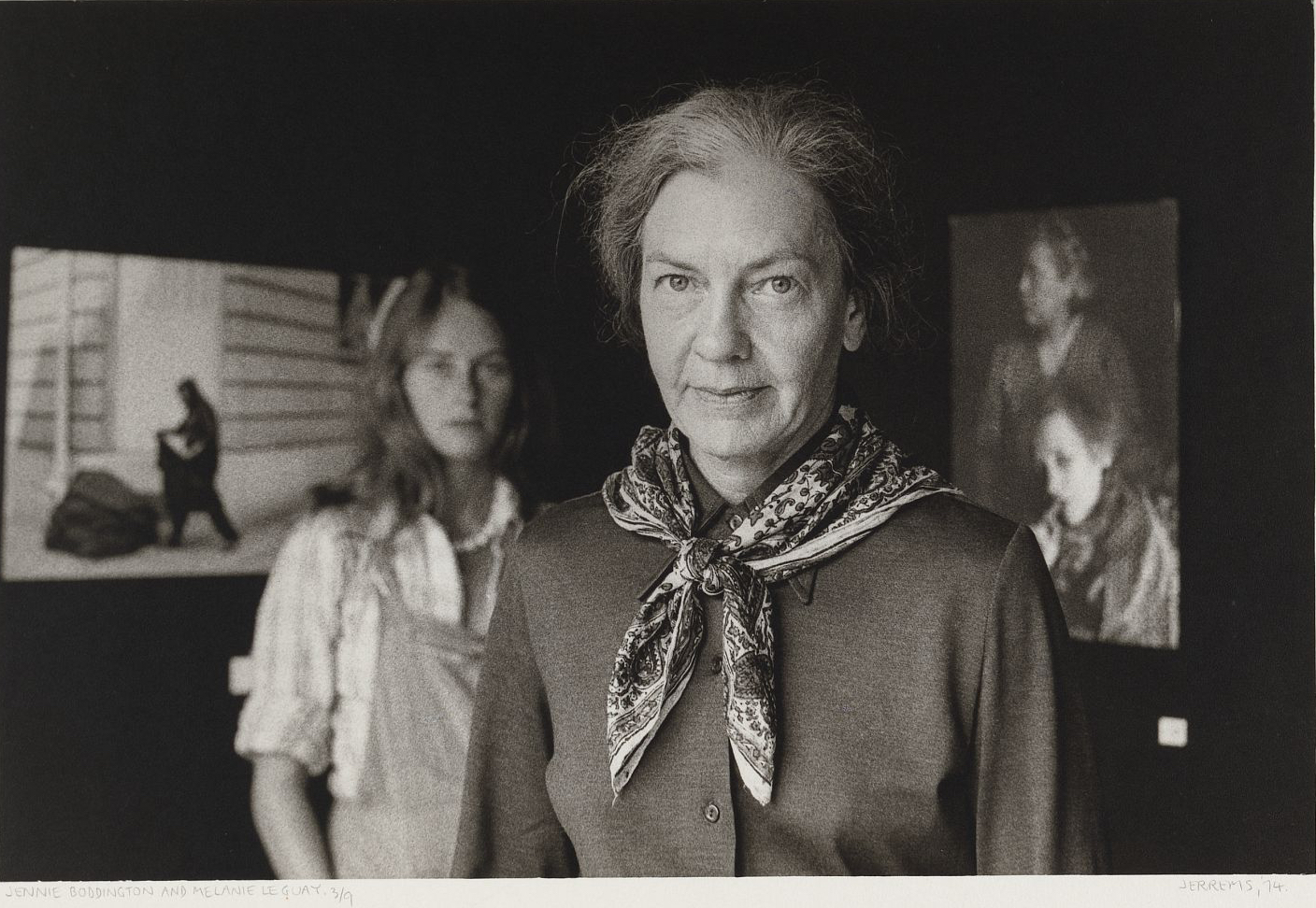
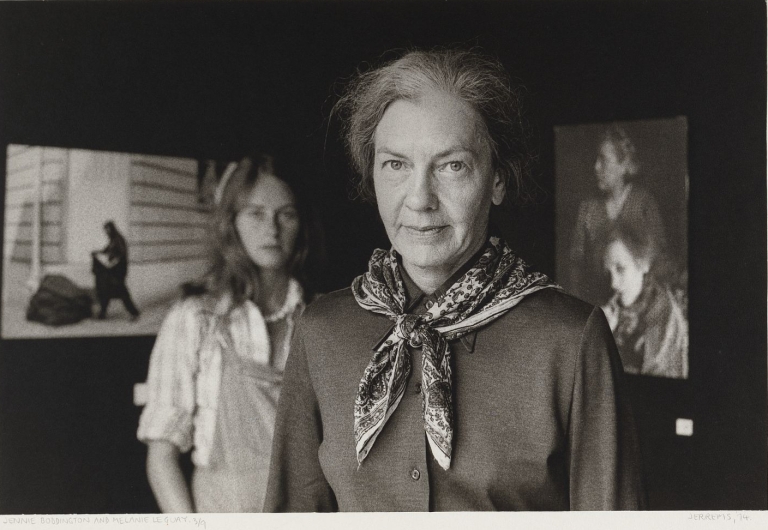
She had staged important shows of international work—at the Henri Cartier-Bresson exhibition she organised at the National Gallery of Victoria in 1974, Boddington was photographed with Melanie Le Guay by Carol Jerrems for the latter’s A Book About Australian Women which was published that year. Boddington’s indulgent, even motherly, but watchful regard is apparent in Jerrems shots from that session, which also use the Bresson images on the gallery wall as a visual commentary. The first international shows by David Goldblatt (1975) and the equally controversial Czech Jan Saudek (1977) were at the NGV, which purchased their works. All three shows are ones that I remember as being the most important that I saw in my student years.
61127
Carol Jerrems (1974) Jennie Boddington and Melanie Le Guay 1974, gelatin silver photograph, 20.1 h x 30.2 w cm, Edition 3/9, signed “JERREMS ’74” and titled in pencil, “JENNIE BODDINGTON AND MELANIE LE GUAY. 3/9” Gift of Mrs Joy Jerrems 1981, Accession no NGA 81.3078.215, National Gallery of Victoria, © Ken Jerrems and the Estate of Lance Jerrems

A sense of context is important in evaluating this critical time in the course of Australian photo history and without it, it is easy to be critical of the main players such as Jennie Boddington. In her case she faced plenty of flack. I remember her visit at Athol’s invitation to Prahran College (he was still on her advisory board). Talking with students she encountered objections over her choice of the sort of photography to show (some may have been somewhat jealous at Henson’s good luck) and exacerbated it by arguing that all of us should get some industrial experience (of the kind she had) before thinking about exhibiting. But really we were all arguing the same thing—that photography in the gallery should not be restricted to what was considered ‘art’.

On meeting her on another occasion in the early ’80s at her Richmond home and sitting at her dining room table beneath an apocalyptic Peter Booth painting, one could not be unimpressed by her enthusiasm for her work and her knowledgeability, and sympathise with her resentment at the criticism she received, mostly from men.

Yes, she stayed on too long—two decades—at the NGV, but she is, amongst our other curators, in good company in that regard; there is too little circulation amongst the public galleries still. Perhaps she became complacent, tending to neglect the local scene in pursuit of international work but without the money to make it worthwhile. In evaluating Boddington and her legacy, it is worth reading what Marcus Bunyan and Toby Meagher, have to say.

Share this:

  • Share
  • Tweet
  • Click to email a link to a friend (Opens in new window) Email
  • Click to print (Opens in new window) Print
  • Share on Tumblr
  • Pocket
  • Click to share on Reddit (Opens in new window) Reddit
Like Loading...

Related

Published by jamesmmcardle

Unknown's avatar

Artist and recovering academic enlightened by the metaphoric potential of focal effects and the differences between human and camera vision. View all posts by jamesmmcardle

Posted in Articles used for Wikipedia, Exhibitions, Film photography, In photographers' words, nineteenth century, painting and photography, photobook, photography history, photojournalism, Portraiture and self-portraiture, text and image, Twentieth centuryTagged 1859, 1936, 1939, 1940s, 1948, 1950, 1952, 1956, 1960s, 1967, 1968, 1969, 197, 1970, 1970s, 1971, 1972, 1973, 1974, 1975, 1977, 1978, 1979, 1980, 1980s, 1983, 1984, 1987, 1990, 2010, 35mm colour transparency, A Book About Australian Women, ABC, achievement, ACP, acquisition, acquisitions, activist, Adrian Boddington, advertising photographer, advisory board, aesthetic, AFI prizewinner, AGNSW, aide-mémoire, alphabet, America, ANG, Anne Marsh, Anne-Marie Willis, Anthony Green, Anzac, appointment, Art and Design, Art Gallery of New South Wales, art photography, assignment, Athol Shmith, auction, Australia, Australian Centre for Photography, Australian feature films, Australian Film Commission, Australian films, Australian photo history, authority, Avon Downs, “Art” content, Édouard Boubat, bargains, Beaumont Newhall, Bill Heimerman, Bill Henson, biography, Blackwood, book, breast cancer, budget, Carol Jerrems, cartoons, catalogue, catalogue essay, cinematographer, collectible, collection, colour photography, commercial, Commonwealth Film Unit, complacency, conceptualist, contemporary Australian photography, context, criticism, curator, curator of photography, Czech, Dacre Stubbs, David Goldblatt, David Moore, David Stephenson, dilemma, director, disciplines, Division 10BA, divorce, documentaries, documentary, documentary filmmaker, drawings, early Australian photography, editor, education, Eliot Porter, Emmett Gowin, Encyclopedia of Nineteenth-Century Photography, equal billing, Eric Westbrook, Erwin Rado, Europe, exhibition, fashion photographer, feature film, film reviewer, filmmaker, Franco Fontana, František Drtikol, Fred Kruger, Gael Newton, glass plate, GPO, Graham Howe, Hannavay, Harry Callahan, Henri Cartier-Bresson, Herbert Ponting, high art, historic, historical context, historical photography, Hollywood, Ian Lobb, Ian North, Income Tax, industrial experience, influence, innovation, international, international work, interpretation of colour, interview, investment, investors, J.W. Lindt, Jan Saudek, Jennie Boddington, Jillian Gibb, John Divola, John Szarkowski, Jon Rhodes, knowledgeability, Kodak, Larry Clark, late 1960s, Laurie Wilson, lecturer, Lenton Parr, Les Gray, Letter, libraries, Lindsey Stewart, Lisette Model, local industry, local scene, location, London, male and female artists, Marcus Bunyan, Mark Strizic, medium, medium of communication, Melanie Le Guay, Melbourne, Melbourne Film Society, Melbourne Public Library, Merryle Johnson, Metro Magazine, Micky Allan, migrants, money, museum, Museum of Modern Art, National Gallery of Australia, National Gallery of Victoria, neglect, New York, New Zealand, NGV, NGV Photographic Subcommittee, nude, Of Tender Years, orthodoxy, painting, paintings, Pandora's Box, partnership, Patrick McCaughey, Peter Booth, photo historian, photo history, photographer, photographic, photographic imagery, photographs, photography as art, photojournalism, photojournalist, Pictures Collection, pioneer, portrait, pragmatic, Prahran College, Prahran student, prescient, Print quality, prints, private finance, producer, production, Proserpine, public, purchases, Queensland, Ralph Gibson, realist, representational, rescue, risk, Robert Besanko, Rosa Safransky, rostrum camera, Russell Drysdale, Russell Hurley, Ruth Maddison, scriptwriter, sculptor, sculpture, Second World War, self-conscious, silent film, silver gelatin print, soap opera;, society, solo exhibition, Sotheby's, specious, state government, State Library of Victoria, straight, street photograph, stylisation, subject matter, subjects, Surrey Hills, Sydney, tax concession, television in Australia, The Photographers Gallery, thesis, Toby Meagher, too late, training films, value, Visual Arts Board, visual commentary, vitality of photography, wall space, wardrobe assistant, well known, Wes Stacey, Wikipedia, William Clift, William Eggleston, women, Writing photographic history in Australia : towards a critical account13 Comments

13 thoughts on “December 14: Context”

  1. Brian Carr's avatar Brian Carr says:
    17/12/2019 at 1:47 PM

    Great piece, thanks James.

    LikeLiked by 1 person

    Reply
  2. Pingback: January 1: Diptych – On This Date in Photography: by James Mcardle
  3. Pingback: Melbourne snapshots – The Bowden Archives and Other Marginalia
  4. Pingback: April 18: Photographers’ – On This Date in Photography: by James Mcardle
  5. Pingback: April 14: Photographers’ – On This Date in Photography: by James Mcardle
  6. Pingback: May 6: Darkly – On This Date in Photography: by James Mcardle
  7. Pingback: December 6: Drought – On This Date in Photography: by James Mcardle
  8. Pingback: Announcing – Prahran Photography
  9. Pingback: The Alumni: Peter Leiss – Prahran Photography
  10. Pingback: March 9: Maverick – On This Date in Photography: by James Mcardle
  11. Pingback: The Lecturers: Gordon De’Lisle – Prahran Photography
  12. Pingback: 'The '70s Lens: Reimagining Documentary Photography' National Gallery of Art, Washington
  13. Pingback: October 8: Prosopography – On This Date in Photography: by James Mcardle

Leave a comment Cancel reply

This site uses Akismet to reduce spam. Learn how your comment data is processed.

Post navigation

← December 11: Carol
December 21: 1970s →

Menu

  • About
  • Contact
  • Prahran Project Shortlist
  • Coming soon

Blogs I Follow

  • reloaded
  • britishisms.wordpress.com/
  • History of WA Photography
  • Prahran Photography
  • Iconic Photos
  • un regard oblique
  • Vertigo
  • Ben's Blog
  • PENGUIN SERIES DESIGN
  • chasing delight
  • Guided By Art
  • J.K. Pikkujämsä
  • The Dutkiewicz Archive
  • About Murakami
  • brian rope's (mostly) photography blog
  • newsteadnatives.wordpress.com/
  • Alison Bennett
  • The Golden Fleece
  • The Logical Place
  • The Transparent Photographer

Category cloud

Art about art art and science Articles used for Wikipedia Australian photographers Contemporary digital imaging Environment and landscape Exhibitions Film photography humour image and text In photographers' words installation nineteenth century painting and photography photobook photographic technology photography history photojournalism Portraiture and self-portraiture propaganda Sequences, series. Social comment street photography Studio photography text and image The Body Twentieth century vision

Enter your email address to follow this blog and receive notifications of new posts by email.

Join 403 other subscribers

Archives

  • December 2025
  • November 2025
  • October 2025
  • September 2025
  • August 2025
  • June 2025
  • May 2025
  • April 2025
  • March 2025
  • October 2024
  • September 2024
  • August 2024
  • July 2024
  • June 2024
  • May 2024
  • April 2024
  • March 2024
  • February 2024
  • January 2024
  • December 2023
  • November 2023
  • September 2023
  • August 2023
  • July 2023
  • June 2023
  • May 2023
  • April 2023
  • February 2023
  • January 2023
  • December 2022
  • November 2022
  • July 2022
  • June 2022
  • May 2022
  • April 2022
  • March 2022
  • February 2022
  • January 2022
  • December 2021
  • November 2021
  • October 2021
  • September 2021
  • August 2021
  • July 2021
  • May 2021
  • April 2021
  • March 2021
  • February 2021
  • September 2020
  • August 2020
  • July 2020
  • June 2020
  • May 2020
  • April 2020
  • March 2020
  • February 2020
  • January 2020
  • December 2019
  • August 2019
  • July 2019
  • June 2019
  • May 2019
  • April 2019
  • March 2019
  • February 2019
  • January 2019
  • December 2018
  • November 2018
  • October 2018
  • September 2018
  • August 2018
  • May 2018
  • April 2018
  • March 2018
  • February 2018
  • January 2018
  • December 2017
  • November 2017
  • October 2017
  • September 2017
  • August 2017
  • July 2017
  • June 2017
  • May 2017
  • April 2017
  • March 2017
  • February 2017
  • January 2017
  • December 2016
  • November 2016
  • October 2016
  • RSS
  • About
  • Dribbble
  • LinkedIn
  • Instagram
  • Foursquare
  • Vimeo
Create a website or blog at WordPress.com
reloaded

an old blogger digs over the field once more

britishisms.wordpress.com/

History of WA Photography

Prahran Photography

The Legacy of Prahran College 1970s photography

Iconic Photos

un regard oblique

images that haunt us

Vertigo

Where literature and art intersect, with an emphasis on W.G. Sebald and literature with embedded photographs

Ben's Blog

Ramblings of Ben Boyong

PENGUIN SERIES DESIGN

the art of Penguin book covers

chasing delight

Stay Curious

Guided By Art

Educational and other resources for guides

J.K. Pikkujämsä

Words without borders.

The Dutkiewicz Archive

A site about art and art history in Adelaide

About Murakami

A Project Blog by Mayu Kanamori

brian rope's (mostly) photography blog

To follow this Blog click on the 3 horizontal lines at the top of the page, then click on the blue coloured link that reads Follow BrianRopePhotography

newsteadnatives.wordpress.com/

Alison Bennett

The Golden Fleece

The Logical Place

Tim Harding's writings on rationality, informal logic and skepticism

The Transparent Photographer

Life as an Artist-Photographer

  • Comment
  • Reblog
  • Subscribe Subscribed
    • On This Date in Photography: by James Mcardle
    • Join 403 other subscribers
    • Already have a WordPress.com account? Log in now.
    • On This Date in Photography: by James Mcardle
    • Subscribe Subscribed
    • Sign up
    • Log in
    • Copy shortlink
    • Report this content
    • View post in Reader
    • Manage subscriptions
    • Collapse this bar
 

Loading Comments...
 

    %d