
Australia’s Greens senator Sarah Hanson-Young said today that the party would introduce a bill in the November sitting period to “ban the broadcast of live executions”, after a debate earlier in the week about whether Australian regulators could block the looming US military execution which is expected to be livestreamed.
They want Labor’s digital duty of care bill to go much further, confirming they will send the legislation off to an inquiry but that they support the bill in principle. Sarah Hanson-Young said Australians were “sick and tired of being manipulated, dictated and addicted by big tech”, saying the Greens would back the bill if the government added the ability for Australians to directly sue tech companies. The inquiry, which will be formally locked in later today, will report back in late November.
Conservative campaign groups, podcasters and media personalities have strongly criticised the bill, claiming it would be used to censor right-wing groups and viewpoints – claims the government strongly denies. The bill was a major topic of debate at the CPAC conservative conference last weekend in Brisbane.
Hanson-Young responded that rightwing campaigns against the legislation were “running cover for big tech”:
To suggest this is about censorship or about shutting down anything is absolute rubbish. It is a fake debate, it’s got nothing to do with it, and it is purely the radical right running the speaking points of big tech.
Also today, on the site of the New York auctioneers of rare books, fine art, and works on paper, Swann Galleries (founded in 1941) you will find a 1969 print of Malcolm Browne’s shocking Burning Monk, South Vietnam of 1963; Eddie Adams’ 1968 General Nguyen Ngoc Loan Executing Viet Cong Prisoner Nguyen Van Lém, Saigon; Sergeant Robert L. Haeberle’s Bodies of women and children are shown on a road leading from the village of My Lai massacre, South Vietnam of the same year. You may wonder who is buying these images, and hope it is a museum, or is it a publisher of books on the fascination with violent death that is distinctively prevalent in America, that country that loves its guns above freedom and the sheltering of refugees from violence elsewhere?
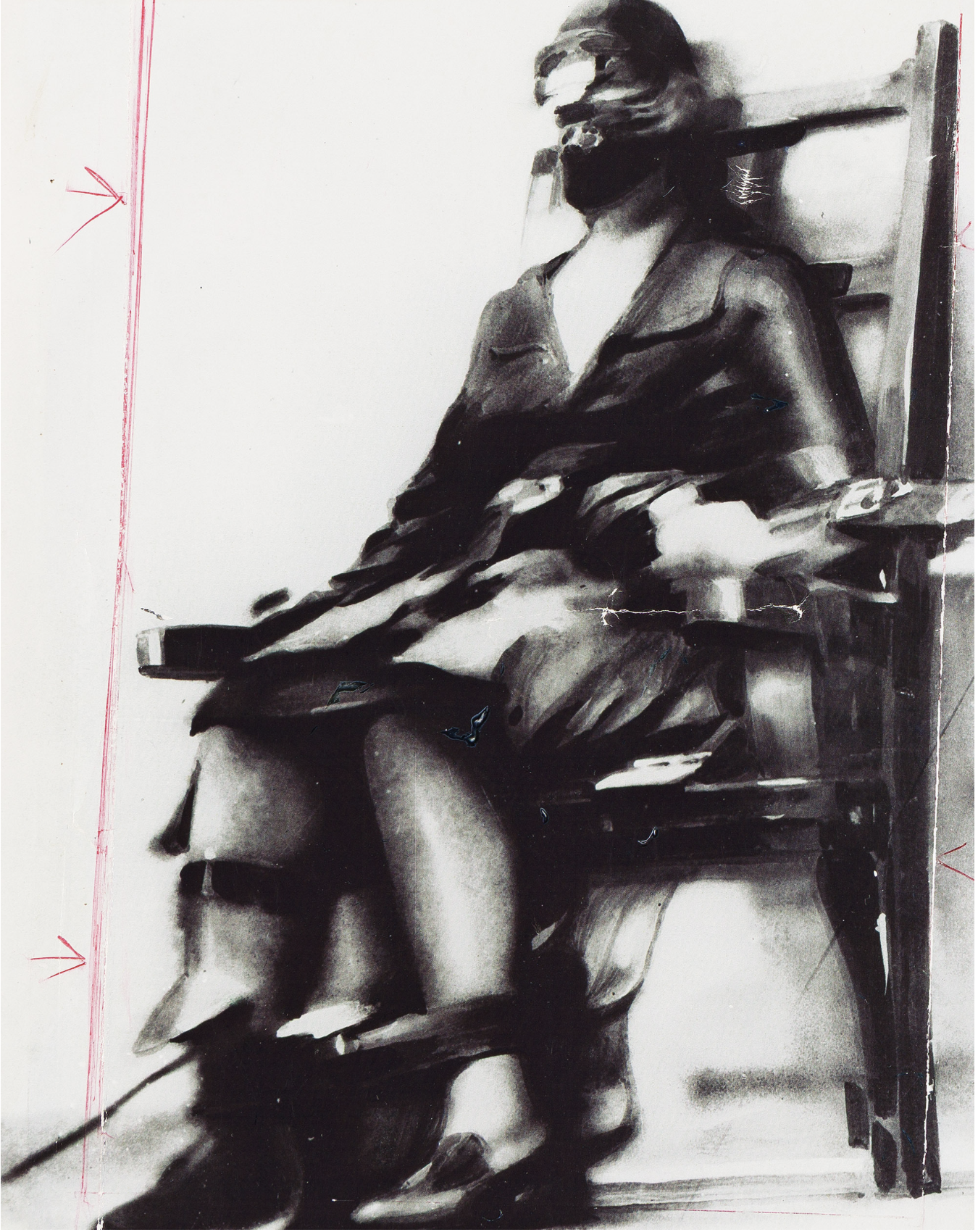
In the same auction is this print of Tom Howard’s 1928 Execution of Ruth Snyder, which Swann notes is of “the first woman to be executed [by electric chair] and first photo of execution by electric chair”. The print, with cracks in its glossy emulsion and a picture editor’s crop-marks and seemingly accusatory arrows in blood red, seems to bear traces of the violent death.
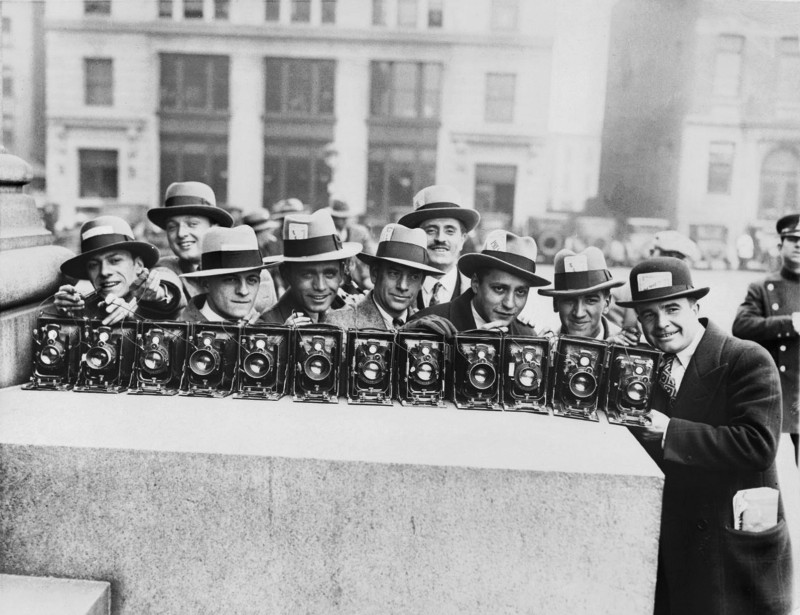
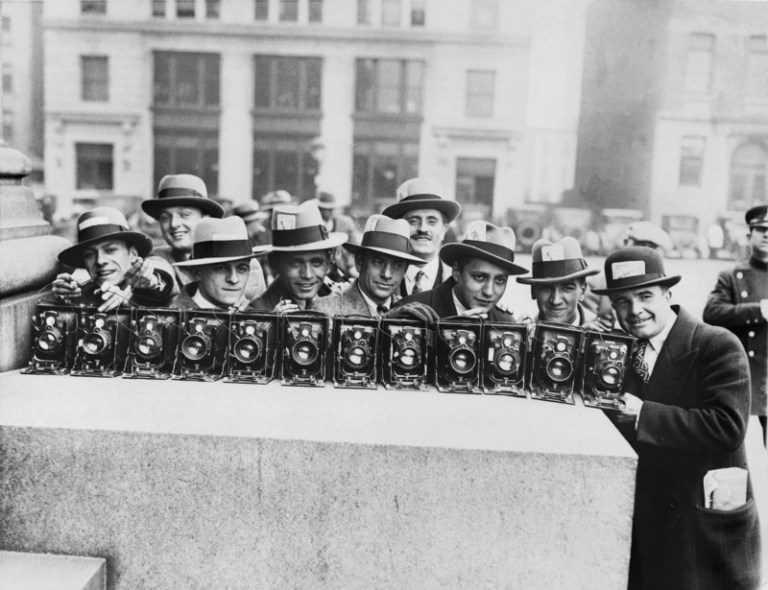
Let us reflect that it is a week since 8 October, the day in 1961 when Tom Howard died, and a century since his recording of an execution. He was an American photographer for ‘Pacific and Atlantic Photos’ during the 1920s and his has become one of the most notorious photographs of an execution, that of murderer Ruth Snyder, at Sing Sing Prison on 12 January 1928, Ruth went to the electric chair 10 minutes before Judd Gray, her co-accused. The media attention that the trial and execution attracted was unprecedented.
There have been countless photographs of executions since the invention of photography, but Howard’s, published in the tabloid New York Daily News under the headline ‘DEAD!’, caused a sensation, given that, unsurprisingly, photography of state killings had been banned in the United States.
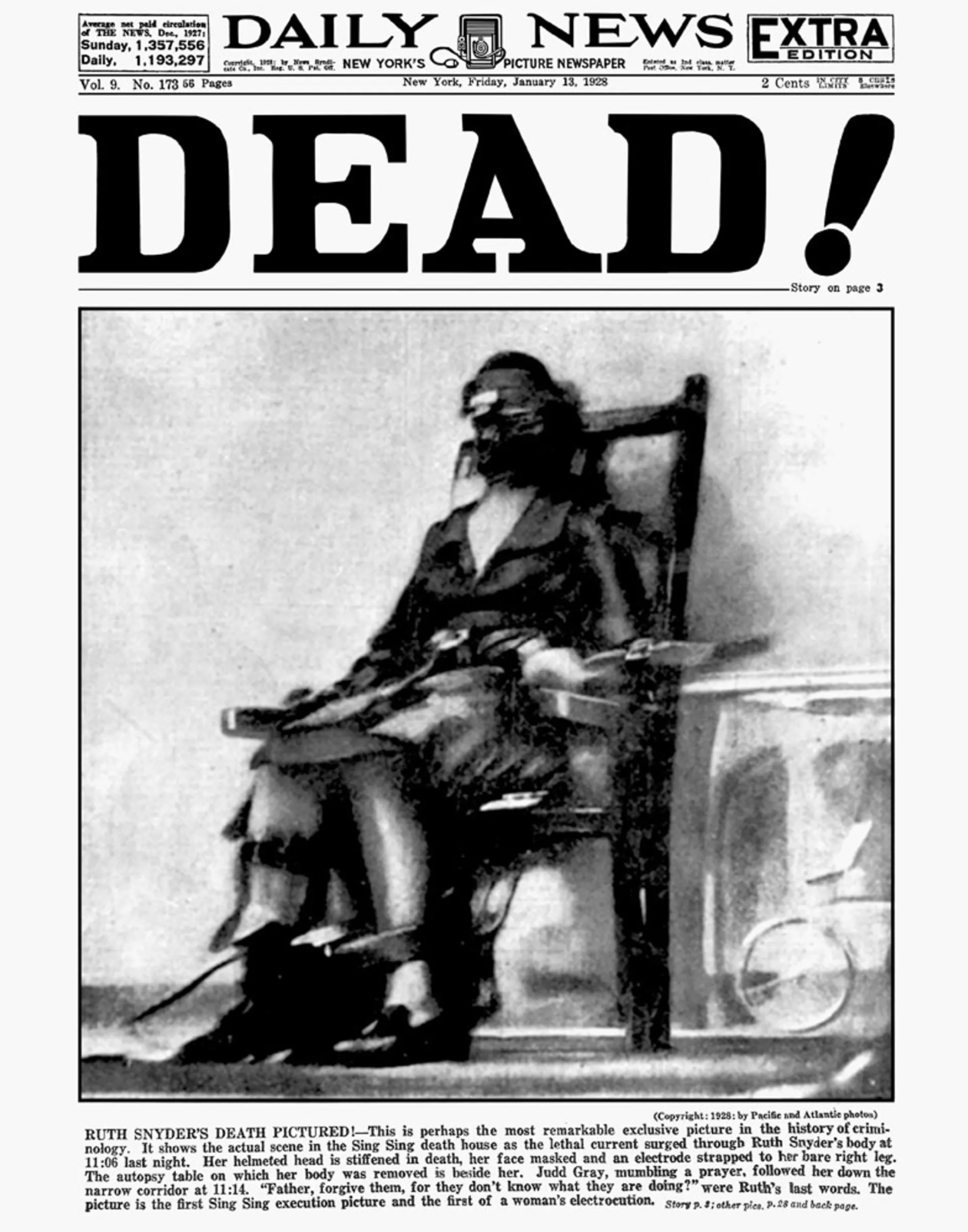 That’s because it’s an ugly business, perhaps more evil than the deed that brought the accused to this end, because in its cold blooded legality it lacks the passions of revenge or hate that prompted the action being punished. Even in 1920s America, publication of Howard’s photograph alerted readers to its cruelty and prompted calls for the end of capital punishment. There are qualities in Howard’s image that stand out for their emotional effect on the viewer, where other such images of executions may be mundane despite the gravity of their subject.


To get his picture Howard resorted to the use of a concealed camera, strapped to his ankle under his trouser leg and operated with a release in his jacket. Camera shake, a Dutch tilt, accidental cropping and back-focussing make it haphazard, and on the man’s upper leg in the centre foreground you can see a sign of double exposure quite different from the blur of the swaying fabric on the woman’s dress on the right. 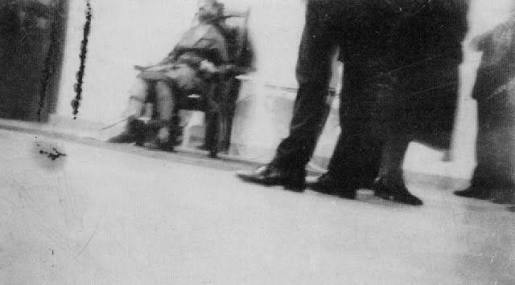 Howard tripped the shutter twice in order to be sure of an exposure in the dim light, and the man, whose pose seems almost casual, has shifted his stance between the exposures. Interestingly the woman appears to have turned away from the spectacle. His camera was relatively large format, being custom made to fit his ankle, and fitted with a lens with leaf shutter typical of the hand held bellows cameras of the era. The focal length is short in order to make the camera compact so the field of view is wider than desired by the picture editor.
When the photograph published the next day is tightly cropped and so heavily retouched that it is almost a painting with little visual information about the subject. It is this uncropped version that carries the most emotional impact, because of the apparently casual—even relaxed— onlookers against the evident rigidity of the victim against the tight restraints.
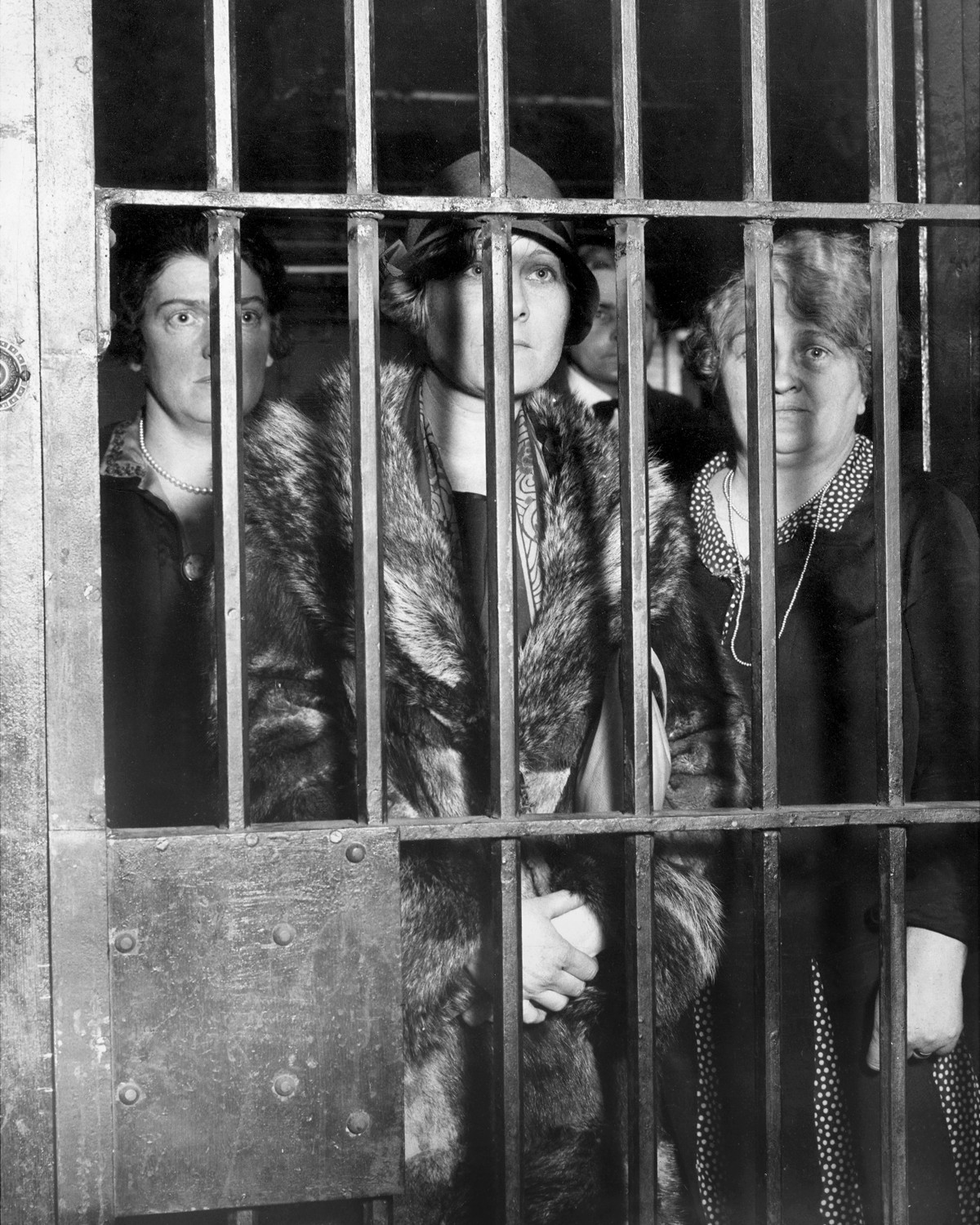
Snyder was the co-accused in the case, the actual killing being done by her lover. She is remembered in popular culture as Phyllis Dietrichson, the main antagonist of the 1936 serialised story and 1944 film Double Indemnity; and “the Incomparable Bessie Denker”, an unseen character in the 1954 play and 1956 film The Bad Seed; while Howard became well-known for this photograph and inspired Picture Snatcher (1933), a Warner Brothers-First National Film starring James Cagney, about an ex-con who becomes a photographer for a tabloid paper and sneaks a camera into Sing Sing Prison to snaps photograph a woman being executed in the electric chair. The movie version of the photograph is a stark, well-focussed close-up quite unlike the real one with its photographic facture, the indistinct traces that engage the beholder.
US defence secretary Pete Hegseth declared that on 3 December the US government will execute Nidal Malik Hasan, a former US Army major who killed 13 people and wounded dozens more in a 2009 shooting at Fort Hood, a military facility in Texas. Hegseth also said the execution would be in public and available to watch online. The planned execution, approved by US President Donald Trump, would be the first by military firing squad since World War Two in the US and the first in US history to be broadcast live.
The live-steaming was also condemned as “Roman amphitheatre stuff” by Barnaby Joyce, an Australian politician and member of parliament for the New South Wales division of New England since 2013, and who over 2016 to 2018 was deputy prime minister of Australia and the leader of the conservative National Party (2021 to 2022). He recently joined Pauline Hanson’s One Nation whose political platform, and her rhetoric, align with the ideology and policies of Trump and his administration.
Increasingly into 2026, Hanson has explicitly embraced “Trump-style” leadership, explicitly positioning One Nation policies as the Australian equivalent to Donald Trump’s “America First” agenda. Mirroring Trump’s deporting of ‘undocumented immigrants’, Hanson proposed a hardline targeting of Australia’s estimated 75,000 to 77,000 “unlawful” non-citizens, promising them a “one-way ticket out” or forced removal, explicitly targeting nations she characterises as fostering “extremist ideologies” incompatible with domestic values (naming countries such as Somalia, Sudan, and Pakistan); calling for tightening borders, introducing longer waiting periods (up to eight or ten years) before migrants can access welfare or citizenship.
Like Trump, Hanson dismisses climate change as a “hoax”, firmly rejects global climate frameworks and advocates for traditional fossil fuel production, recently condoning Trumps purchase of diesel from Russia. She advocates for walking away from the Paris Agreement on Climate and completely abolishing Australia’s commitment to net-zero emissions by 2050 arguing that the push for renewable energy destroys the standard of living and drives up cost-of-living pressures, and championing the building of more coal-fired power plants, supporting the gas industry, and introducing nuclear power.
One Nation supports defunding or withdrawing from international bodies, including the United Nations Refugee Convention and the World Health Organization (WHO), alongside reducing foreign aid. To dismantle government bureaucracy and “slash waste”, One Nation has proposed eliminating various federal agencies, including the National Indigenous Australians Agency and the Therapeutic Goods Administration.
Hostile to mainstream media she promotes “fake news”, framing critical reporting as dishonest, and banning specific mainstream news organisations from press events. Hanson has endorsed Trump’s reliance on tariffs as a mechanism to protect domestic industries and to prioritise local workers and “national interests” over global trade or labour agendas, despite criticisms regarding the potential negative impact on export-reliant sectors like farming. Despite that stance their actual parliamentary voting patterns favour big-business donors and their opposition to corporate diversity, equity, and inclusion (DEI) programs, gender identity mandates, and pandemic-era vaccine mandates and advocating for ‘sovereign’ individual freedoms against perceived institutional censorship.
Hanson declined to condemn the Trump administration’s proposed 3 December livestreamed firing-squad execution of Fort Hood shooter Nidal Malik Hasan. While she acknowledged that the vast majority of Australians would have no interest in watching a violent, state-sanctioned killing, she argued that the decision should ultimately be left to individuals. Framing the issue around free speech and free will, Hanson stated,
If we’re talking about freedom of speech or freedom of what people want to do, it’s up to their choice if they want to.
We shall soon see how much Australians want Pauline Hanson and how aligned is the majority with American morality.


