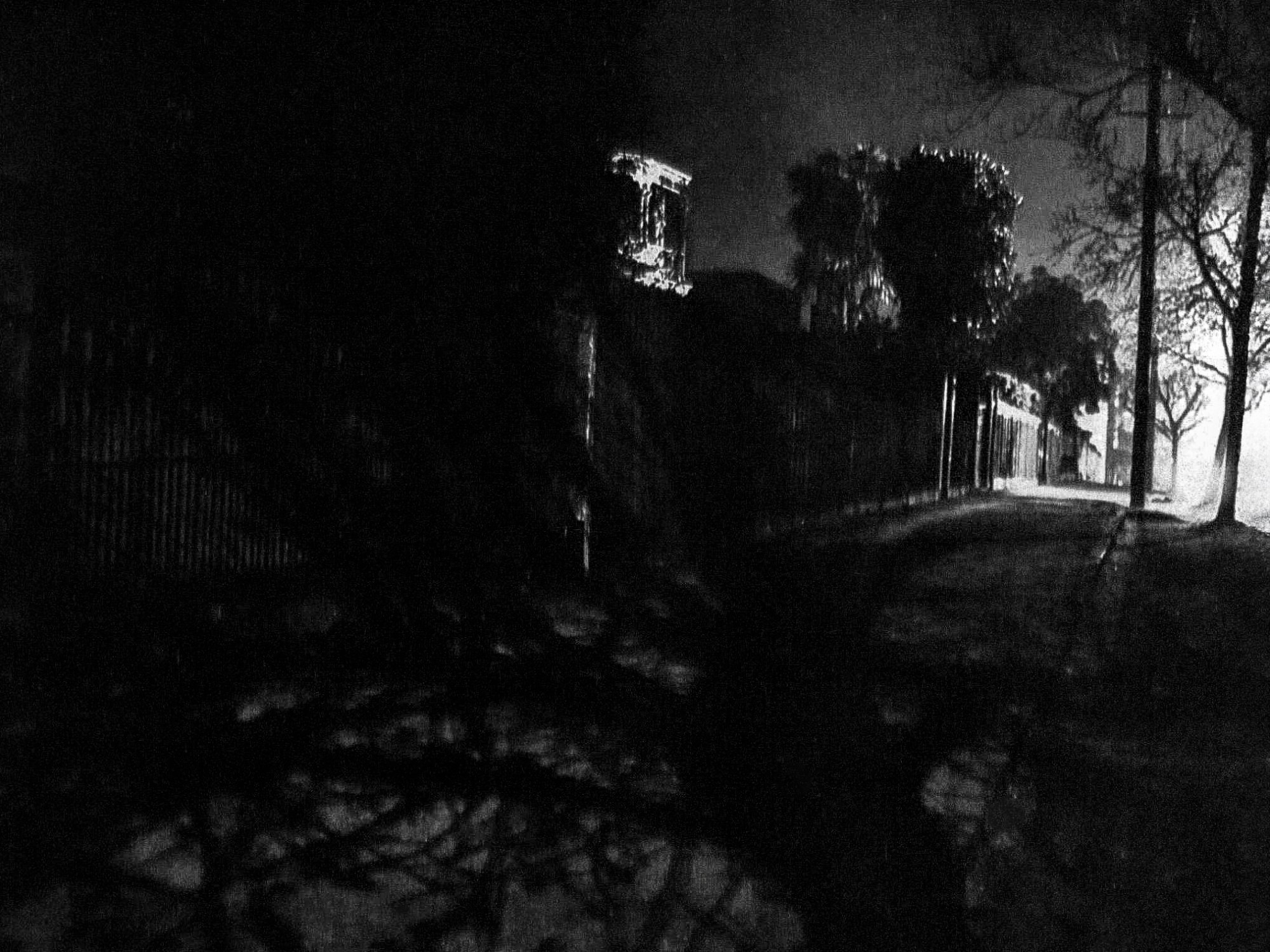
 Right on cue, just as the February leaf was wrenched from the calendar, the drought broke and hours of steady night rain soaked the garden, balm to plants scorched by our summer of merciless 40ºC days.
Barely an hour’s walk away, other trees stand blackened after the fires, and the twisted wrack of people’s homes amongst them, victims of a Sturm und Drang of racing, rapacious flames.
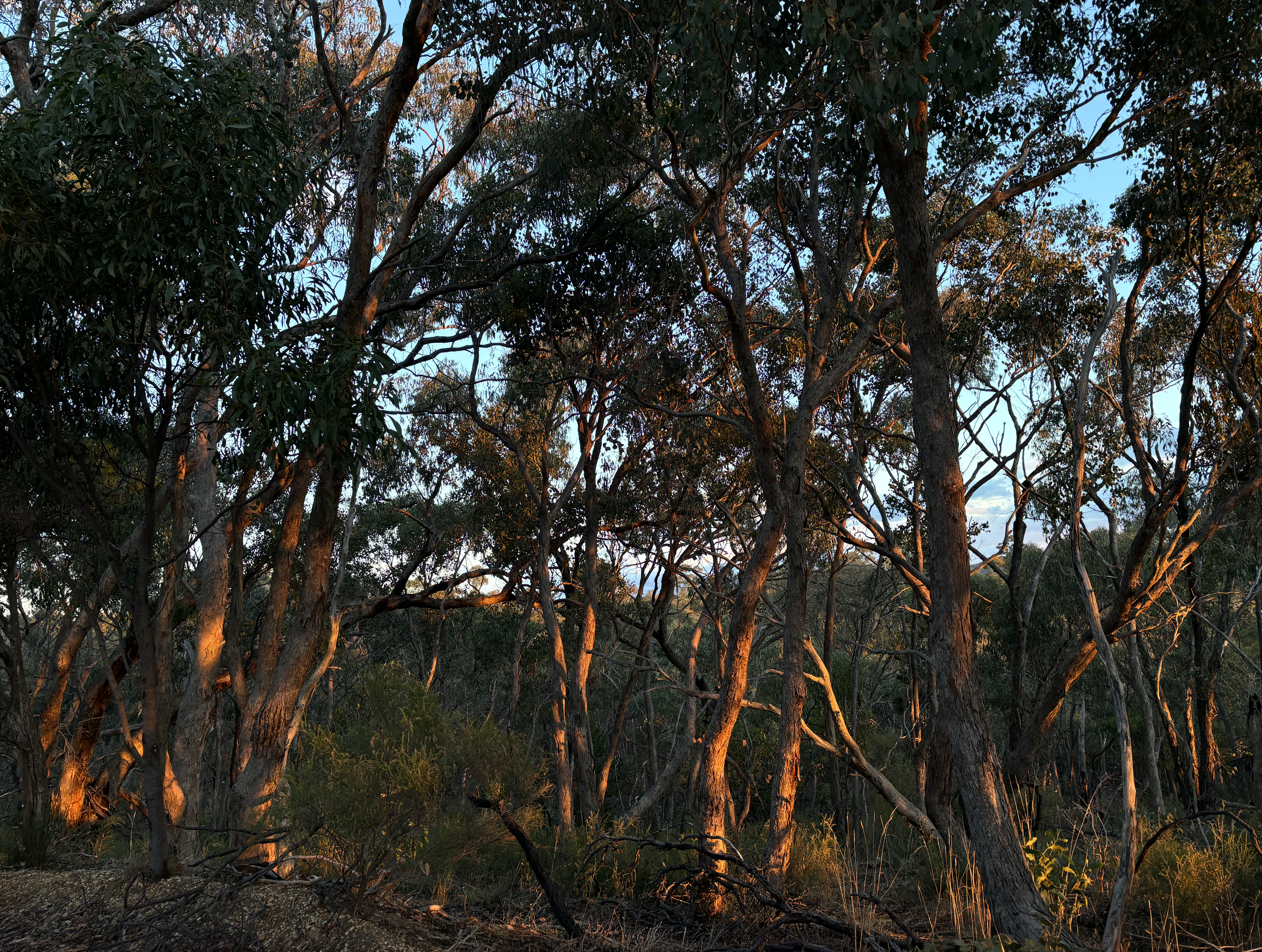
Though there may come hot winds still, over the northern horizon, it’s autumn at last. This most photogenic of seasons is lit by an amber sun that lingers at the horizon, its beams filtering low through the bush, embellishing trunks and leaves in glowing gold against the deep of the blue-black shadows.
As I recover from a bout of Covid and its subsequent ‘rebound’, I’ve occupied some hours researching, for a Wikipedia biography, Basil Burdett (1897–1942), an art curator, collector and critic largely now forgotten because of his early death at 44 in a plane crash in Java during WW2.
It is Richard Haese, in his 1981 Rebels and precursors : the revolutionary years of Australian art who is the most thorough student of Burdett’s life and significance. He argues that, through his legendary 1939 Herald Exhibition of French and British Contemporary Art, the critical tradition that Burdett established was the necessary precondition for what followed: The Angry Penguins — Max Harris, Albert Tucker, John Reed—the Heide group, and George Bell and the Contemporary Art Society— who embraced modernism in the early 1940s and were, in Haese’s account, doing in more radical form what Burdett had already done: connecting Australian art and intellectual life to the humanism of European modernist culture while insisting on values intrinsic to the Australian experience.
The tragedy, as Haese frames it, is double. In public terms, Burdett’s death in 1942 meant he could not ensure that the liberal establishment he had helped create retained “his own openness and humanism”. In personal terms, the wholeness and harmonious relationship — in art, in culture, in life — that he sought was perpetually out of reach, frustrated by the Australia of the 1930s, by his own temperament, and by the circumstances of an existence shaped, by his illegitimate birth and homosexuality, things he could not openly acknowledge.
Jan Gerraty’s 1978 Monash University honours thesis, Basil Burdett: Critic and Entrepreneur, remains the most focused scholarly study of his critical writings in The Herald and elsewhere. Together with Haese’s Rebels and Precursors (1981) and some discussion of him in Chanin, Pugh and Miller’s Degenerates and Perverts (2005), these writers confirm a reputation that, had he lived another two decades, might have become foundational in the story of Australian modernism. Instead, Burdett exists at the edge of that story: essential to it, but incompletely recovered — a cultivated, diffident, irreplaceable figure who saw what was coming and did not live to see it arrive.
Why hunt out this now somewhat obscure figure? Because some of my time is spent in the Castlemaine Art Museum as a guide. Much of the collection dates from the 1930s, the period on which Burdett found himself in the crossfire between traditionalist ‘gum tree painters’ and the modernists who were struggling to emerge in Australia while in Europe it had sprouted from its roots at the very turn of the century.
Just now, in this season when I can walk our bush tracks in the light I adore, some of these artists appear in a new exhibition Shadowlands at Castlemaine gallery, curated by our dedicated volunteer Dr Jenny Long, who writes of her selection for the show:
“Shadows are the dark side of light. They come in many mysterious forms; shadows fall, they lie in corners, behind rocks, lengthening in twilight. Artists love the pattern and play of light and dark…”
I don’t include every artwork from this show here, and some discussed, while they are from the CAM collection, are not in the exhibition. This selection is used to ask: “are painters able to conjure this theatre of light with means more primitive than our sophisticated photographic technologies?”
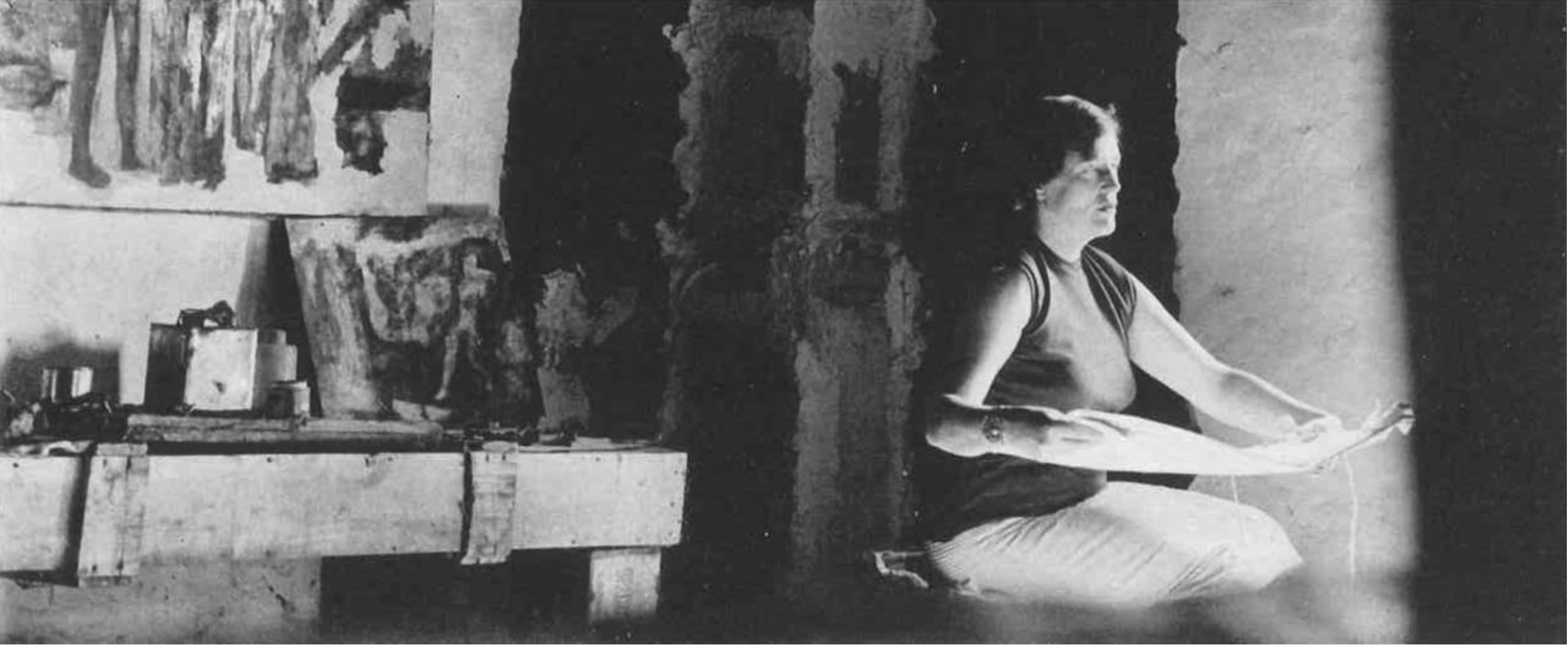
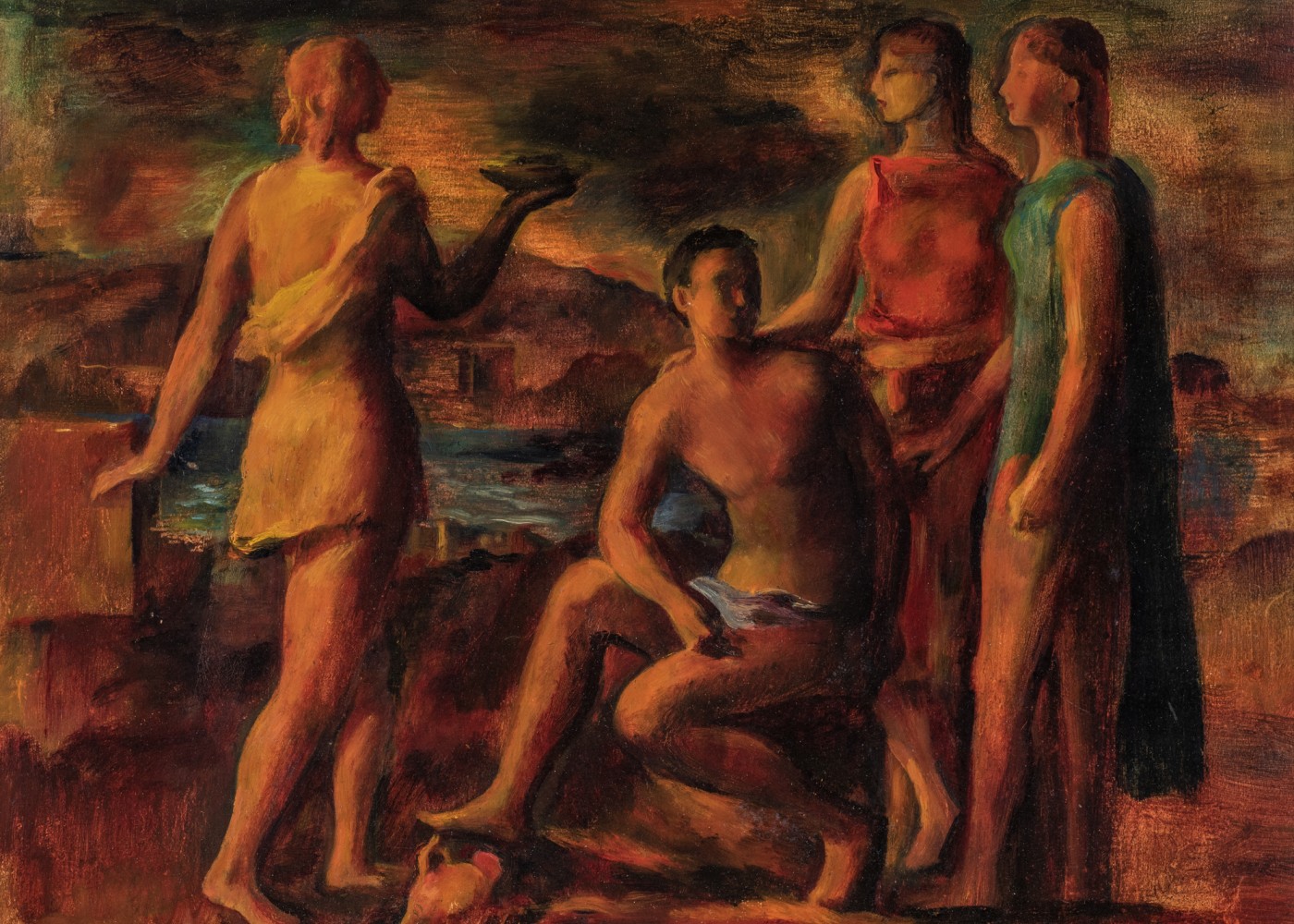
Jean Bellette, photographed above by Laurie Le Guay, certainly distils that lowering gilded glow in her Acheron, painted only two years after Burdett’s fatal plane crash in Java, where he was an administrator for the Australian Red Cross. On the Art Museum website her painting headlines Long’s Shadowlands, and appropriately so, since in ancient Greek mythology the Acheron, sometimes known as the “river of woe”, was one of the five rivers of the Greek underworld across which Charon would ferry the souls of the dead to the dread, dark edge of Hades. In Bellette’s painting perhaps we see Acheron personified as a son of Helios, the Sun, and of either Gaia, mother of the sky, or Demeter, goddess of the fertile earth, who was turned into the Underworld river bearing his name after he offered wine to the Titans in their drinking contest against Zeus.
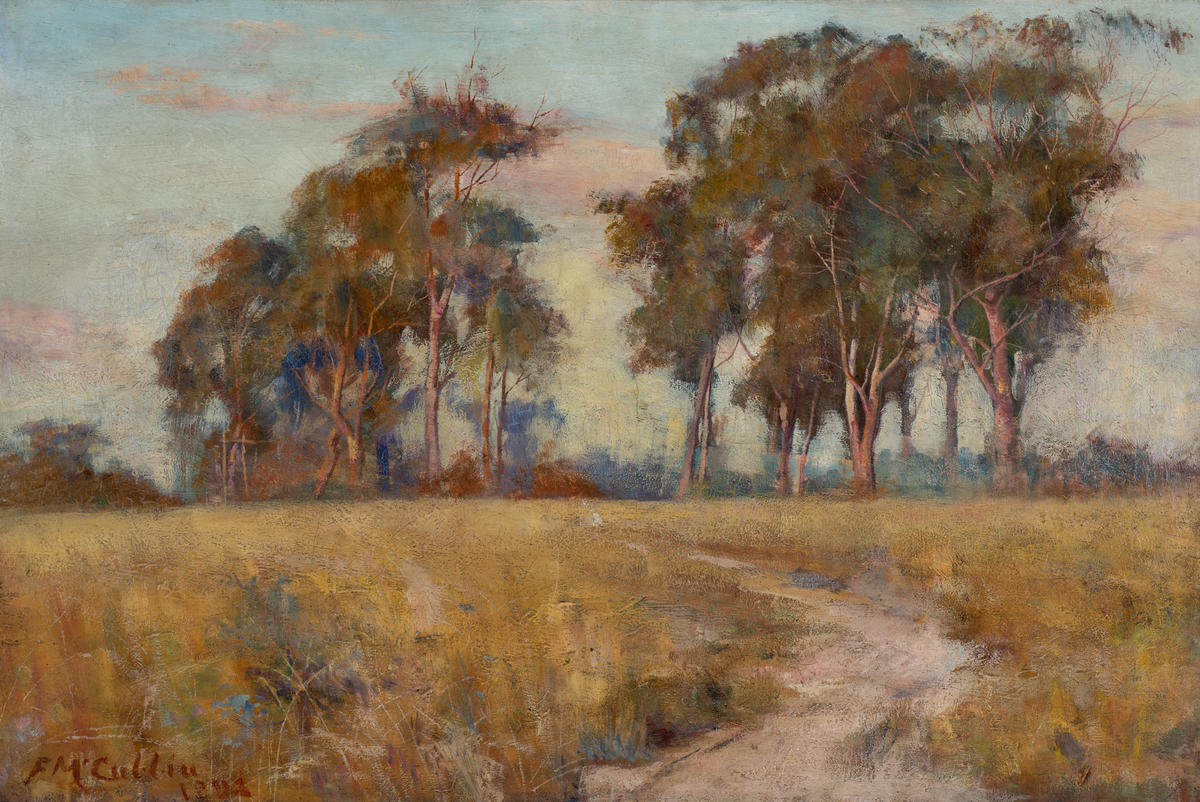
That rosy light with which McCubbin touches these eucalypts which perhaps still grow at Macedon, approximates that unique lucency of autumn, the season in which—other guides and I agree—he painted this lyrical frieze; the dry grasses are showing green and the atmosphere is sweetly vaporous.
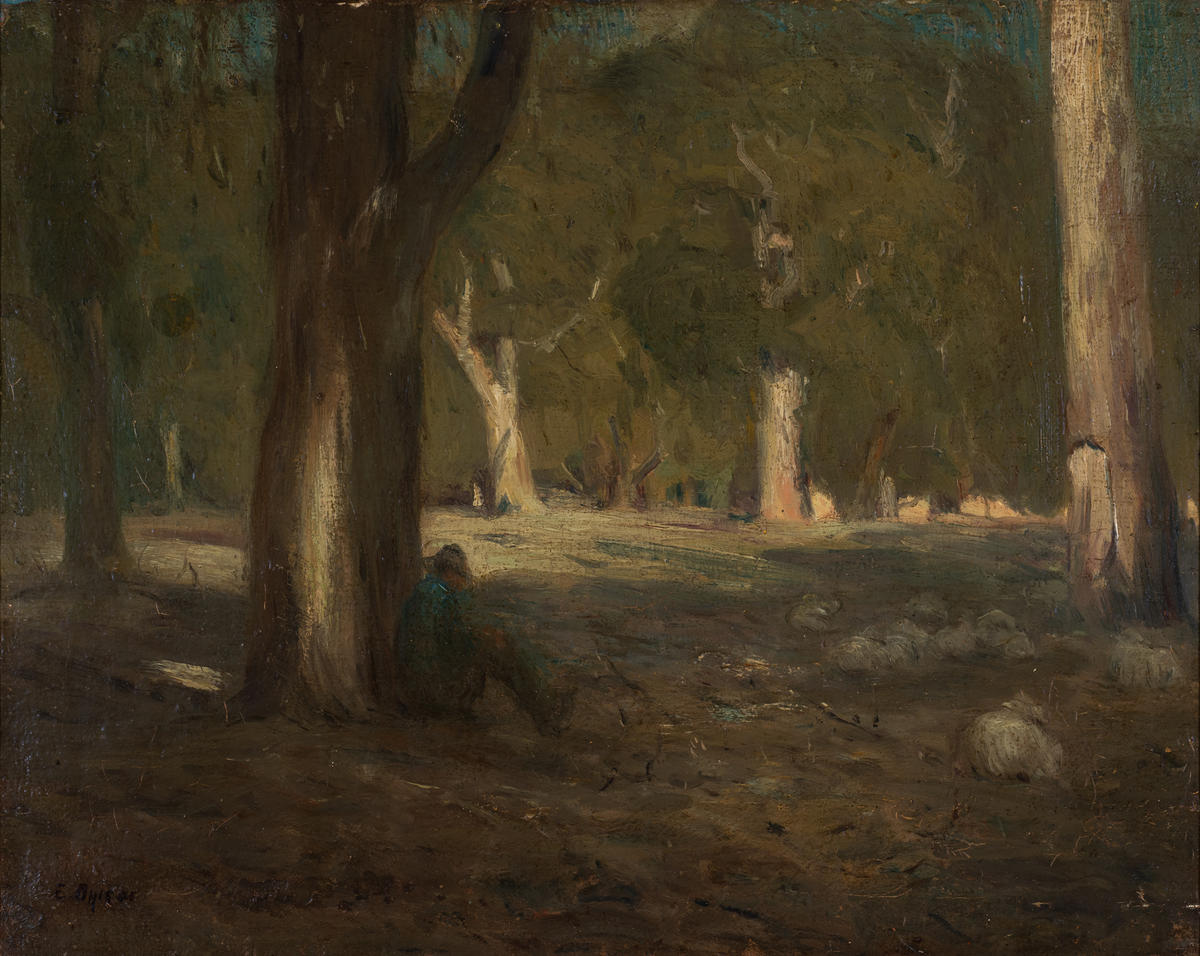
Edward Officer presents a scene that evokes that slanting light, but titles his picture Moonlight in the Australian Forest. The work is given no date in the collection, but may come from one of two of his solo shows at the Melbourne Athenaeum of 1902 and 1912, quite likely the earlier, given that this appears to be the work of a less mature artist. The reviewer writing up the show for the Melbourne Punch of 13 November 1902 spares him the magazine’s habitual Aussie rib-poking:
“Mr. Officer is an artist. His works are characterised by genuine poetic feeling, a sense of the mystery of space and atmosphere, a true feeling for delicate colour effects and by sound technical accomplishments. Many of the works, however, are too refined ever to be popular with the people who demand plenty of story, cheap sentiment and glaring colours in a work of art. As a rule Mr. Officer works in ‘low tones,’ rarely employing the drum and cymbals in his colour orchestra. He would never be a success as scene painter to the Theatre Royal. Mr. Officer delights in the quieter, remoter, less commonplace aspects of nature; dim landscapes, slow, secret creeks, long desolate plains, red sand and grey mulga, secluded valleys, grey dawns, soft moonlights, russet sunsets—these are the effects that appeal most intimately to the painter. Some of the pictures, indeed, breathe the very atmosphere of pastoral peace, and take us back to the old Greek days when Pan piped in the warm summer evenings to the shepherds in some Arcadian vale.”
Can Officer have actually painted this nocturne by moonlight, or is it a painterly day-for-night rendering of late sunlight in darker pigments?
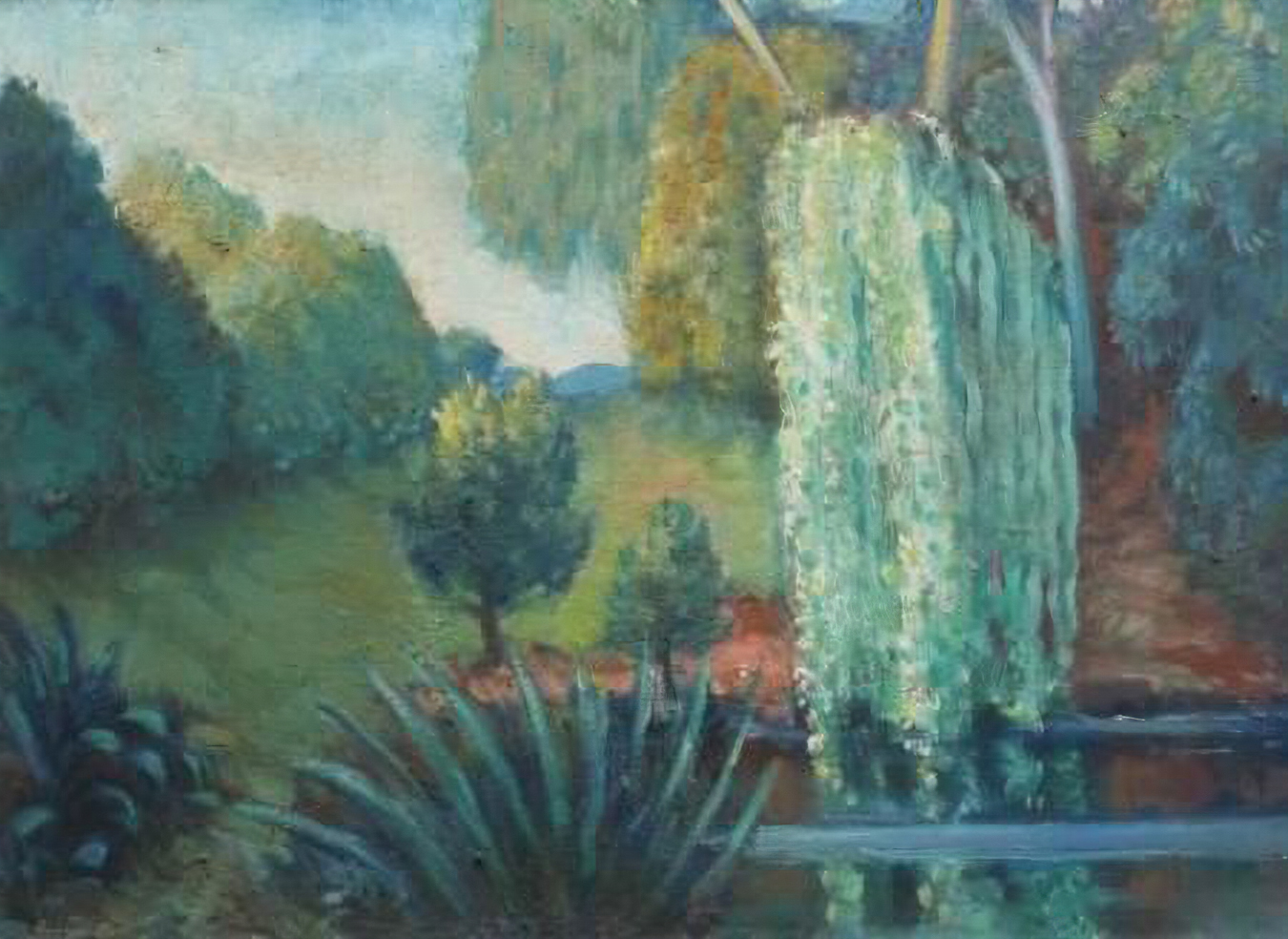
George Bell (not represented in Shadowlands), pursuing a modernist interest in urban, rather than bushland, environments, shows us the effect of Australian equinoctial light—whether autumn or springtime—on the mixed imported plantings in the Botanical Gardens, flood-lighting the blond tresses of a glorious weeping cherry and its reflection in the lake interrupted by a brief zephyr ruffling its waters, while advancing shade cools the fleshy spikes of an aloe.
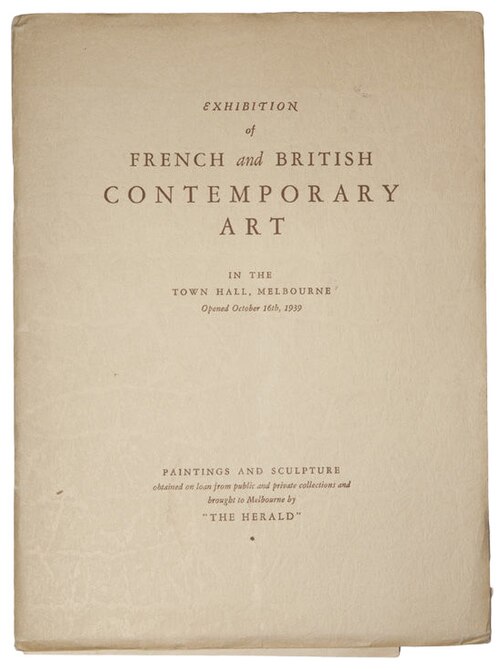
While Bell was fulsome in his support for Burdett’s 1939 ‘Herald Exhibition of French and British Contemporary Art‘, the latter’s tastes were somewhat broader and more eclectic than Bell’s rather doctrinaire Cézannism. Bell’s school produced a distinctive house style — controlled, structured, Cézannesque — and Bell resisted tendencies that moved too far beyond that framework, whether toward Surrealism, Expressionism, or the more radical abstractionism that was gaining ground in Europe in the late 1930s. Burdett, by contrast, showed more openness to a wider range of modern tendencies.
There was also a broader tension in Bell’s position: he was a teacher with a programme, and programmes tend toward orthodoxy. Some of his most gifted students — most famously Arthur Boyd, Sidney Nolan, and Joy Hester, who congregated around the Heide circle — would come to feel that the Bell school’s Cézannism was a constraint rather than a liberation, and that it was insufficient as a basis for an authentically Australian modern art.
Burdett, as a critic rather than a teacher, was less implicated in Bell’s orthodoxy. His early death in 1942 cut short what might have been a more fully developed critical dialogue. But in the years they were both active, their relationship was one of strong alliance against the conservatism of Menzies’ Australian Academy of Art, and both actively opposed its receiving a Royal charter. Any differences between the two men were of emphasis.
The Victorian Artists’ Society, Australian Art Association and similar bodies in the interwar period were the institutional home of a painting culture that remained heavily indebted to the Heidelberg tradition and its successors — the rural landscape, the pastoral scene, gum trees and creek beds and the play of Australian light on open country—not for merely aesthetic preference but with ideological weight: landscape in that tradition was bound up with national identity, the pioneer myth, the idea that the Australian character was formed in and expressed through the bush. As Burdett, in several iterations, put it:
Our painters today seem to have lifted up their eyes to the hills, and to have permanently focused them there. The landscape setting of our life absorbs them. The life itself is neglected. Our painting is like a novel without any characters. Landscape pervades our exhibitions like a recurring decimal monotonously repeated ad infinitum. Is there nothing in our life worth depicting on canvas?
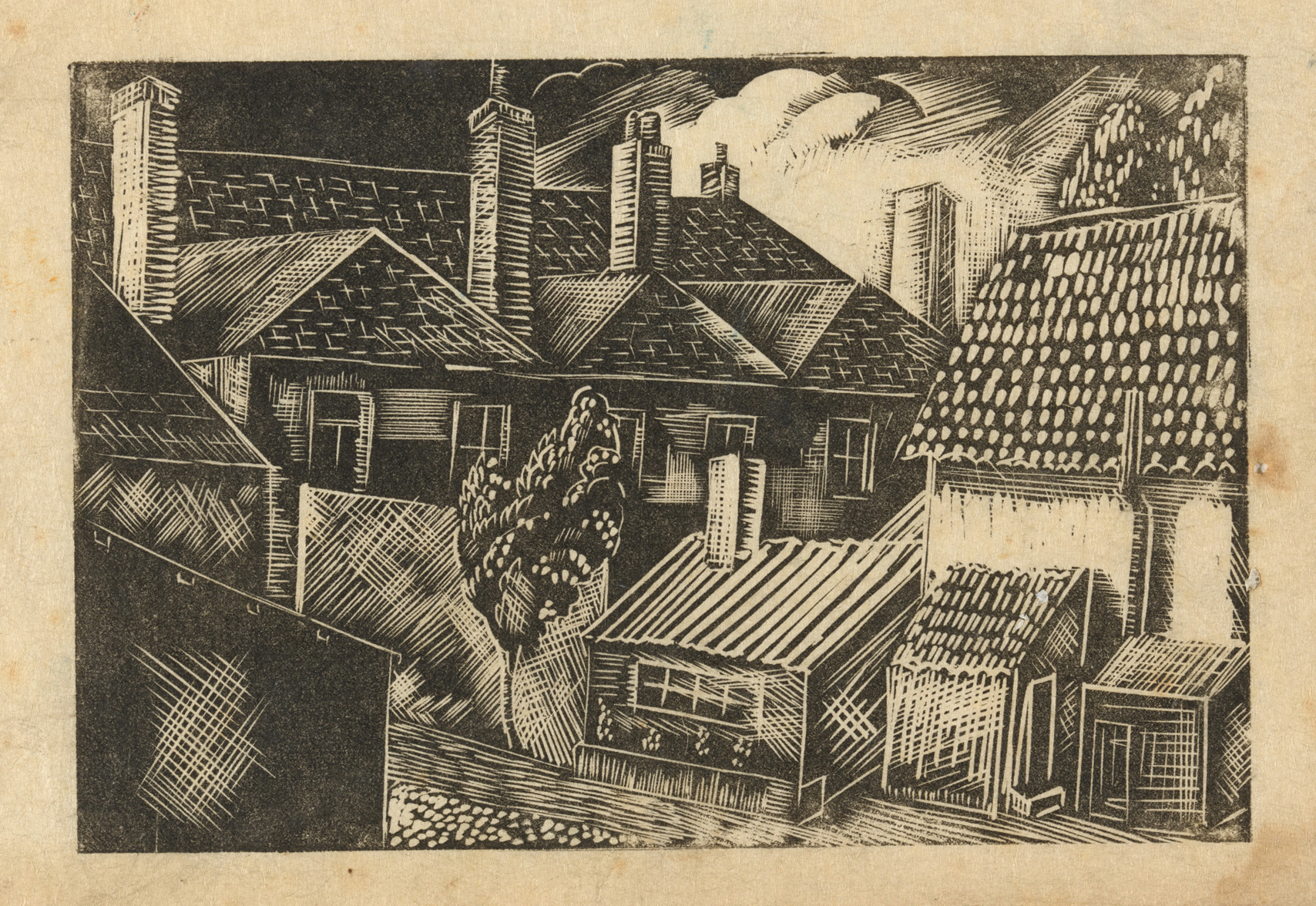
Bell’s preference for cityscapes, the figure in interior settings, for urban and studio subjects, was in this context quietly but meaningfully oppositional. It aligned him with a European, specifically French, idea of what serious painting looked like — the tradition running from Manet through Cézanne and into the School of Paris. Serious modern painting, as Bell understood it, implicitly rejected the nationalist-landscape orthodoxy of the conservative societies, and Australian painting, he believed, needed to become cosmopolitan rather than provincial, metropolitan rather than pastoral —clinging to the bush as the proper subject of Australian art was itself a symptom of cultural backwardness.
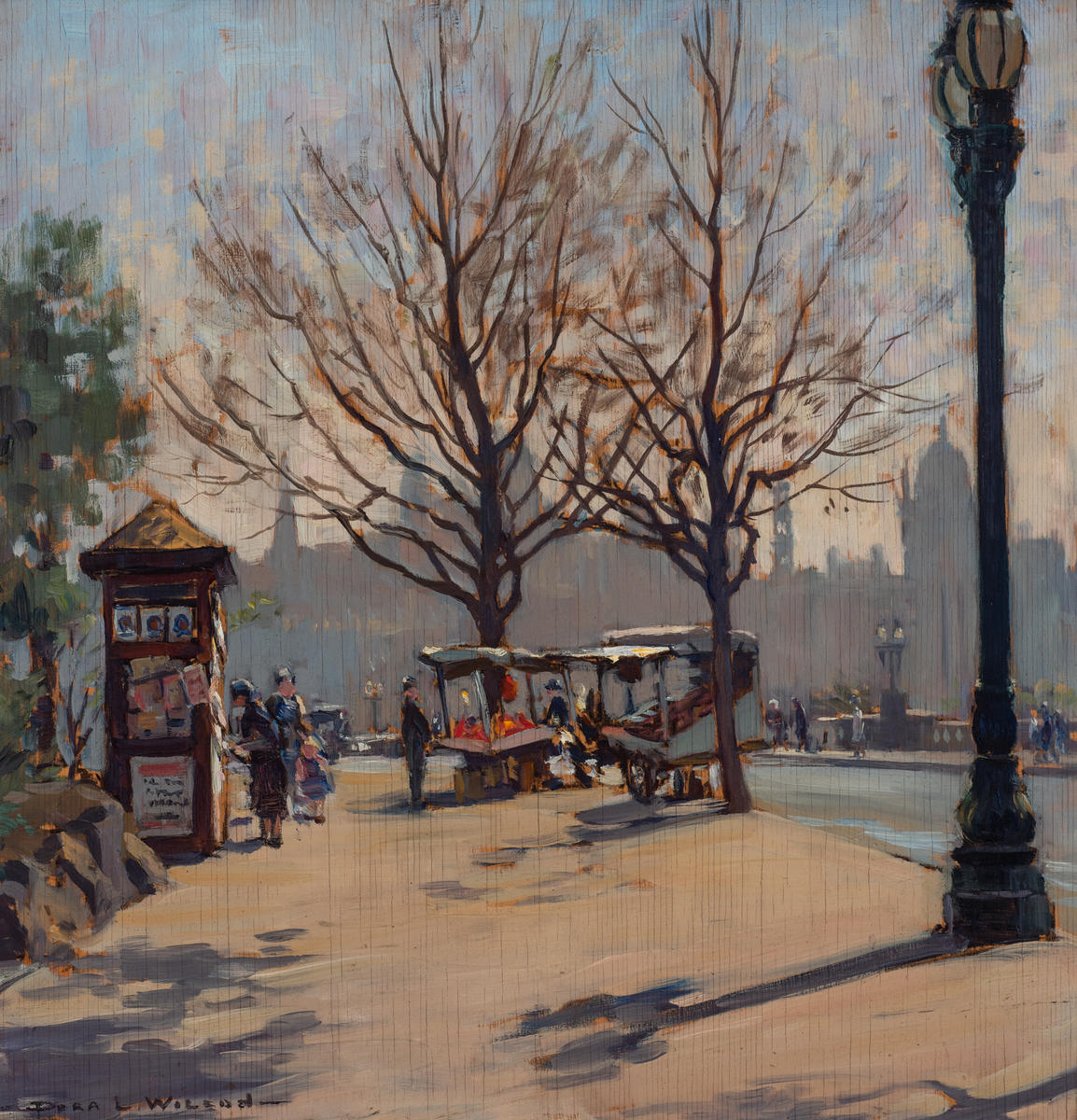
Dora Wilson was co-exhibitor with Bell at annual Australian Art Association members’ shows, and like Bell, she had spent time traveling and exhibiting in Europe, returning in 1929, but unlike him, never became an avowed modernist, though she did devote herself to painting the cityscape of Melbourne—from the seat of her car in later years. Her contre-jour study of Princes Bridge and its palpable aerial perspective is evidently a scene from April or May with the last leaves of the plane trees scattering the pavement and seasonal oranges and the last tomatoes for sale in the street stalls. But is there something distinctively warm about Australian light at this time of year? Is it tinted perhaps with the red dust of the past summer?
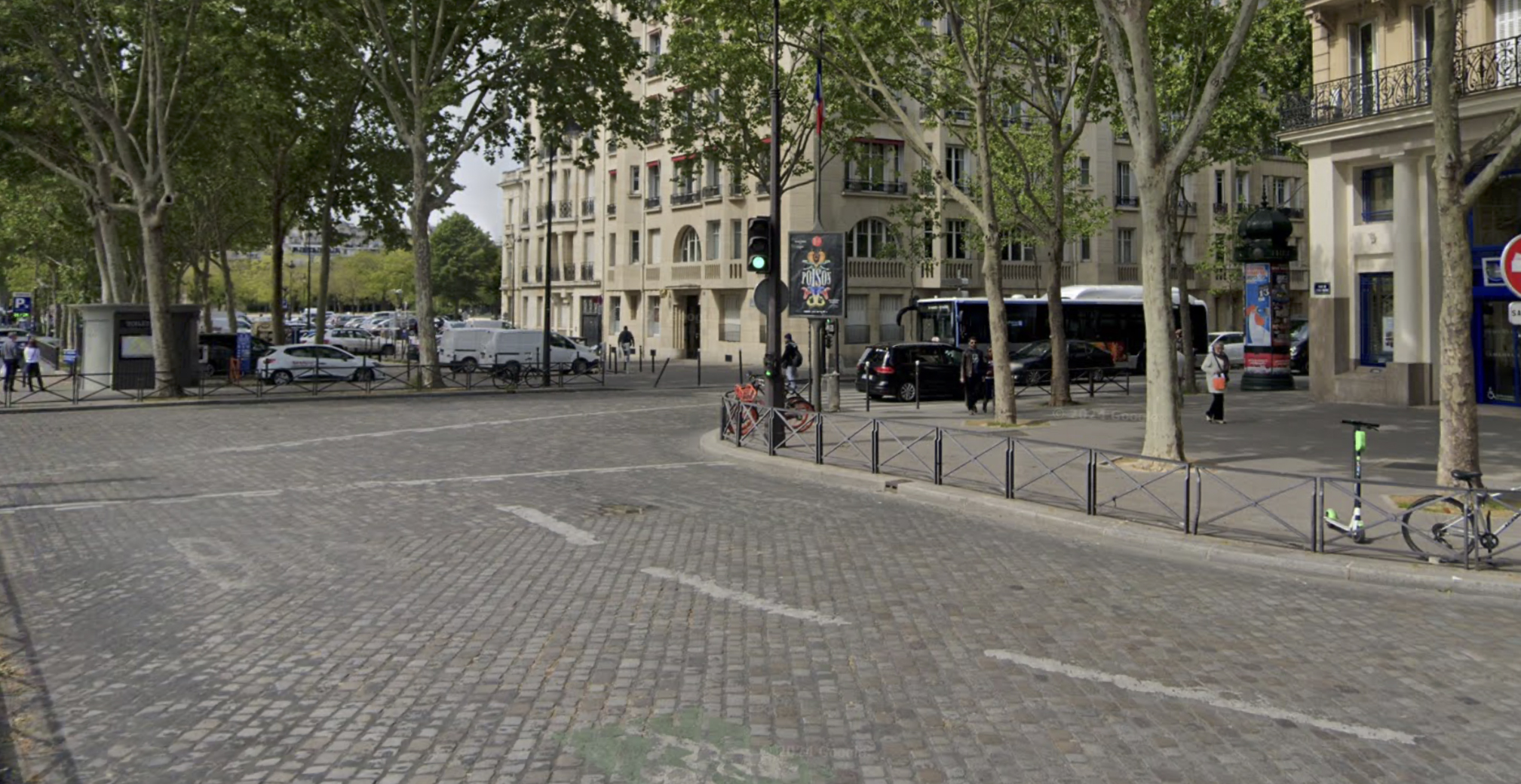
A photograph in this exhibition Shadowland is by Charles Houen (1927-2009), about whom there is scarce information. An obituary in the Australian Photographic Collectors’ Society Newsletter of April 2009 confirms his being a typical ‘camera buff’ and reproduces an NLA picture by Joyce Evans of ‘Chas’ in 1996 with Peter Perry, former director of the Art Museum, where Houen may have joined in one of the seven Castlemaine National Exhibitions of Photography that were held 1964–1971, for which this image of a Parisian street may have been taken. Like Wilson’s painting, it is oriented against the light, but in which season, it is difficult to tell, despite the long shadows.
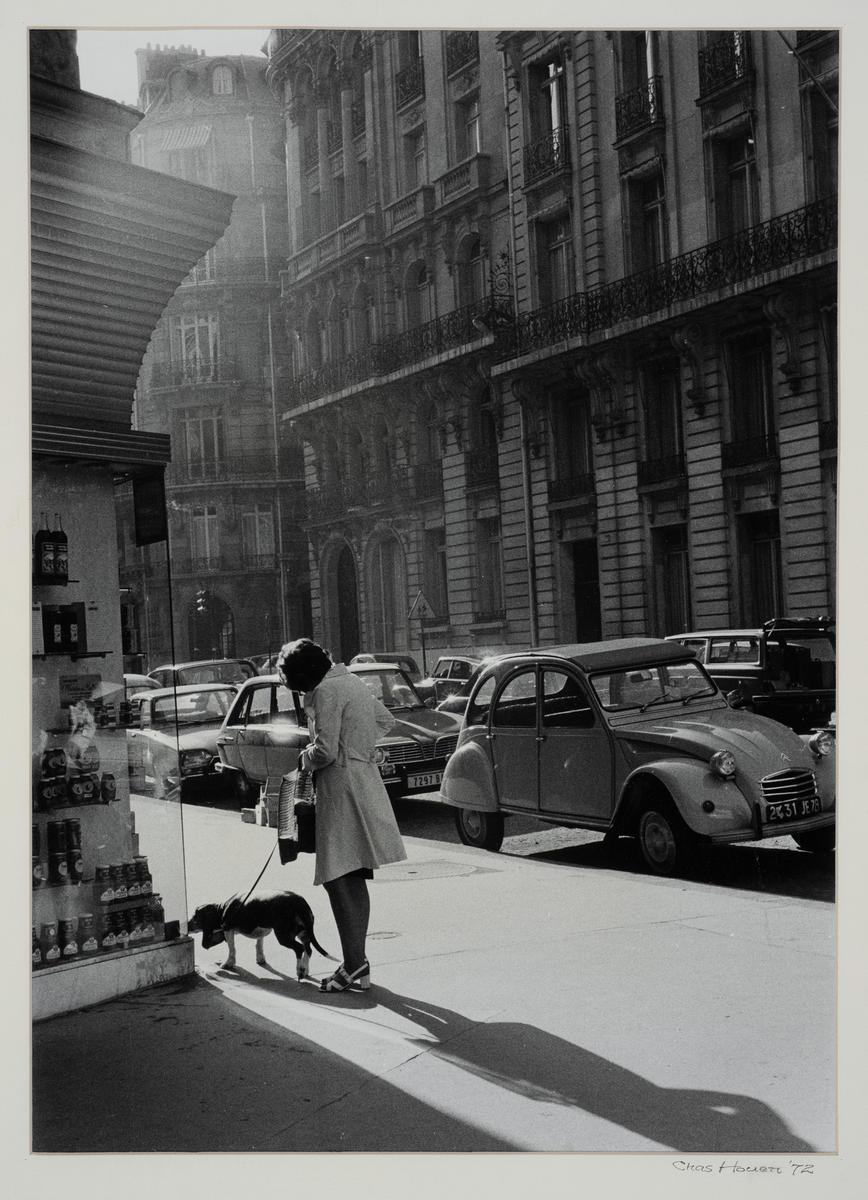
No clue gives away the location of Houen’s rather amateur, though intentionally faintly comic, street photograph which is now mainly of historical interest, more a reminder for me of another of America’s ghastly presidents, Lyndon B. Johnson’s penchant for lifting his basset hounds by the ears, rather than any Francophile nostalgie.
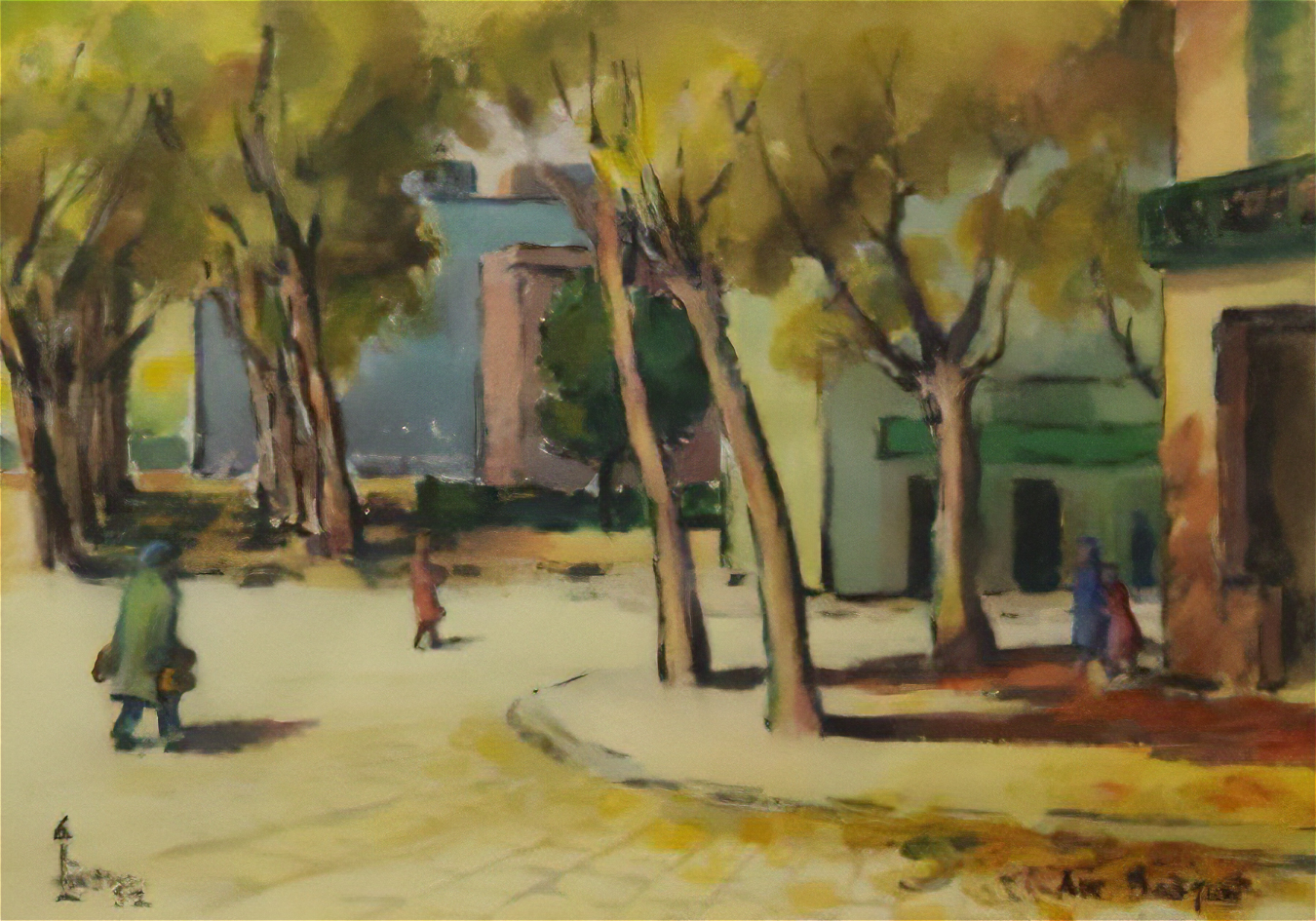
Arthur J. Lindsay however, helpfully locates his painting (above, in a very poor copy) as made In Paris, Corner of Ave Bosquit (actually Bosquet), and we can determine that it was made from here, looking across Avenue de la Motte-Picquet to the corner of Avenue Bosquet (unseen at right) where it meets Avenue de la Bourbonnais.
I’m indebted to fellow guide Chris Wheat for his biographical details for this otherwise little-known artist:
Born in Melbourne in 1912 Lindsay died in Castlemaine 78 years later. His life was anything but ordinary and we can only wonder what drew him finally to Castlemaine to paint quiet pictures of our world. In earlier days he had embraced a career as an artist and for a while took lessons from Rupert Bunny. He exhibited first in Melbourne in 1938. In 1939 he was sketching in Japan, after that he moved to Hong Kong. He returned to Melbourne in 1946 and again exhibited work, this time in response to his experience of war. Later he returned to Hong Kong and lived for a while in a Buddhist monastery. By the 1950s he was in Europe and exhibiting paintings of his travels in Spain, England and France. In France he sketched the great sculptor, Alberto Giacometti. Back in Melbourne and with his male partner he opened a sweet shop in Caulfield. We are fortunate that later he chose Castlemaine.
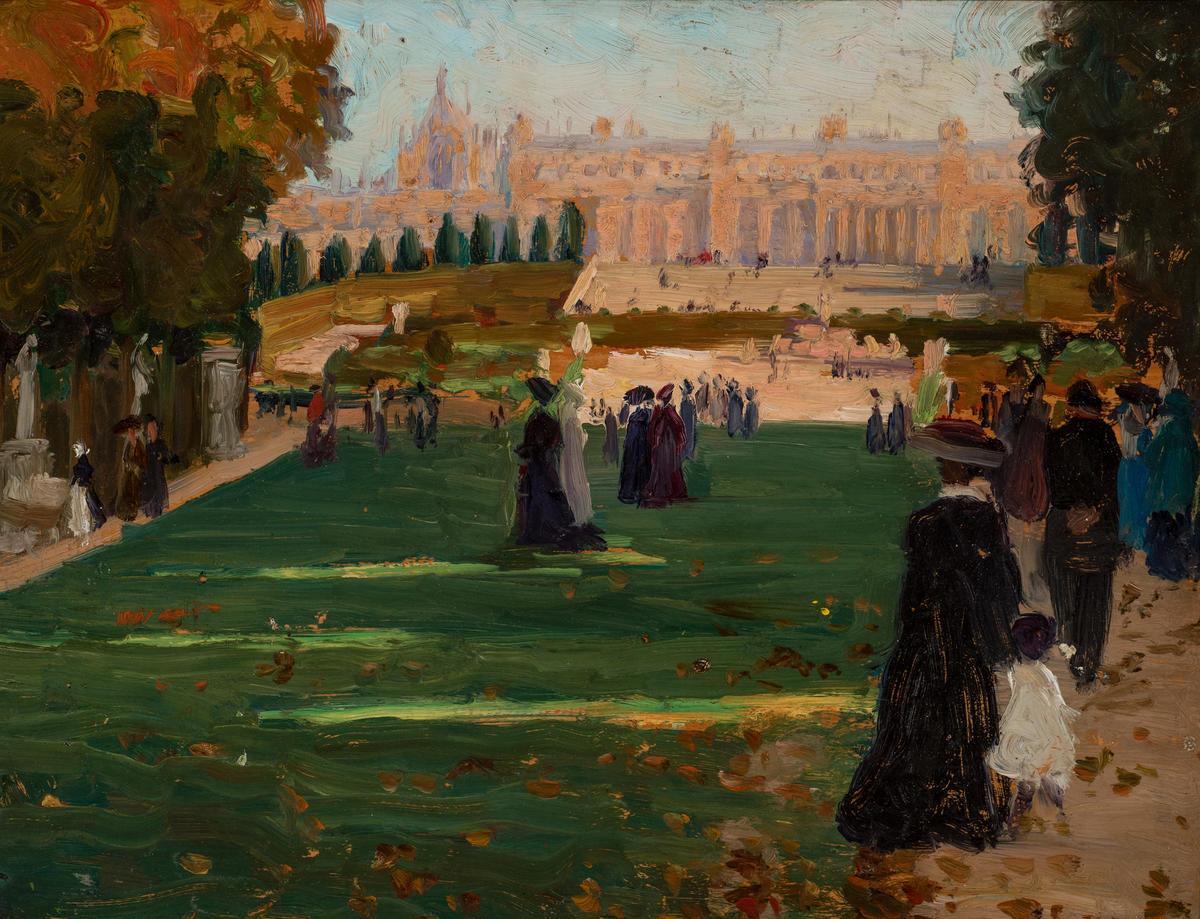
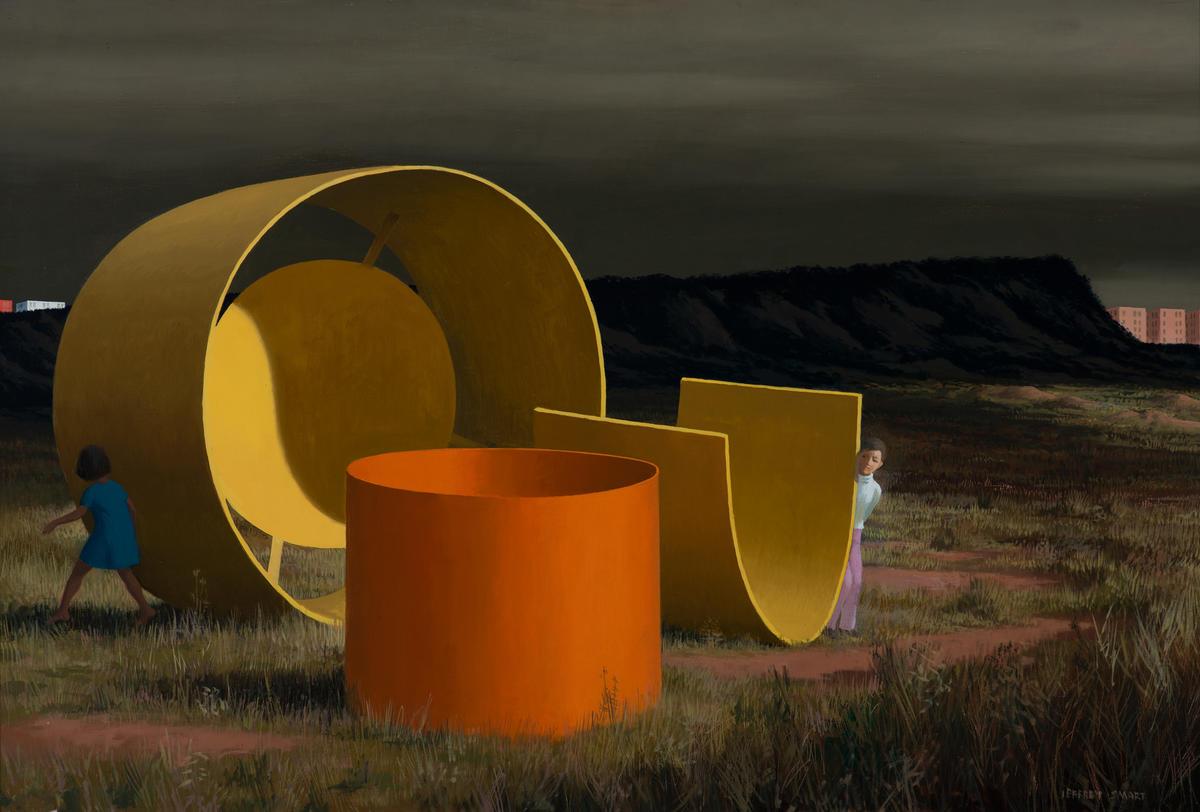
McCulloch however, notes that Lindsay was a student of George Bell in 1942, and that is evident in the cloisonné outlining he uses to contain the washes of colour that represent low slanting light. But in Europe, has that light another quality, a different temperature, from that of Australia? I will leave you to judge that in the example of images from two places from works in Shadowlands. One is Ethel Carrick‘s 1909 Royal Avenue, Versailles, definitely an autumn scene, and the other, Jeffrey Smart’s Hide and Seek made in Italy depicting low light against a dark rain clouds on the horizon, but in what season?
There is another form of illumination that delights the artist and the photographer, and that is artificial; a readymade theatre of light offered by the city at night. What exciting chiaroscuro, dazzle and dark! Multiple rays from sources distant and close, above, below, beyond and beside, intersect to offer unexpected and unique effects, and that is not to mention the drama of cast shadows.
For painters this was a field visited (outside the studio) by Utagawa Hiroshige, for example, in his Night View of Saruwakacho (1856–57) depicting a busy street in Edo’s theatre district at night, and in Western art by the English painter John Atkinson Grimshaw (1836–1893) who in the late 1860s and early 1870s, worked in a signature style to detail nocturnal scenes of urban streets or industrial dockyards shrouded in mist or rain-soaked reflections of moonlight or gaslight, like Liverpool from Wapping (1875).
We think nothing of using our phones to photograph at night—the software does the work for us—but for early photographers such low light levels posed insurmountable difficulties, compounded by a lack of any reliable means of determining exposure. Selenium cell light meters only appeared in 1932—the Weston Model 617, introduced 1932, being among the first usable ones. Not highly sensitive they required a practical knowledge of the inverse square law to estimate exposures further from light sources. Before that, a photographer shooting a gas-lit street in Berlin or a floodlit monument in Paris was working from tables in photo journals or from their own notebooks.
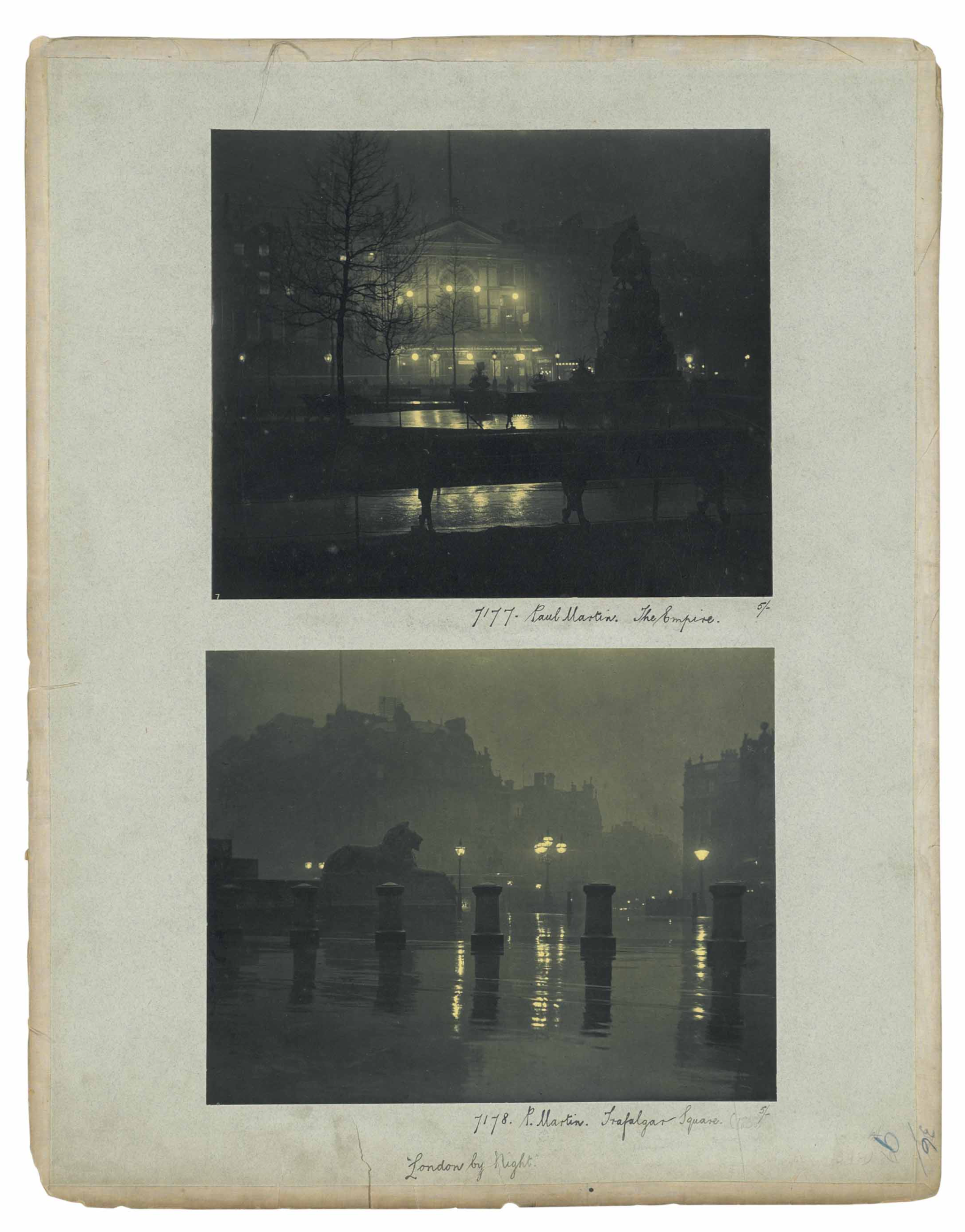
England’s Paul Martin overcame such technical problems as halation, and painfully slow film speeds as low as 5 ISO, in 1895–96 to photograph the rain-sodden, foggy streets of urban London when gas lighting was being replaced by electricity; his London by Gaslight series (unpublished) won him the gold medal of the 1896 R.P.S. annual exhibition and acclaim among leading Pictorialists of the day. Lens speeds too were continuously improving. but rendering artificial light, especially yellowish gaslight, was a difficulty caused by the blindness of blue-sensitive emulsions to that end of the spectrum.
Hermann Wilhelm Vogel was extending emulsion sensitivity further across the visible spectrum. In 1873, he discovered that adding eosin dye to photographic emulsions created what became known as orthochromatic (or isochromatic) dry plates, helping establish Germany’s photographic industry as a world leader. However, orthochromatic emulsion remained insensitive to some red and yellow wavelengths, so required extra exposure to correctly render gaslight or candlelight. Vogel pursued this problem until his death, when in 1902 his successor Adolf Miethe announced the breakthrough: a red-violet sensitising dye called “ethyl-red” that enabled truly panchromatic emulsion — capable of rendering the full visible spectrum in perceptually accurate tonal relationships in monochrome. A tungsten street lamp, a café window, a neon advertisement — these now registered on film with something approaching their actual visual character.
Commercial availability of fast panchromatic film transformed the genre of night photography. Wratten & Wainwright in 1906 became the first company in Britain to manufacture and market panchromatic plates, incorporating dye sensitisers produced for them by Höhst, and the Germans kept their lead through the late 1920s with AGFA releasing increasingly fast panchromatic emulsions; by the early 1930s their Isopan series—Isopan F, Isopan SS, Isopan Ultra—offered roughly ISO 200 . Eastman Kodak released its ‘Super-Sensitive’ Panchromatic sheet and roll film in the late 1920s.
With panchromatic film, photographers found it possible to achieve still higher speeds with souped up-developers, but emulsions of the period processed in standard developers, such as D-76 (introduced by Kodak in 1927) and the older Metol-hydroquinone (MQ) formulae, produced dense, contrasty negatives that printed poorly under the extreme luminance ratios of night scenes of 1000:1 contrast range. Standard developers of the period would block up highlights disastrously while leaving shadow areas thin and grainy. Hypersensitisation—bathing film briefly in a dilute solution of ammonia or hydrogen peroxide before exposure—could boost effective speed by half a stop to a full stop—a delicate procedure, as over-treatment caused fogging, but it found enthusiasts in German and French technical literature.
Practical chemistry experimentation, both by manufacturers and by photographer-chemists, continued. Two-bath developing, a principle understood from the late 1910s but refined considerably through the 1930s possessed the advantage of self-regulation: heavily exposed (highlight) areas exhausted their absorbed developer rapidly and stalled; shadow areas, with less absorbed developer, developed more slowly and proportionately. The result was a dramatically compressed tonal range — exactly what the night photographer needed. In Australia, photographers were paying attention and the Australasian Photo-Review published their advice to their fellows.
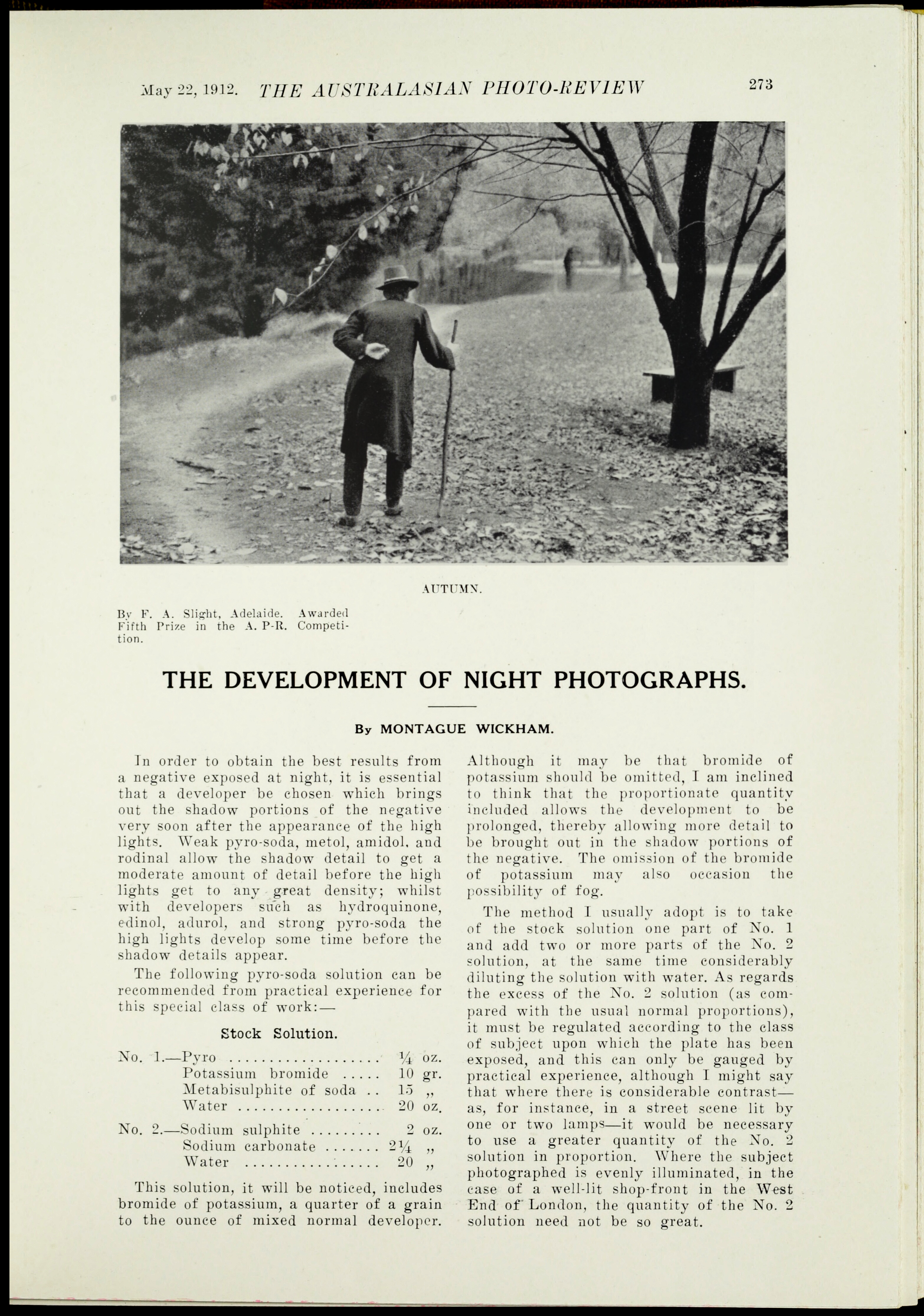
German chemist Willi Beutler‘s Neofin formula (evolved through the 1930s and eventually commercialised) used very fine-grain, compensating chemistry that made push-processing of panchromatic film more reliable and my father and I were still using it in the mid-sixties…magic stuff!
In Australia, it was into this specific technical moment that Wilhelm Ludwig Lucke-Meyer arrived, though from a considerable distance. Born in Witten in the Ruhr in 1893, trained as an engineer, a veteran of German infantry and artillery in the First World War, he had disembarked in Adelaide in December 1926, eventually settling in Melbourne. By 1933 he was exhibiting at the Victorian Salon of Photography — juried, pictorialist, and demanding to satisfy. The sophistication of his exhibited prints was not acquired locally; he brought the technical culture of Weimar-era photography, its familiarity with fast emulsions, its fluency in developer chemistry, its attention to the urban image as a worthy subject. Working quietly in Melbourne through the early 1930s, he was well prepared as a practitioner of long-exposure night photography.
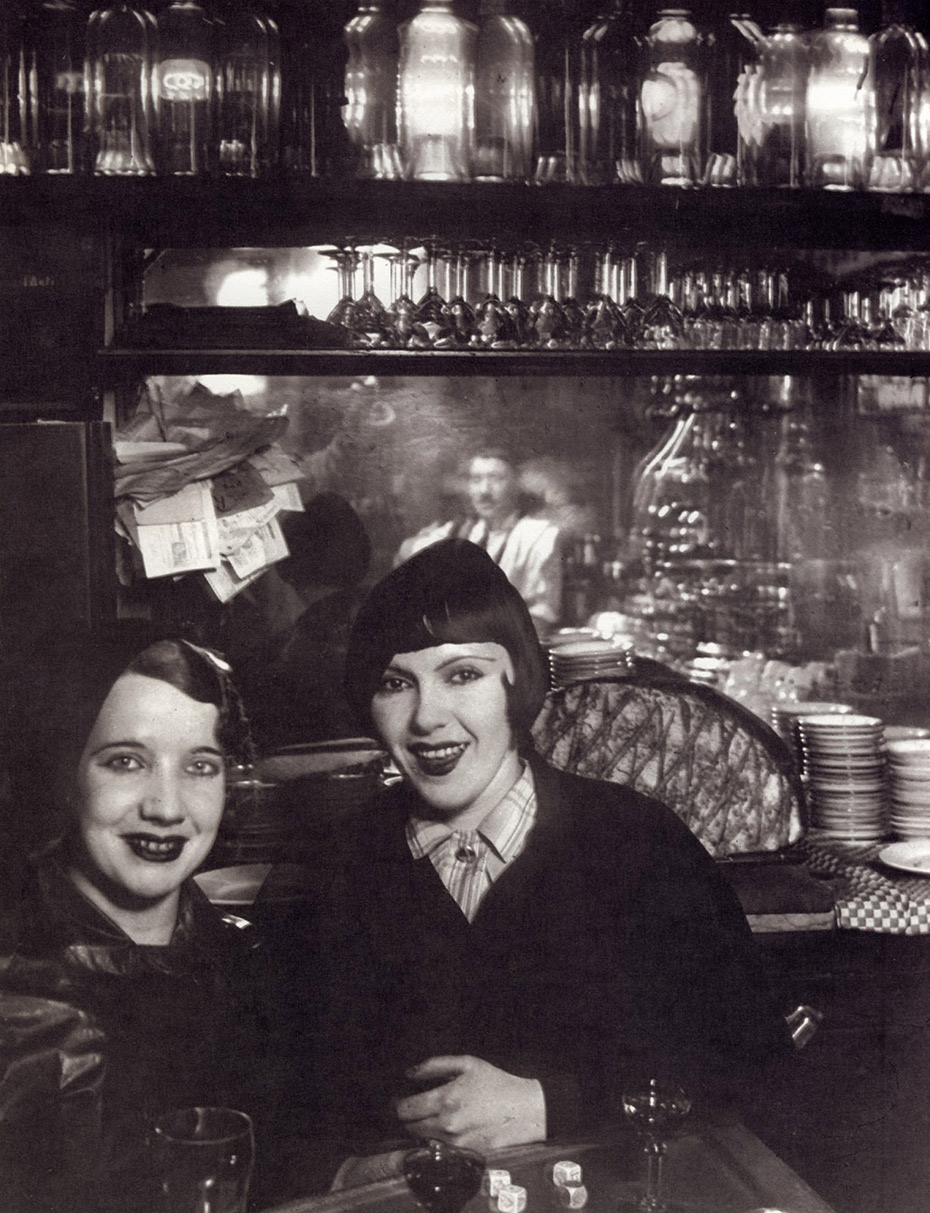 He was commissioned by publisher Sydney Ure Smith to photograph for a book Melbourne by Night, a celebration of the city’s centenary. It crystallised around a European precedent that and his collaborators clearly had in mind: Paul Morand’s Paris de Nuit, with photographs by Brassaï had appeared in late 1932 and entered wide circulation through 1933. The title of Lucke-Meyer’s book is not coincidental — Melbourne by Night directly adapts from the French, and parallels its conceptual ambition: a city made strange and luminous by darkness.
Brassäï was not, in any rigorous sense, a night photographer. A significant portion of Paris de Nuit — the brothel interiors, the bars, the bal musette scenes — was made with flash powder or flash paper. The reflections of a flash gun held by Brassäï or his assistant are visible in mirrors and windows in several of the book’s most celebrated images. His outdoor street work used methods taught him by Kertesz, of long exposures on a tripod, but he was a pragmatist: when the light was insufficient, he manufactured it. The breakthrough of his book is its frank and courageous investigation of the Parisian underworld.
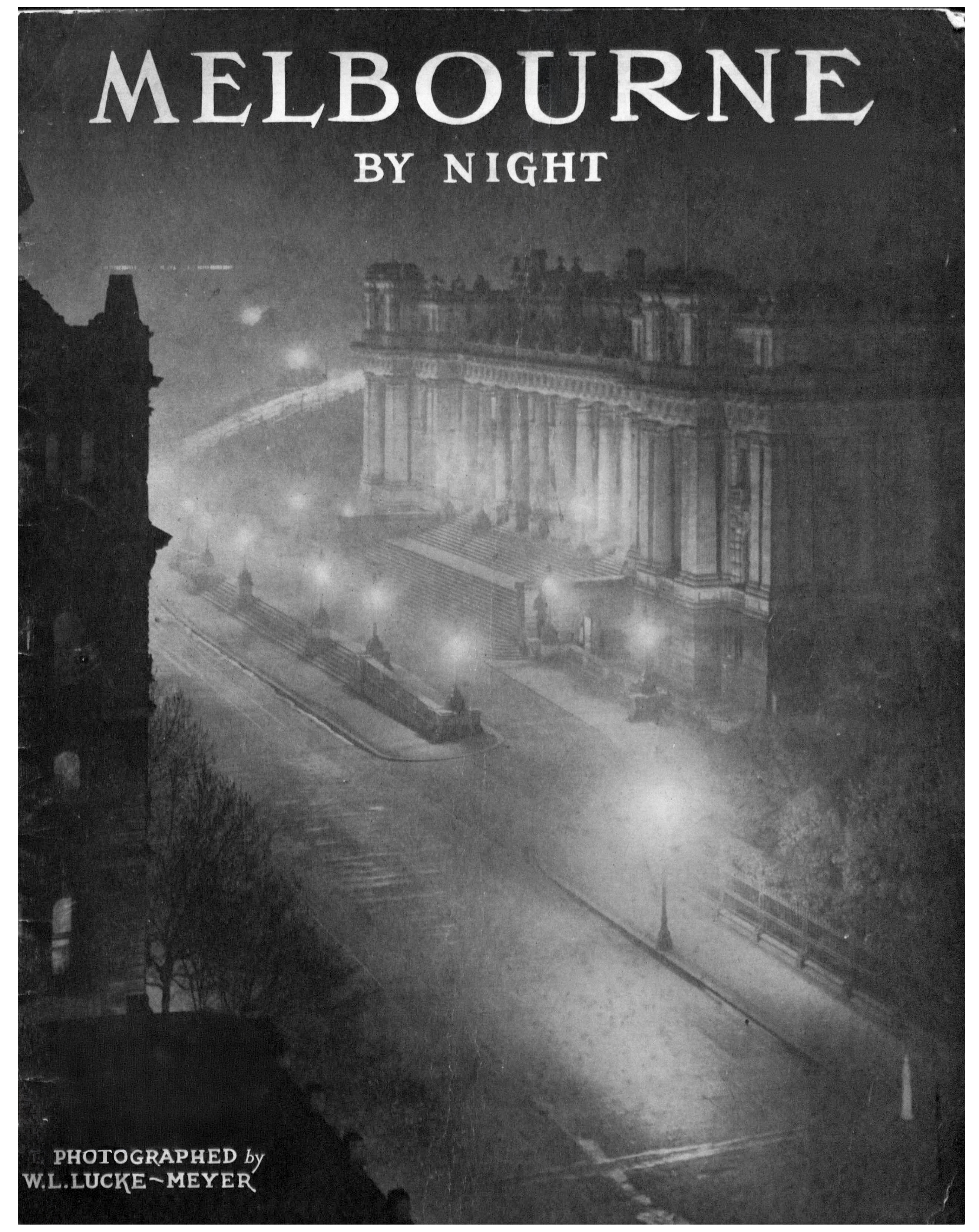
Lucke-Meyer’s Melbourne photographs, though they have a promotional purpose and tame by comparison to Brassaï’s shocking exposé, are a different kind of object, but enchanting for anyone who loves and remembers the once human scale, and charms, of old Melbourne. Working on a tripod with large-format sheet film processed through the compensating chemistry his German formation would have made second nature, Lucke-Meyer recorded the evocative light of his city — the elm-filtered lamp glow of Collins Street, the arc-lit emptiness of Swanston Street at midnight, the concentrated geometry of a laneway where wall-mounted lights describe a vanishing perspective. His are images made by available light alone. In this specific and technical sense, Lucke-Meyer is the more radical night photographer, even if Brassaï’s book is the more radical social document.
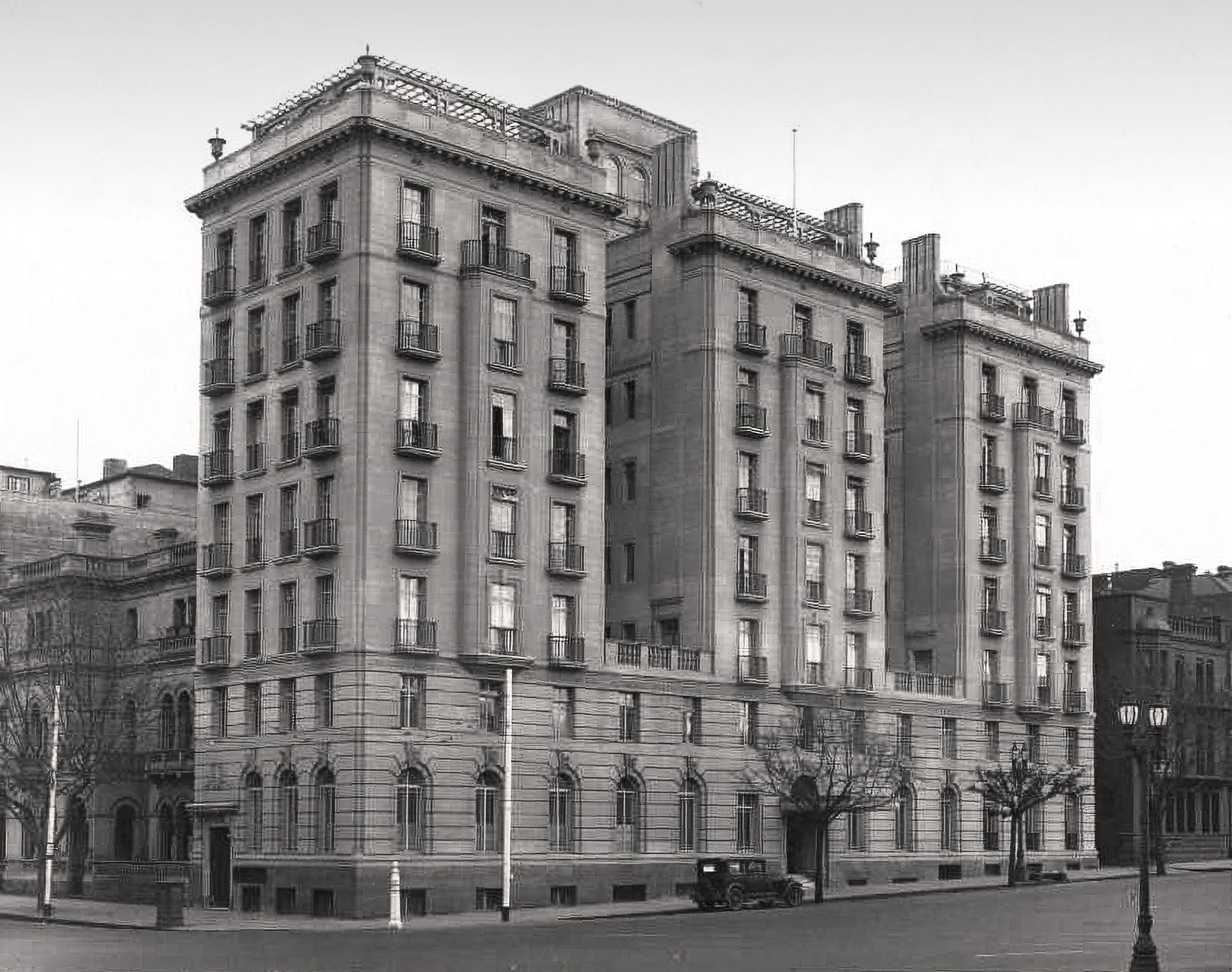
The choice of Basil Burdett to provide the accompanying text was apt; at the height of his career as art and drama critic for the Melbourne Herald—an informed and outspoken supporter of the modern movement in a city largely resistant to it—he was physically elevated, living fashionably at the time in Alcaston House, the Art Deco residential building on the corner of Collins and Spring Streets, directly opposite the Old Treasury — one of Melbourne’s more architecturally self-conscious addresses of the period. He writes from 120 feet above Collins Street, and the landmarks he enumerates from his eyrie — Parliament House, St Patrick’s, the Treasury’s Renaissance facade immediately opposite, the Public Library’s dome resolved through fog — are exactly what those upper floors commanded. His rooftop perspective is not a literary device. It is autobiographical:
“It is the hour of the theatres—in Melbourne. From my city roof-top I look out over a quivering expanse of lights, like the ever-widening ripples of a shimmering sea. In a swift hour the city has been transmuted by the magic of gas lamp and electric light.
“It is no longer the same city whose streets I walked in the broad sunshine of a splendid day, with a blue sky throbbing overhead. It is a new world, more glamorous, more mysterious, more sinister, more beautiful, perhaps a world of echoes and shadows and suggestions, and of light which mocks the memory of the day with the dazzling variety of its chromatic splendours.
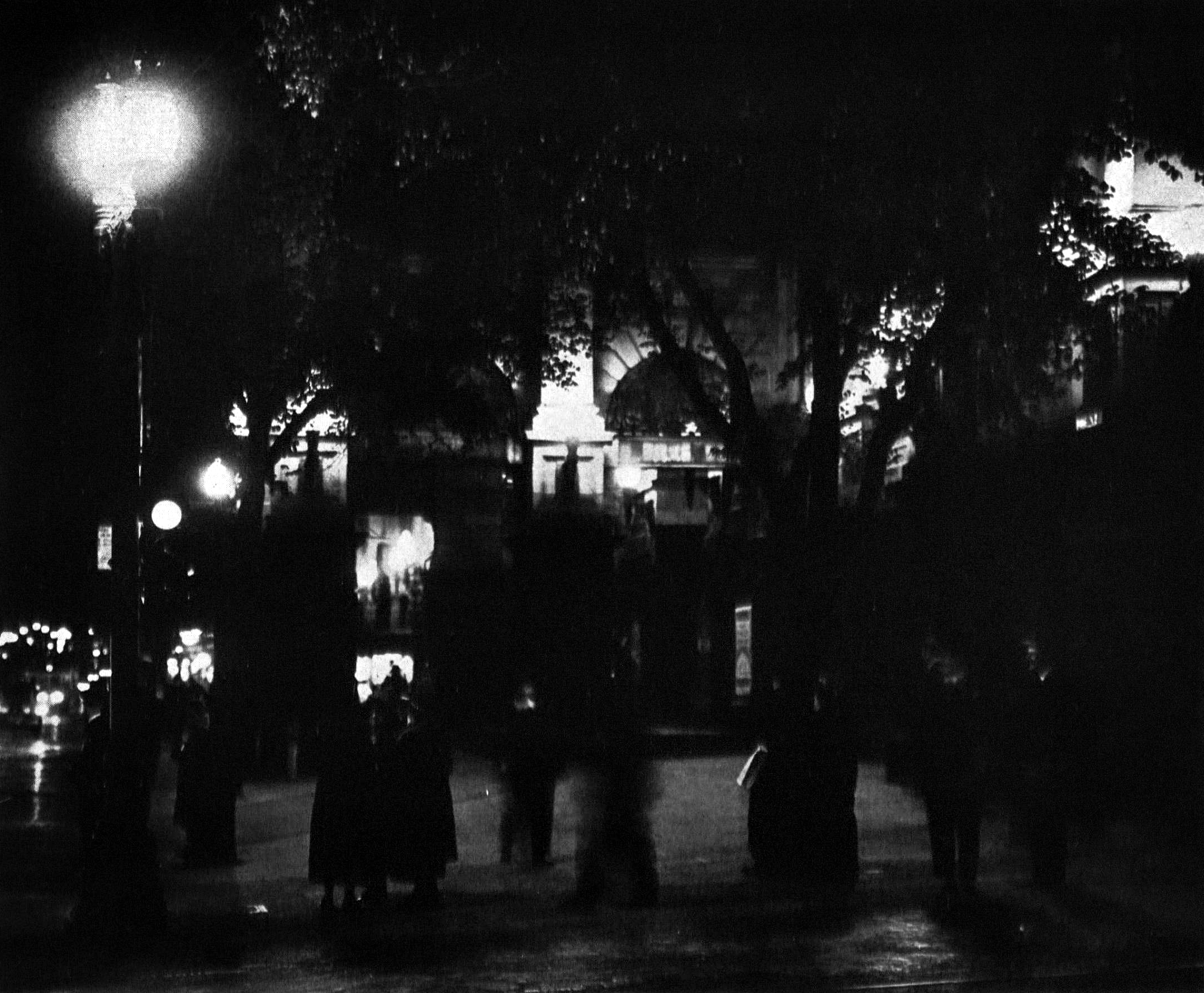
“Two hours since the bars, theoretically, gave up their dead. Cocktail glasses, also theoretically, ceased to clink in the lounges. In hotels and restaurants hundreds of diners are performing the final ritual of drinking undrinkable black coffee from tiny cups and liqueurs from still tinier glasses. The streets are lined with parked cars. The head lights of the latecomers, speeding along the approaching highways, are turning them into thoroughfares of powdery gold, like the air above the city, charged with the fiery particles of the aura created by a million lights. The theatre fronts blaze with jewels, more scintillating than any diamond, more splendid than a window full of gems in a Collins Street jeweller’s.
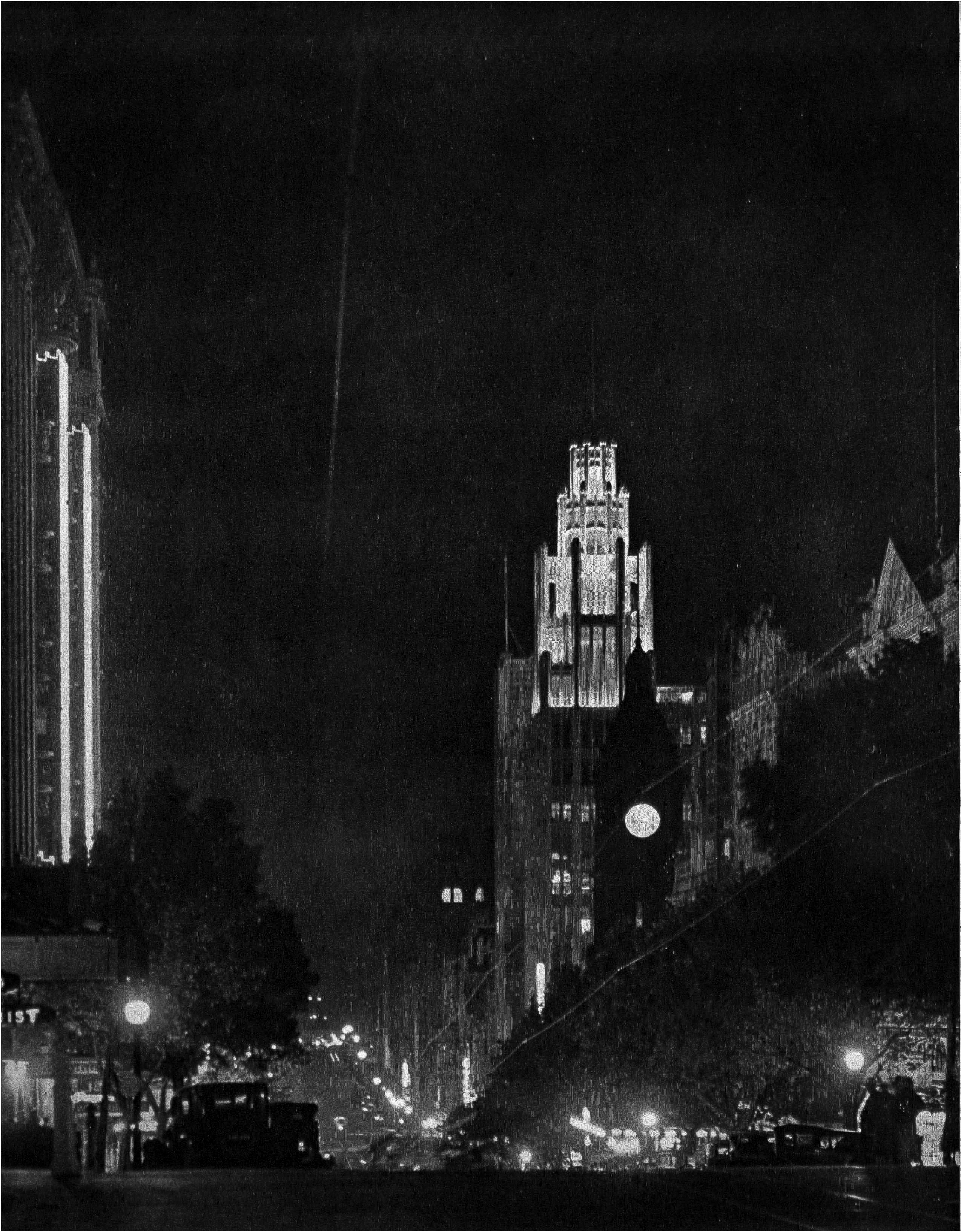
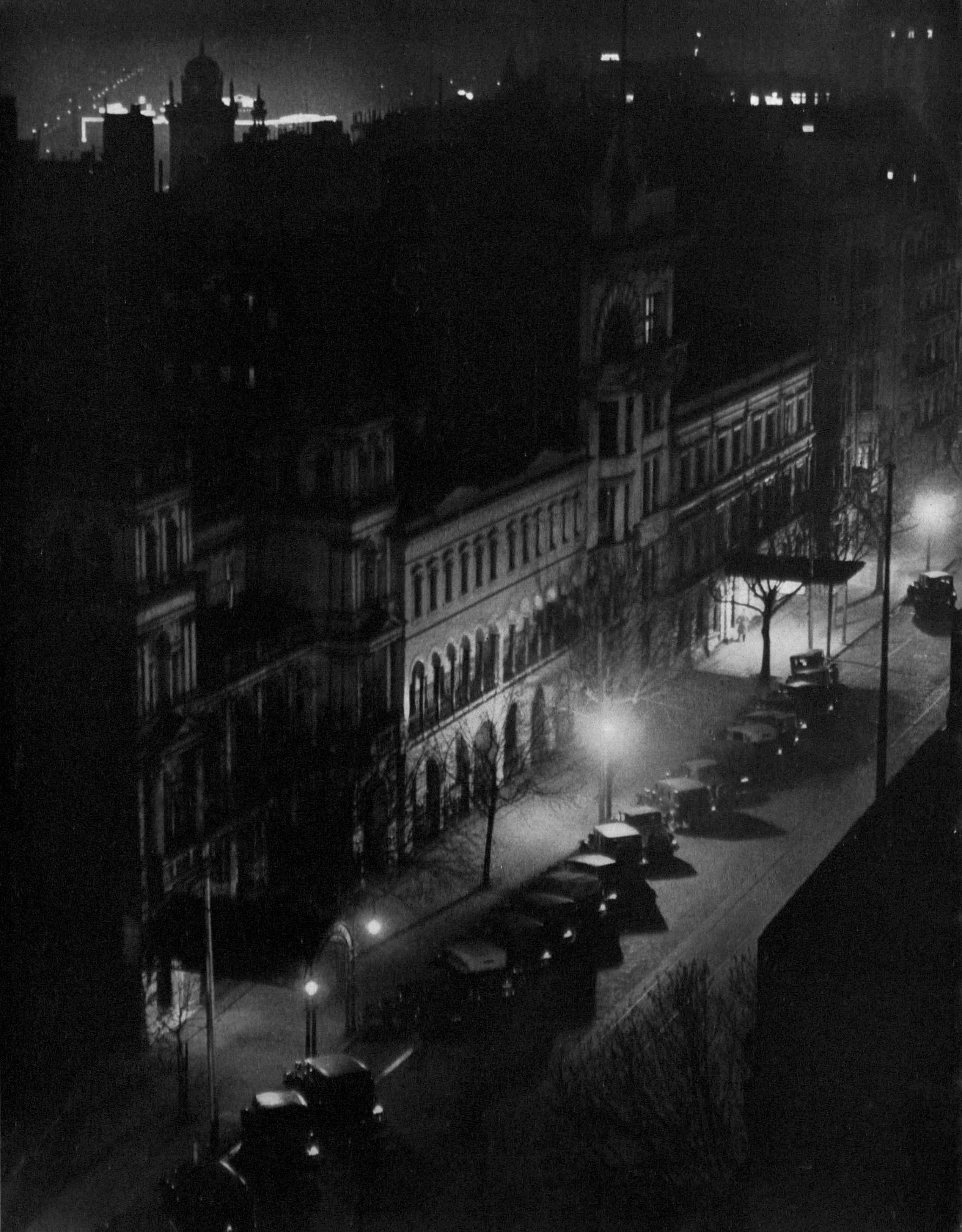
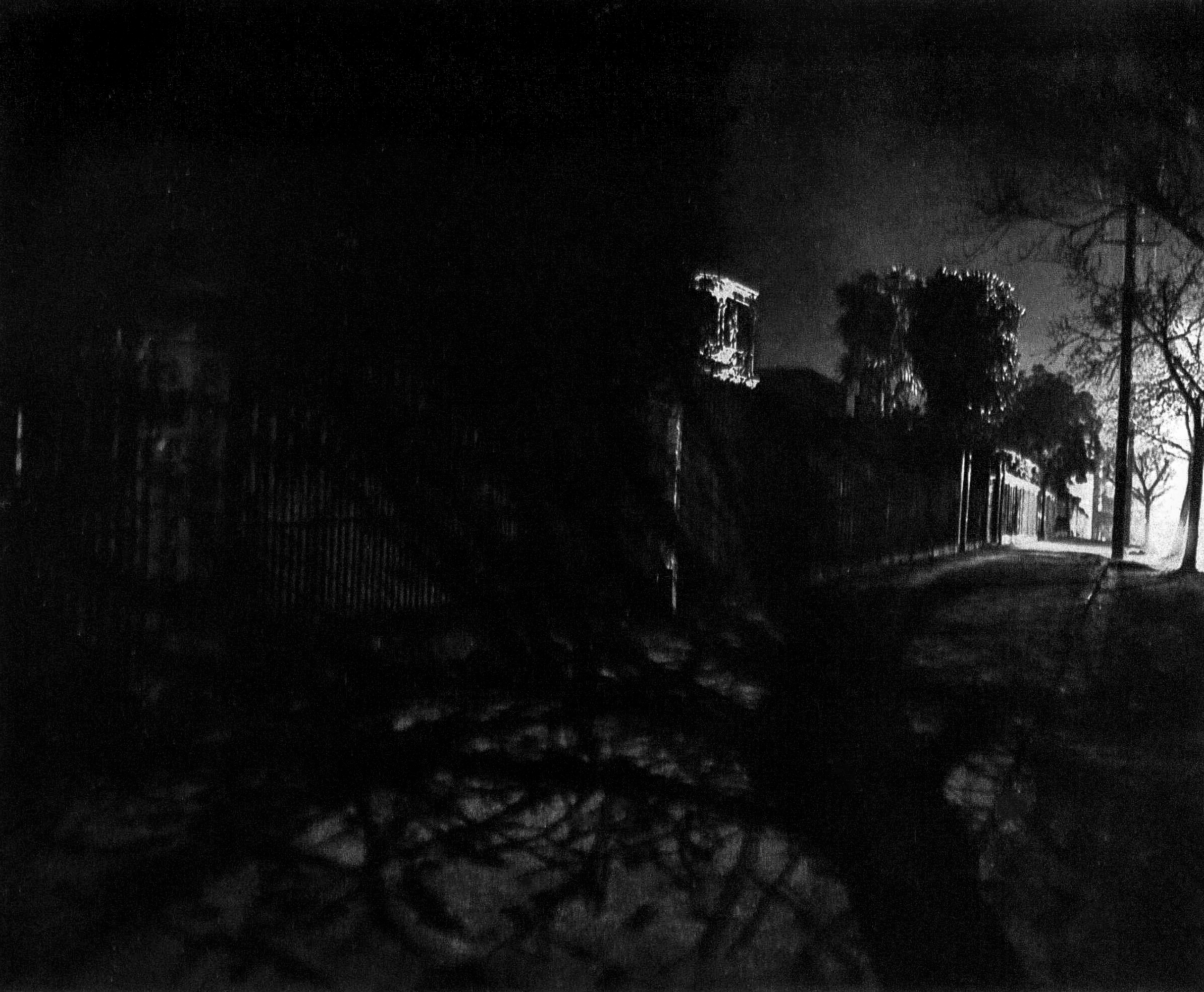
“Withdrawing from the farthest margin of the glittering wash of the city lights, breaking far out to challenge even the mountain solitudes of the Dandenongs, the eye finds the familiar landmarks of the city’s inner ripple—the fire station minaret, Parliament House, St. Patrick’s, the Renaissance facade of the Old Treasury, the Moorhouse spire, the T & G.’s twin towers, the Manchester Unity turret, the spire of Scot’s, the flat Aga Sophia-like dome of the Public Library—some of them steeped in the gloom and mystery of the upper air, others illuminated to a particular splendour unguessed at during waking hours.
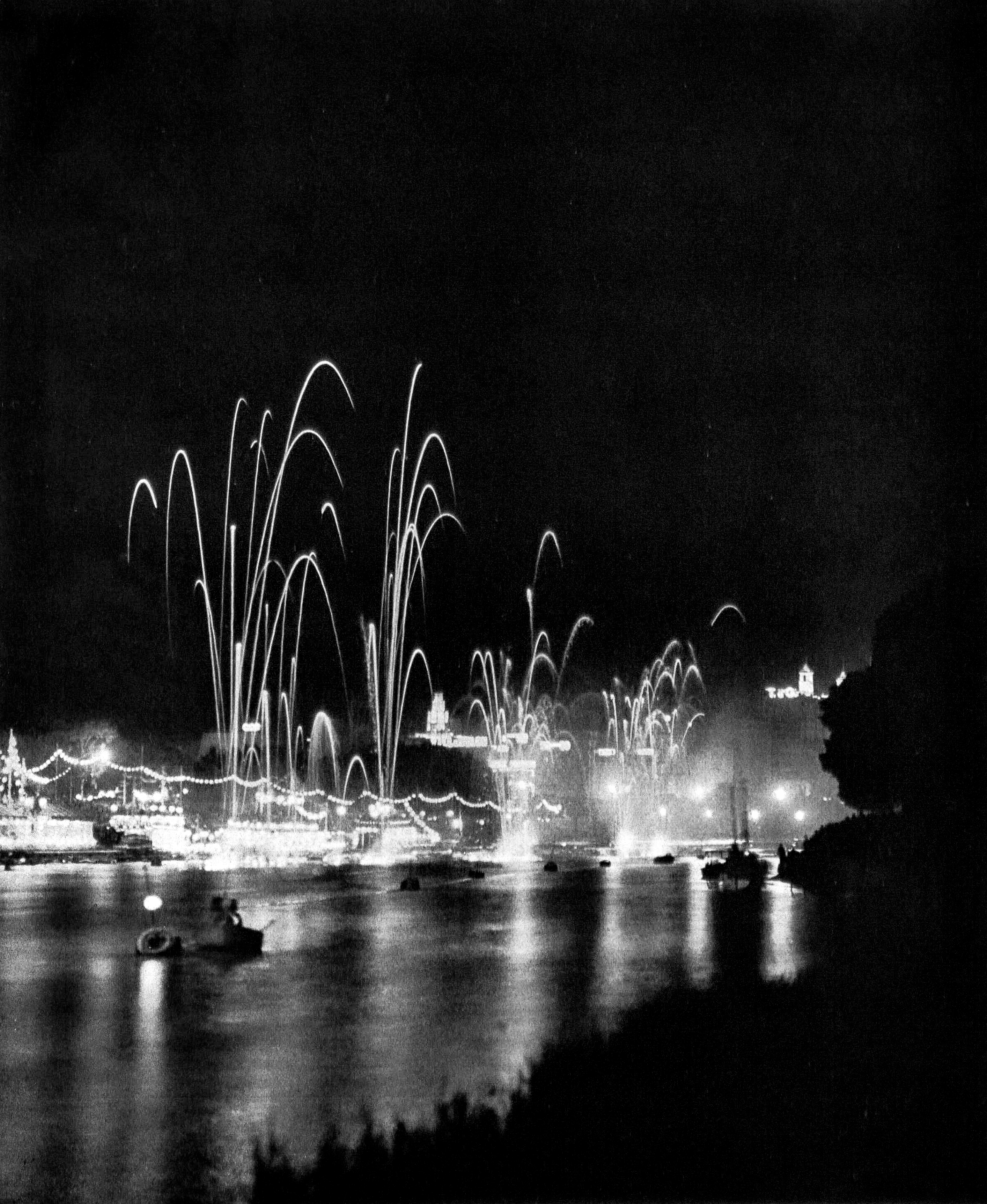
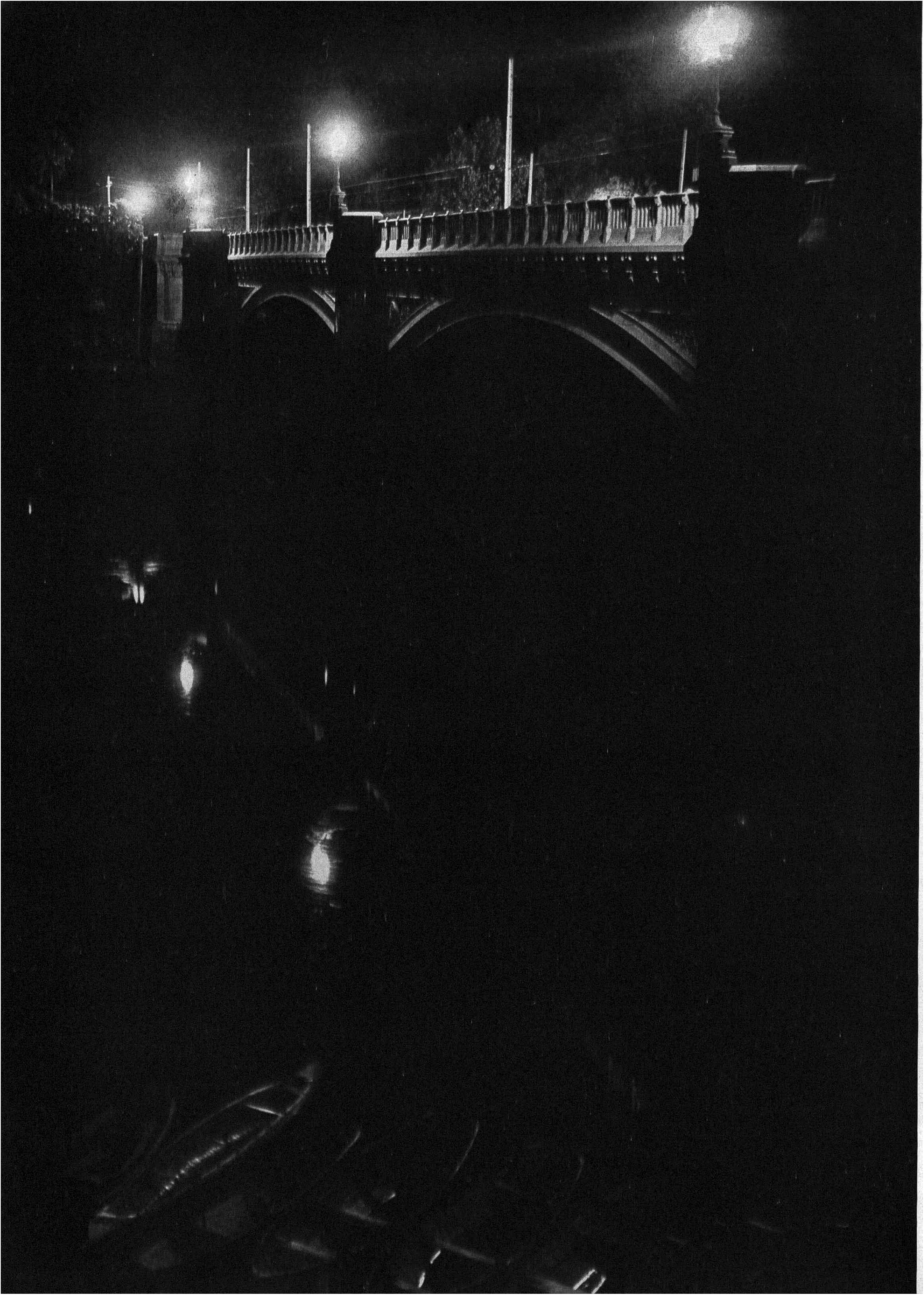
From across the river, over the serrated line of roofs, peeping between towers and steeples, Neon signs wink in red and blue and green. Below me, 120 feet, is Collins Street, its lamps snared in the twining tracery of elm trees and planes. Melbourne seems older at night—“vieux, archivieux” even, like Daudet’s peasant, like London or Paris or Rome. Who could believe, at night, this is a city not yet a hundred years old?
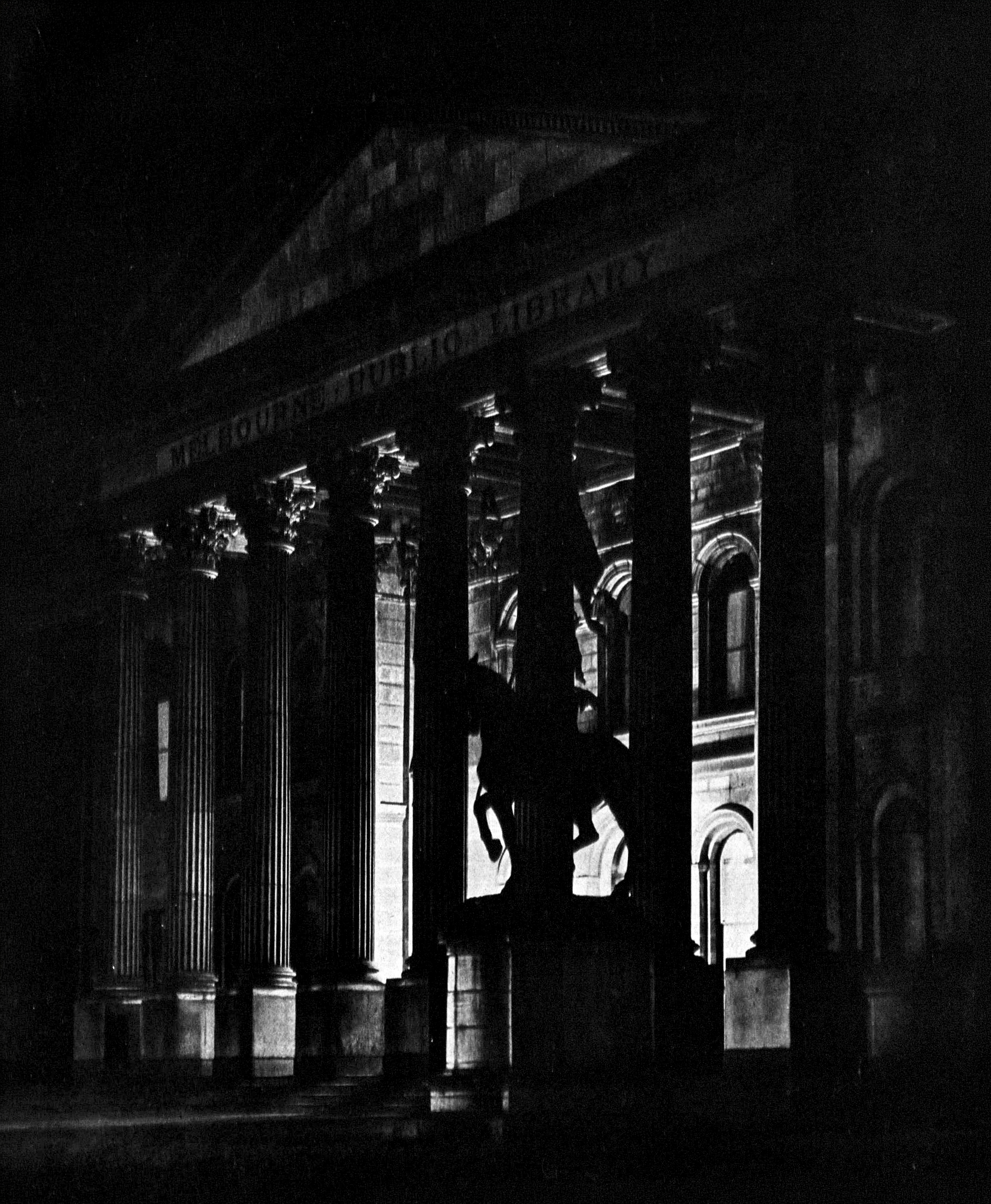
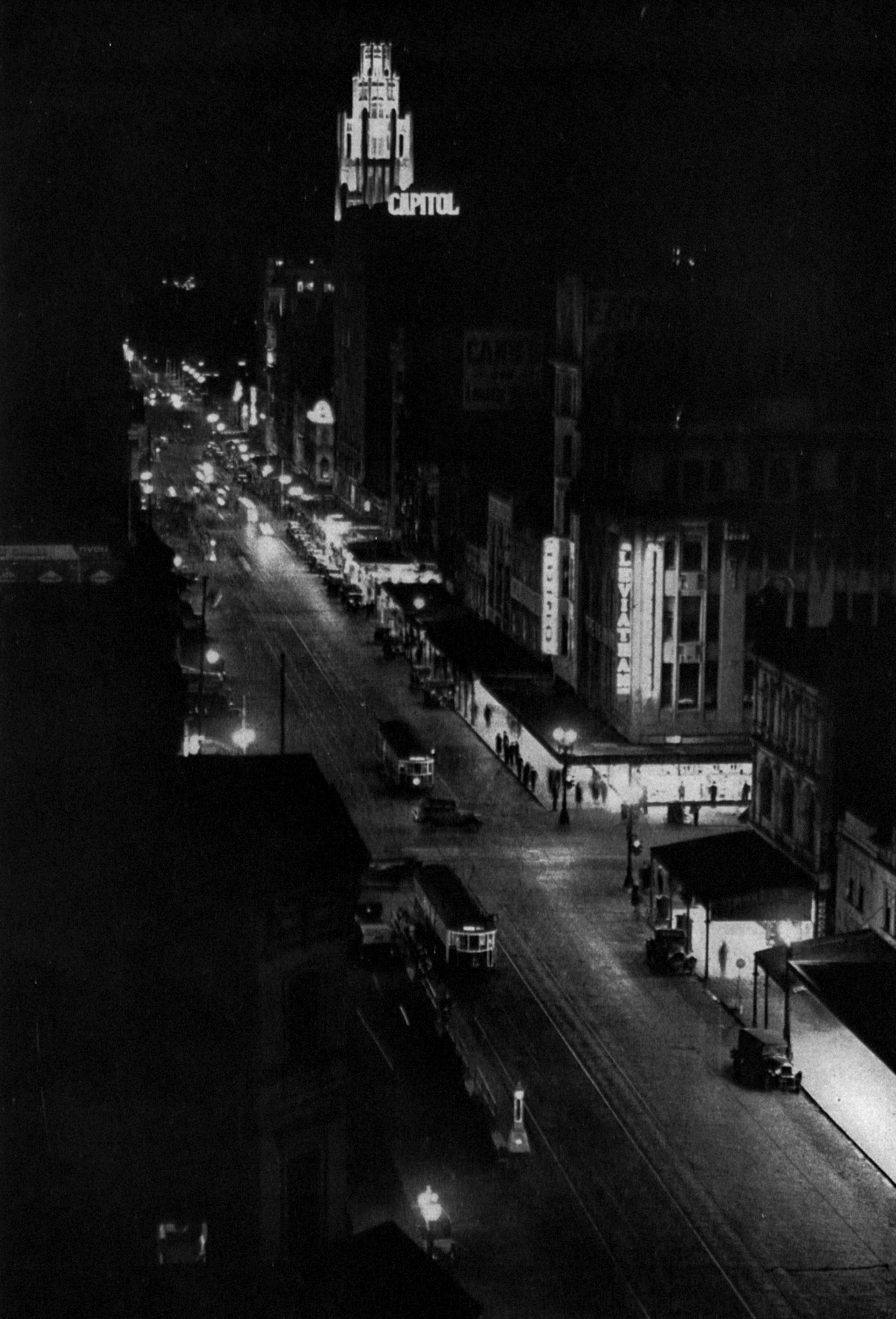
Burdett, from his memories of several visits and long stays in Europe, visiting great artists and rich galleries, and watching as Gertrude Stein met James Joyce in her flat, conjures a cosmopolitan Melbourne…
“Here is romance as potent as any legend of older centres-a far-flung city, more expansive in area than most of Europe’s capitals, risen in the wilderness in less than ten short decades. Below me is the shadow world of city roofs. Sudden, unlighted gables and pediments cut the expanse of a lighted wall or are silhouetted against the bright strip of a lighted street.
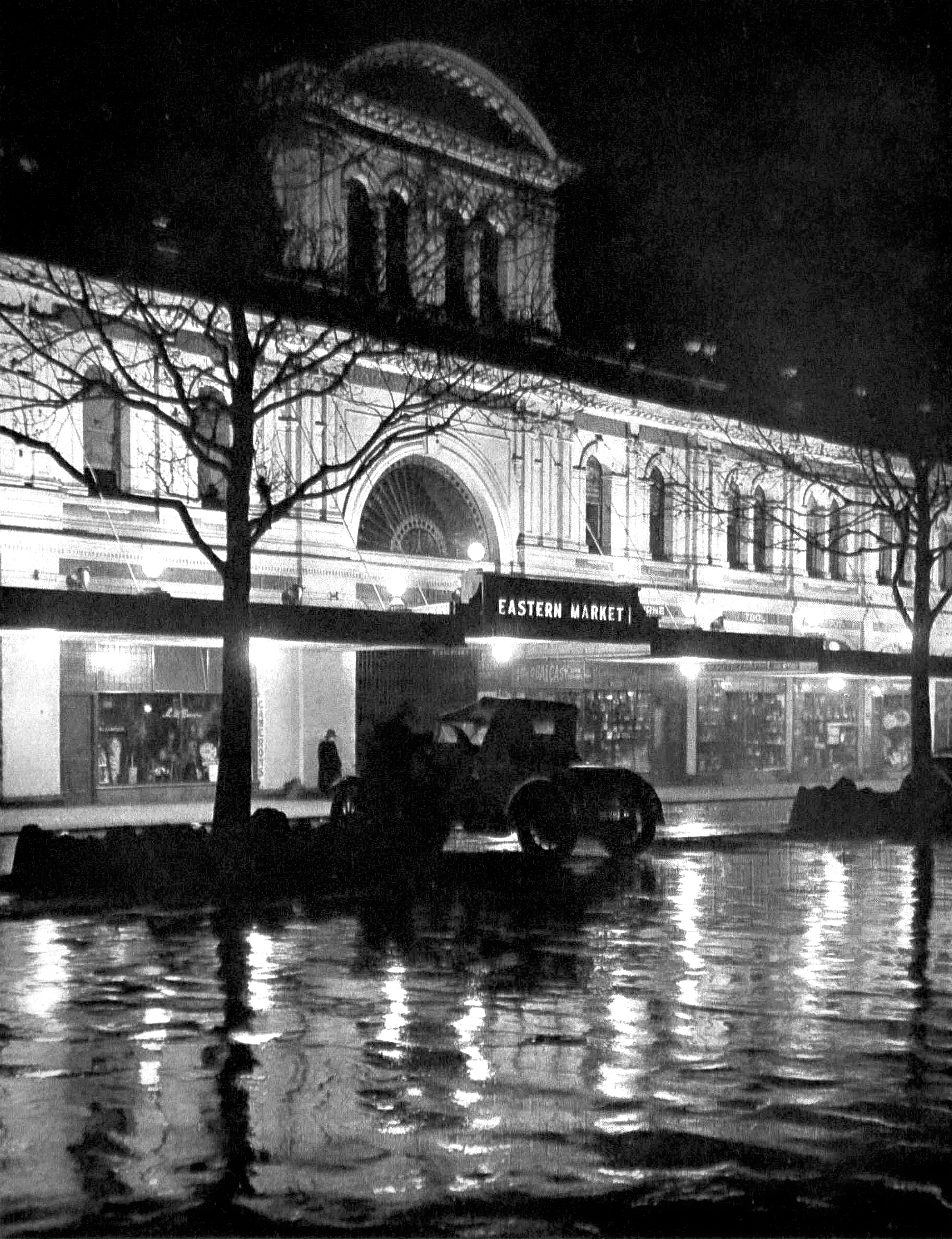
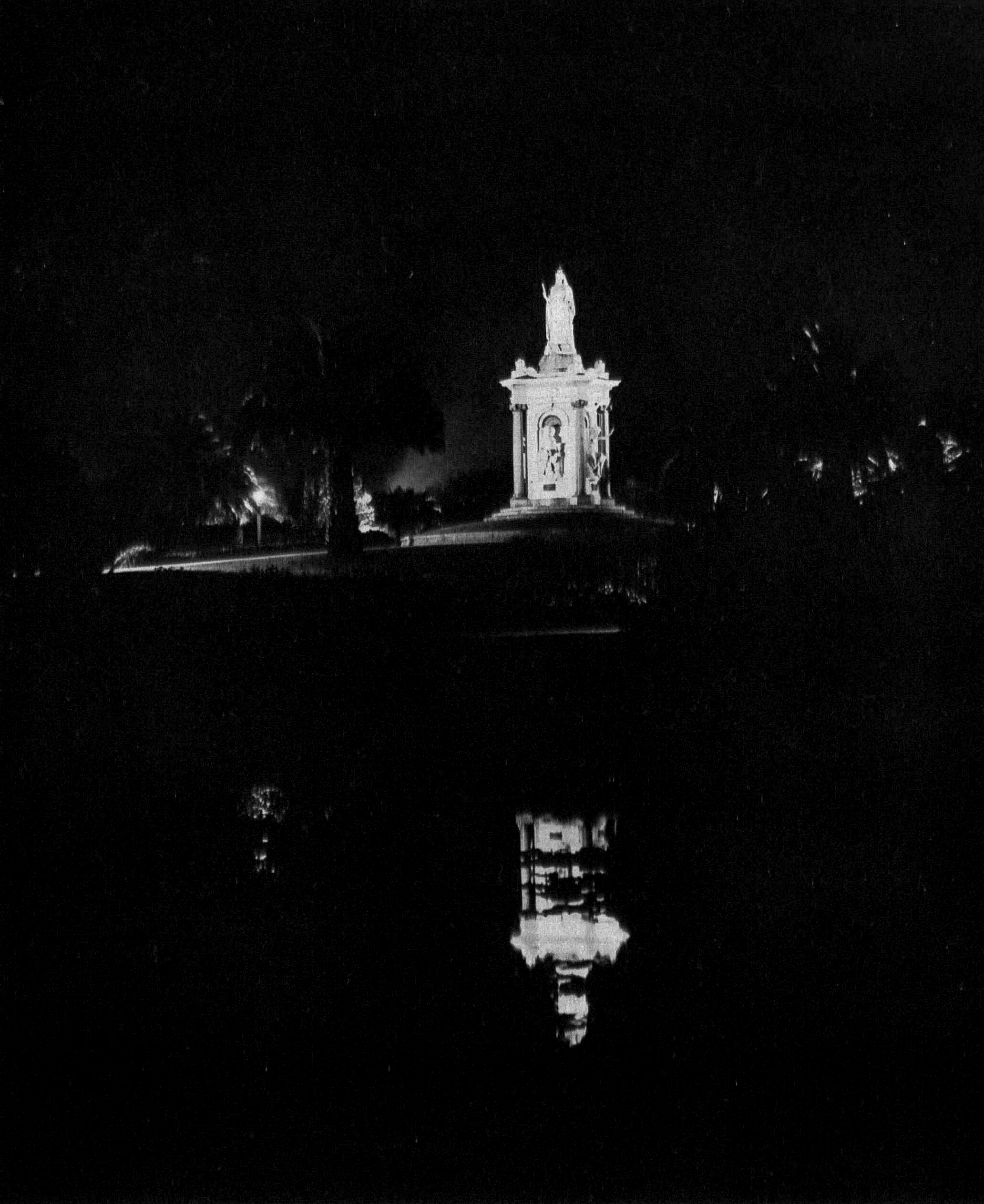
“”Sur les toits de Melbourne —a world where a whole community of beings moves and has its life among the stars and the strange medley of rooftop shapes and forms—the caretakers. A door opens in a roof cottage, emitting a stream of light and a man with a broom and a bucket. A cat steals swiftly to the safe oblivion of an unlit corner. A window opens, a blind is drawn, a light switched on. Someone whistles” Love is the only thing, the newest and the latest thing.” At eleven, when the theatres disgorge their patrons, the streets take life again. The tea and coffee shops have their brief hour. By eleven-thirty the second and more mysterious half of the city’s night begins. Suburbia has gone home. A few rather forlorn-looking remnants cling, like survivors from shipwreck, to the island platforms, waiting for the last trams.
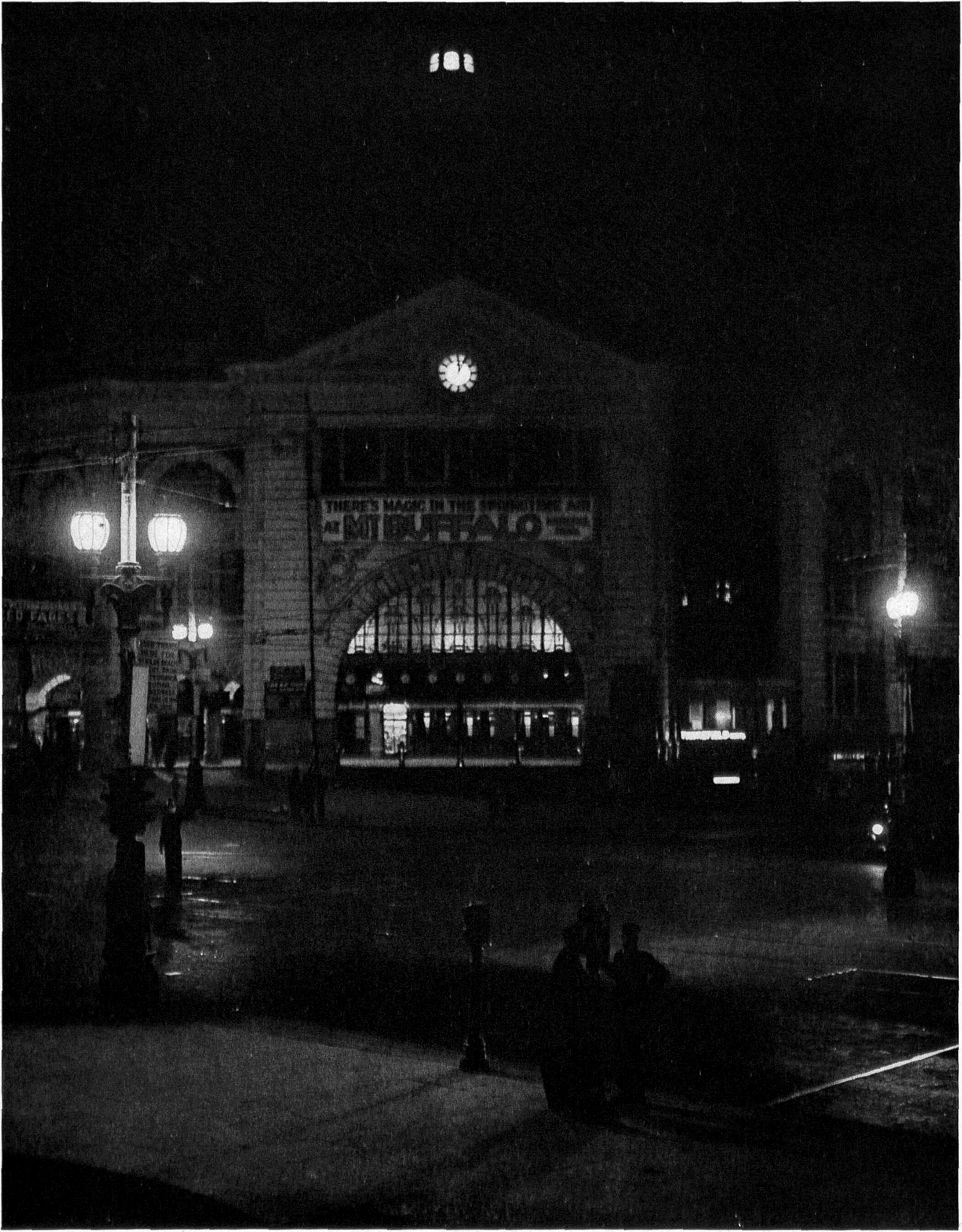
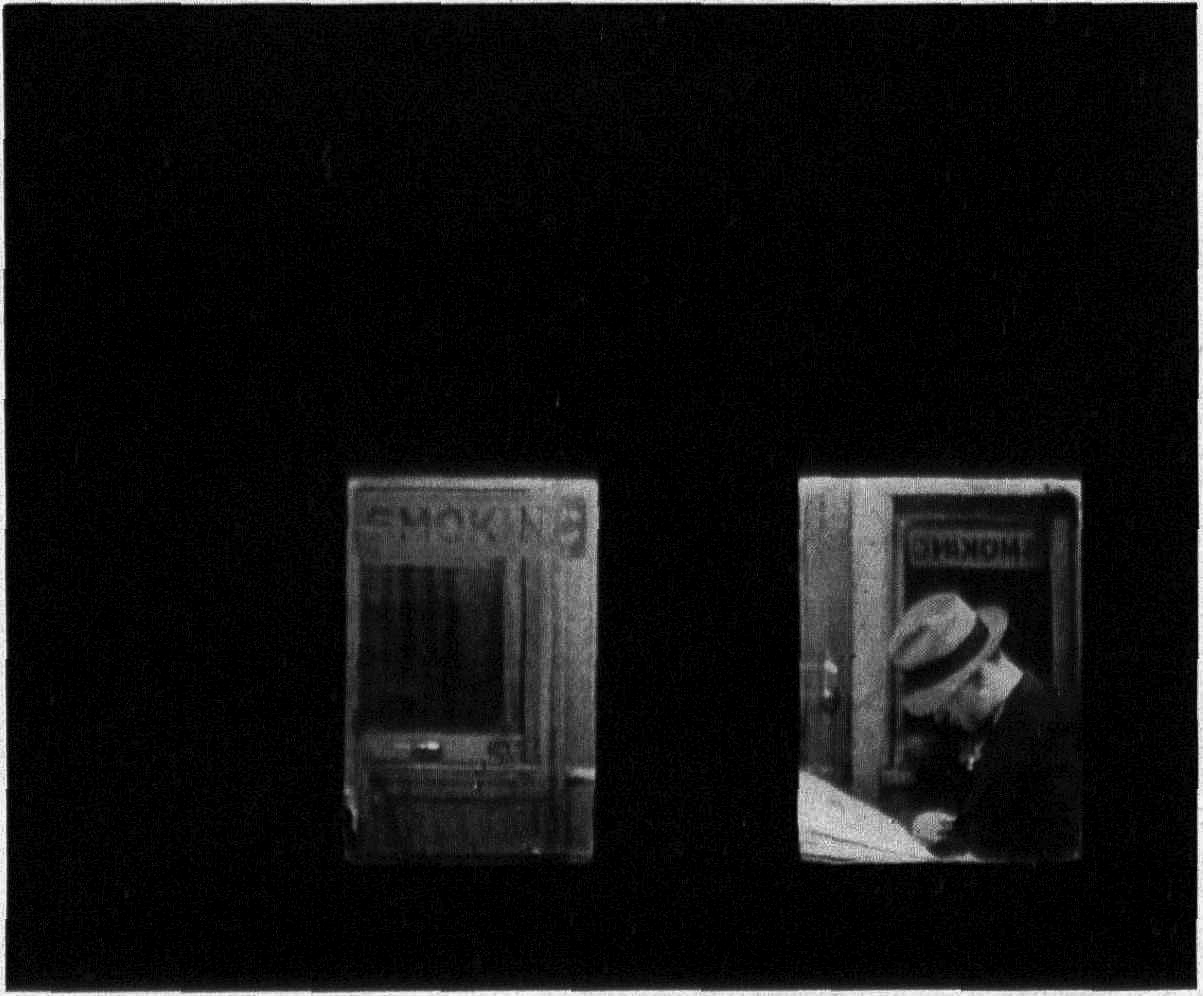
“The last tram has gone. A repair gang works beneath a cluster of electric globes swung from the overhead wires. A man, half-shrouded in darkness, stirs a cauldron of pitch. Tap, tap, go the woodblockers’ hammers. Their figures are silhouetted against the clustered lights. Peering over the railway viaduct, the gleaming rails, silent now, stretch sinuously into a complex and convergent infinity. A train comes slowly, puffing generous clouds, its open trucks laden with mallee roots and sand. In front of the station porters are sweeping the asphalt. A few strays who have missed the last trains are enquiring anxiously for taxibuses. Silence over the city, the rooftops in darkness. Shops which have blared “Say it with Music” and the latest market reports at an innocent populace all day, are slumbering with the rest—the just with the unjust. A coffee shop in Collins Street resplendent, with a brand-new red Neon sign cheers the nocturnal rambler with coffee and biscuits, to the accompaniment of schoolboy pranks from a party of youths and girls.
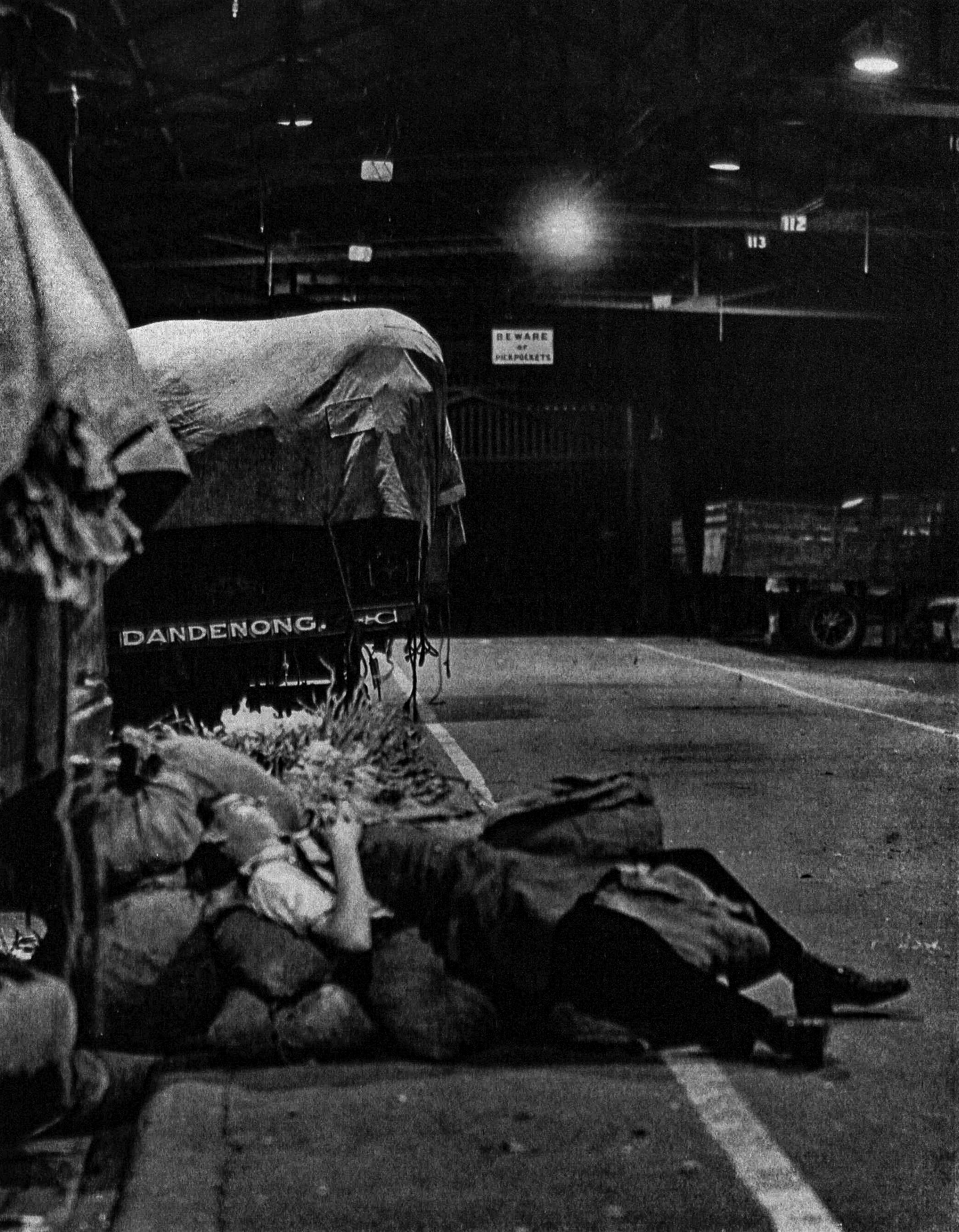
Soon after two the first market cart passes along Elizabeth Street, bringing the odour of fields and market gardens with its cabbages and cauliflowers— earthy incense offered at the Neon-lighted shrines of a voracious Metropolis. The first milk vans arrive an hour later. At three the last dance hall closes. A late bus passes. Men, in twos and threes, still lounge about the doorways of the corner of Flinders and Swanston Streets, sustained by the savoury odours of the pie stalls. At five Pop begins to pack up and make tracks.
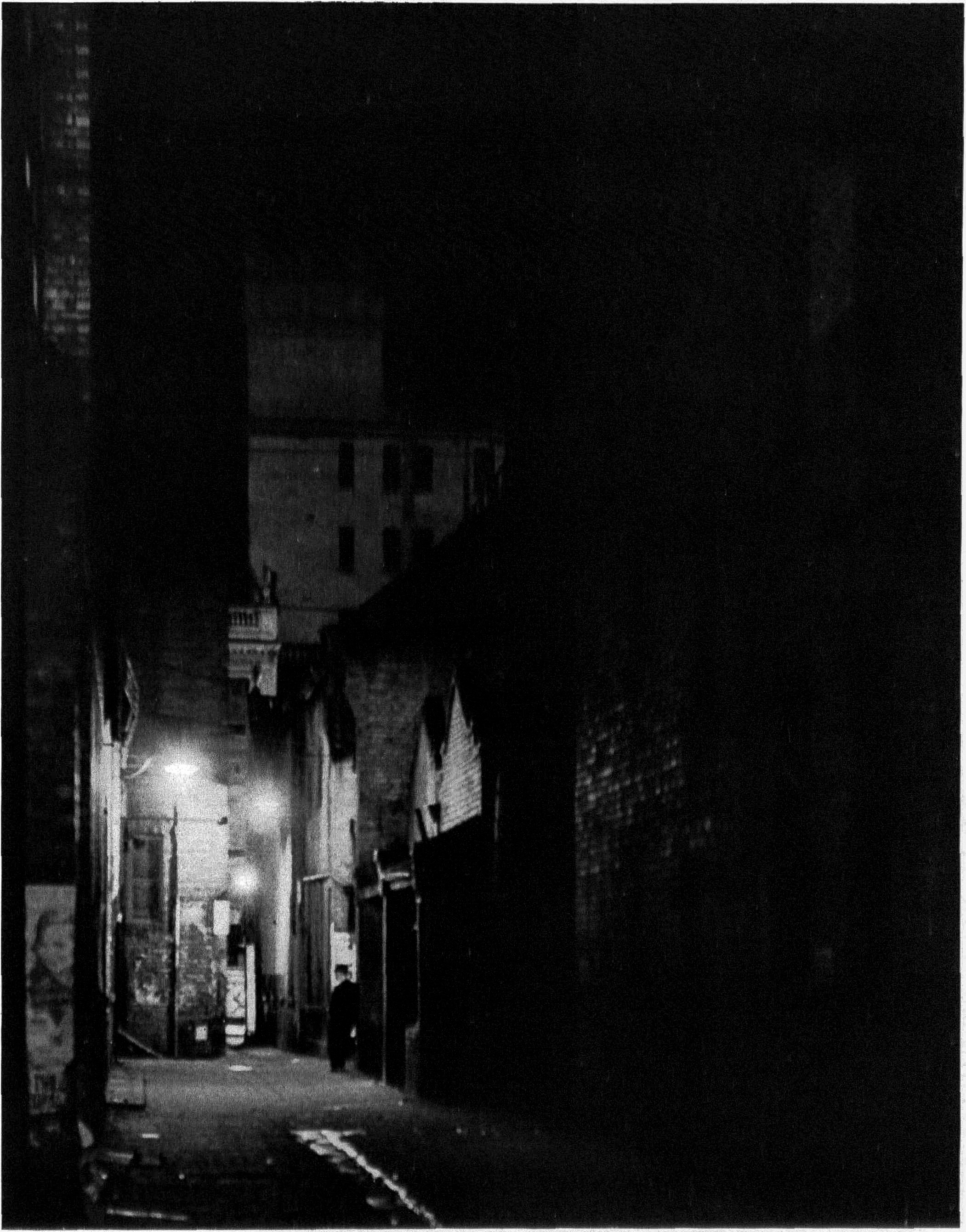
“I decide to call it a night. Walking up Collins Street to Spring Street the world is refreshingly, strangely silent. The hotels, the Melbourne Club are dark. Silence beneath the elm trees and the planes. Only my footsteps’ hollow echo. An odd taxi here and there, nocturnal, mysterious, with a slumbering driver somewhere in its dark depths. As I turn in, the twittering of starlings in the trees beneath my window seems to announce the coming of day and the vanquishing of night and mystery.
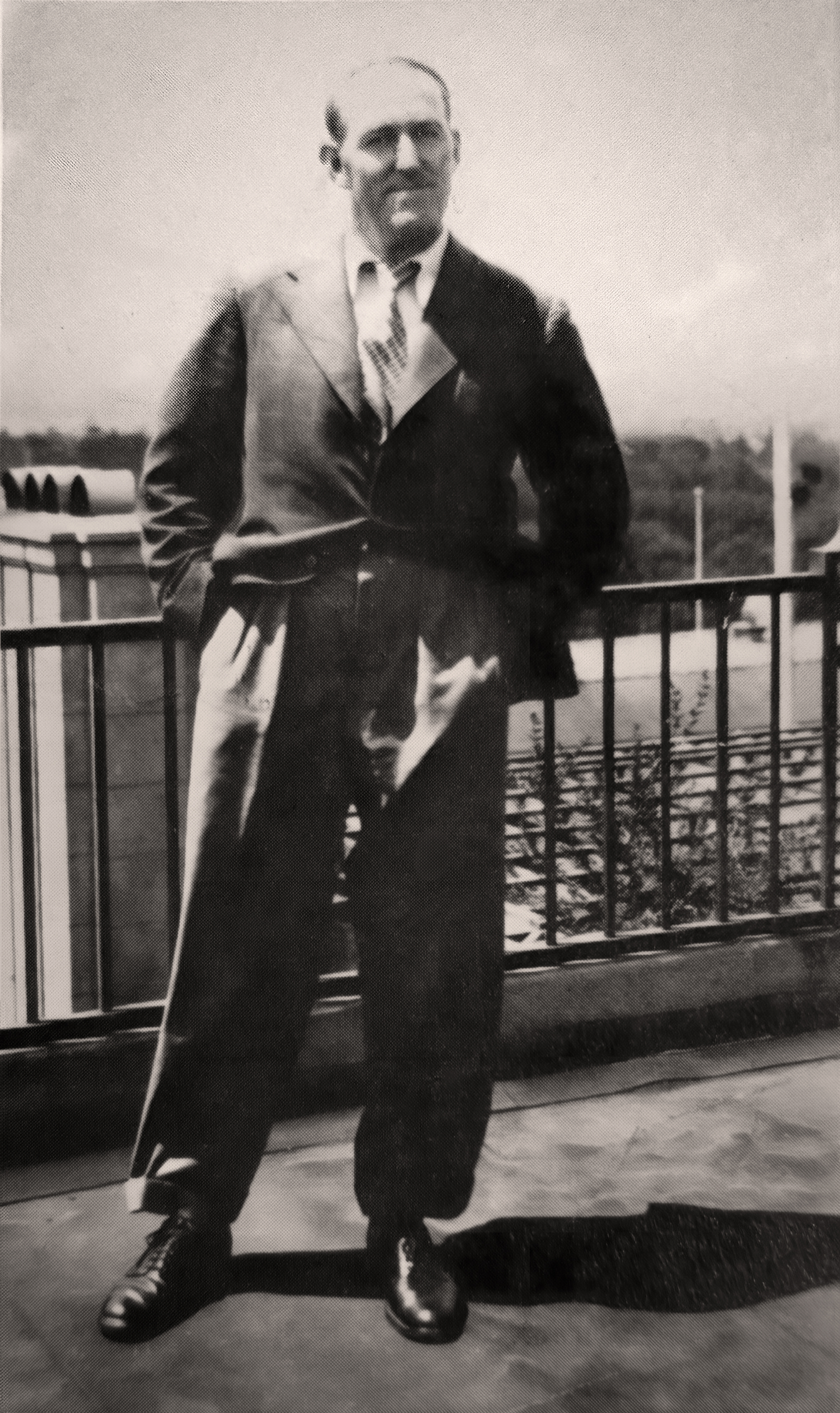
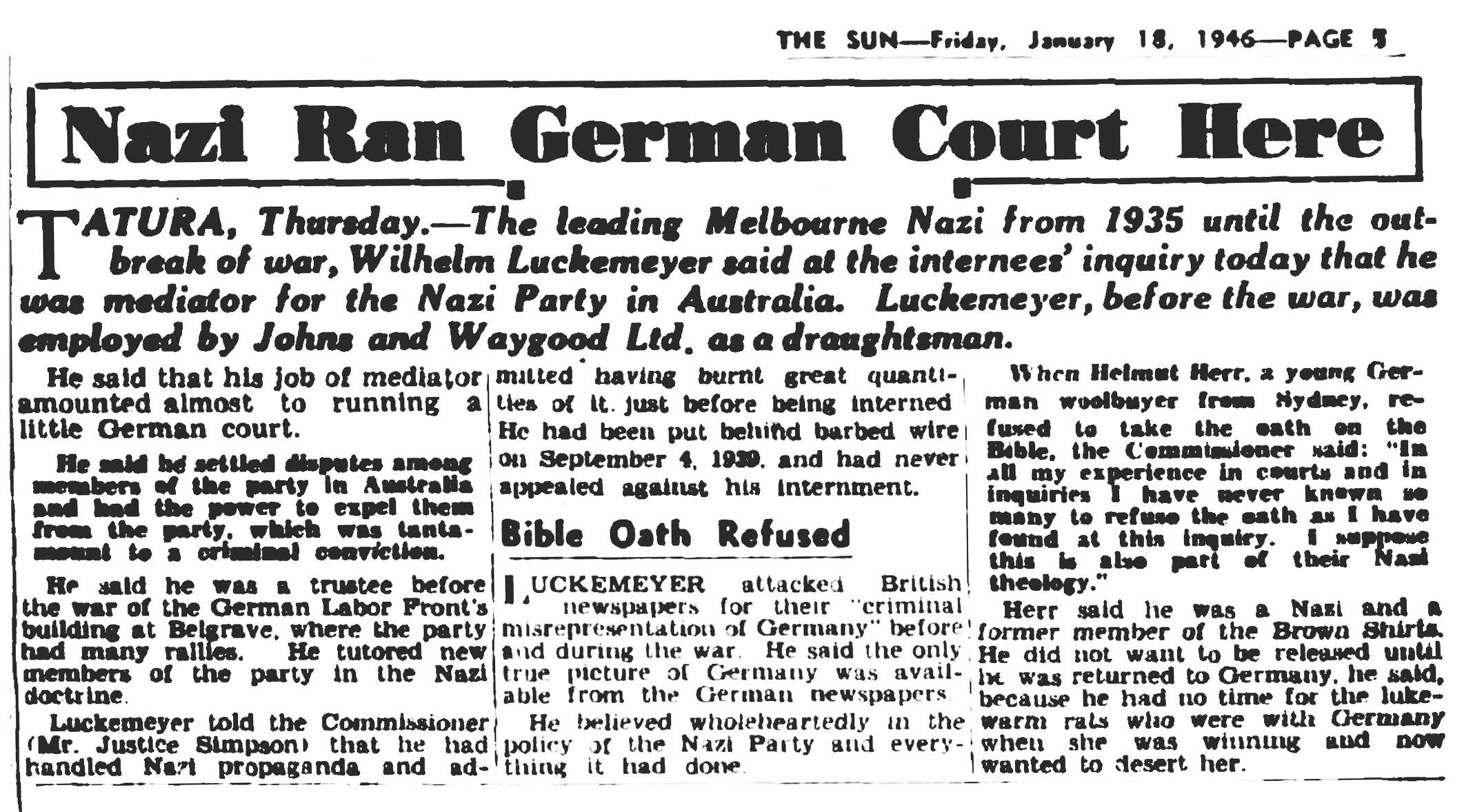
The Second World War proved fatal for writer Burdett, and disastrous for photographer Lucke-Meyer who, after producing this book, lived not far from Burdett in Hotham Street, East Melbourne and supplied images to German publications and the trade journal on modern design and architecture, The Modern Store an ambitious well illustrated new quarterly trade journal. While employed in 1939 by Johns and Waygood in South Melbourne, he was incarcerated as an enemy alien for the duration of the war, then held until 1947. When repatriated at his own request, he hoped to join his sister Julia in Germany, but learned that none of his family had survived. Returning to Australia he sought to remain with support from Johns and Waygood. However, for his undesirable political agitation, Lucke-Meyer was deported on the General Heintzelman on 24 November 1947 to Germany, his career in ruins.


 On This Date in Photography: by James Mcardle

Very interesting James … and sad.
Do we know what happened to W.L. Lucke-Meyer after he returned to Germany. i can find now date of death or other information.
Thank you so much Marcus
LikeLike
Lucke-Meyer was deported basically because of his German political affiliations that officials discovered
LikeLike
Thank you Gael, your writing on Lucke-Meyer at https://www.photo-web.com.au/melbournebynight/default.htm has been very helpful with information on this undeservedly obscure photographer. Is there any trace of him from his later life back in Germany?
LikeLike