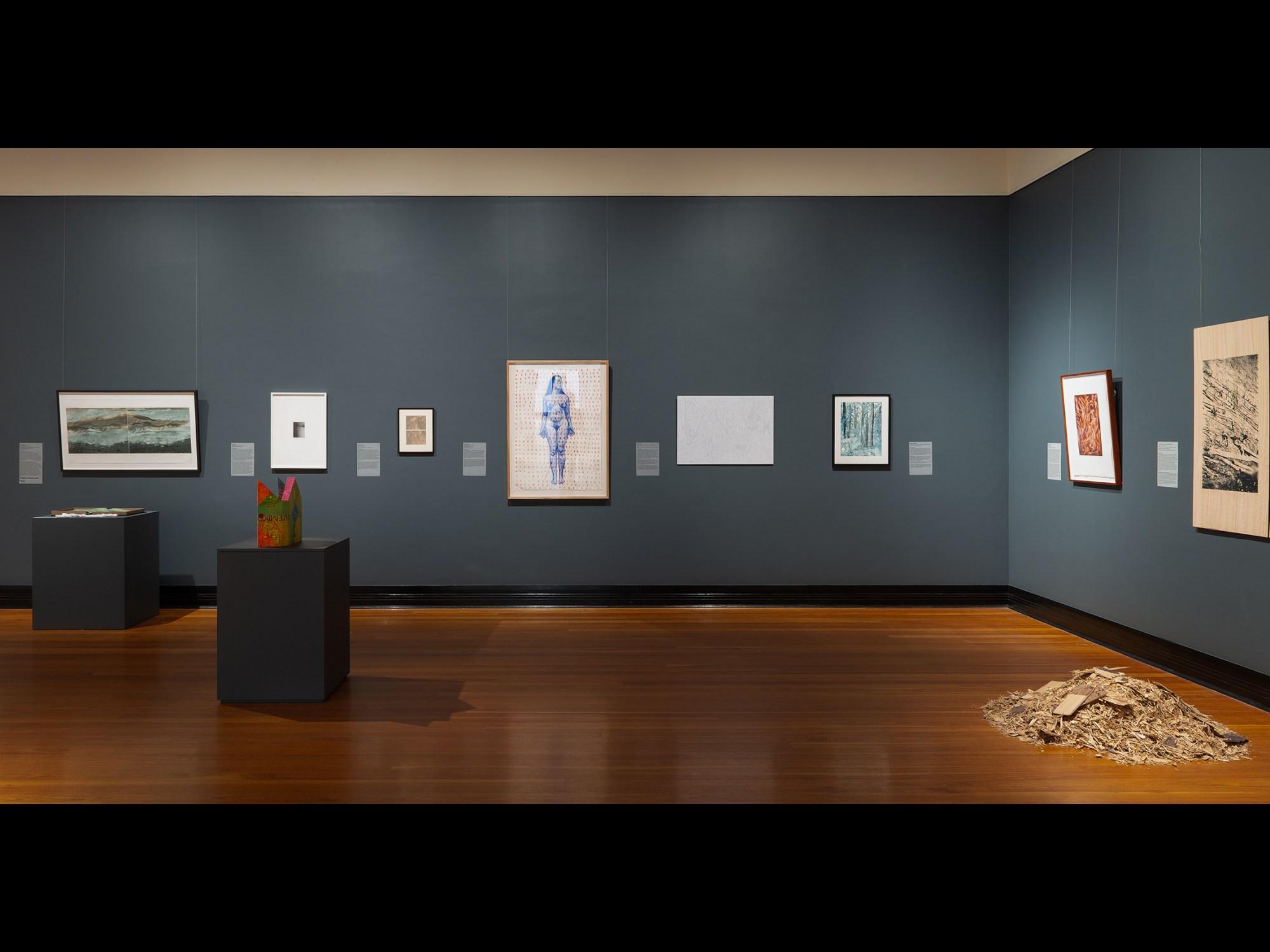
 Once again the Castlemaine Art Museum, home to fine Australian printmaking from three centuries, hosts the biennial, and unique, Experimental Print Prize. Winners have been announced from a pool of 44 finalists and this year, for the first time, the gallery acquires the winning work. Michael Rigg was the inaugural supporter of the prize over its first years, but other benefactors now donate the awards, so that Rigg himself has able to join the finalists in 2025.
Judges were Sally Foster, Curator, Prints &
Drawings at the University of Melbourne, who has held similar positions at National Gallery of Australia, the Art Gallery of South Australia, and at QAGOMA, with Melissa Proposch, a local gallerist, master printer, lecturer in printmaking and drawing at RMIT, and co-founder of Castlemaine Press, well-known for her support of other artists and art journalism.
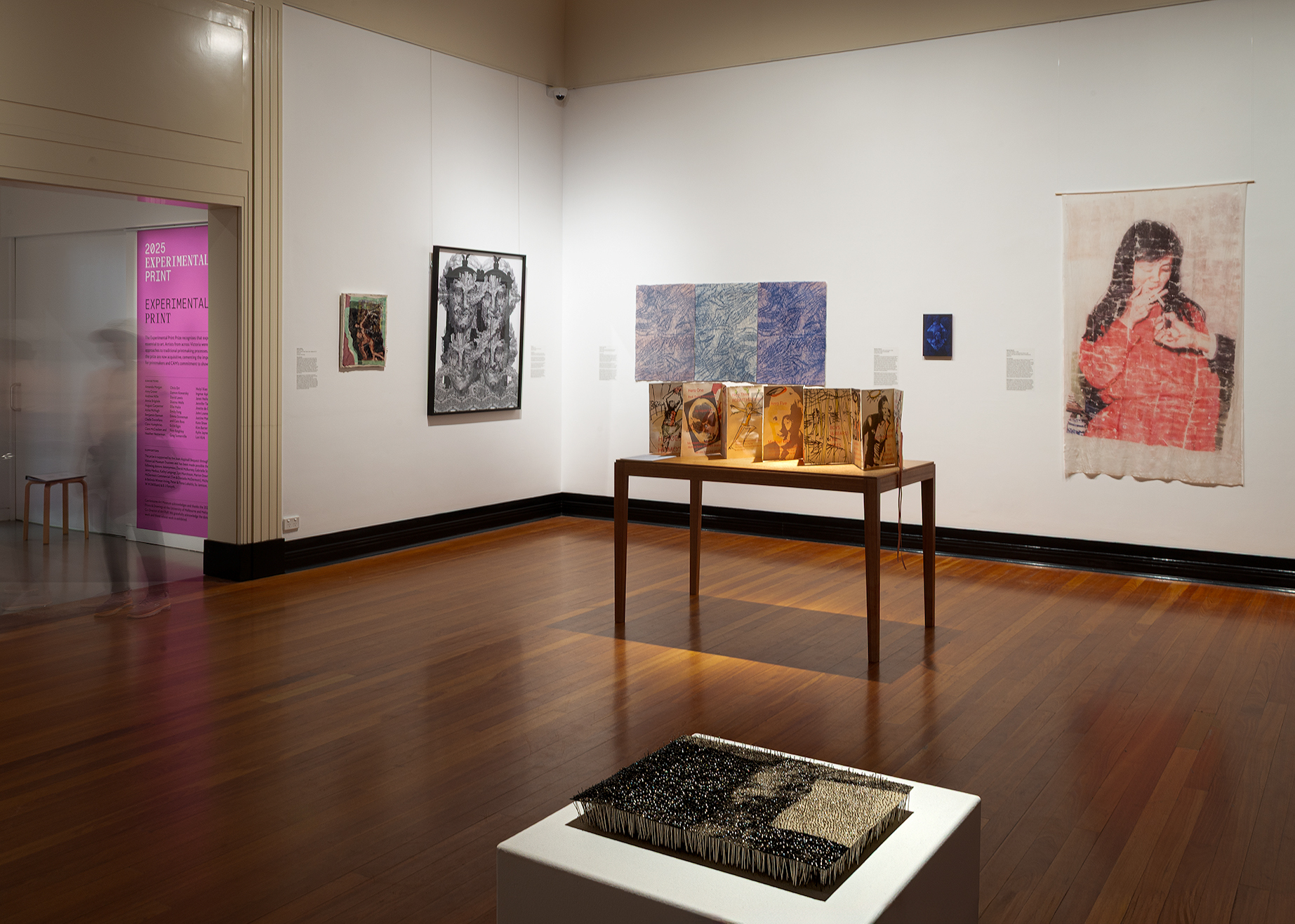
The $10,000 Acquisitive Prize, The pressure here is immense was won by August Carpenter who embraced the nature of this award with a radical sculptural interruption of her otherwise planar, landscape-derived abstract mono-print in chine-collé on Arches paper; she spiked it through all over with thousands of dress-makers pins, the densely-packed heads of which glitter jewel-like under the spots, under which the print is still perfectly visible, while the points of the pins dance menacingly on the plinth.
The two other winners are more relevant here in that they used photography.
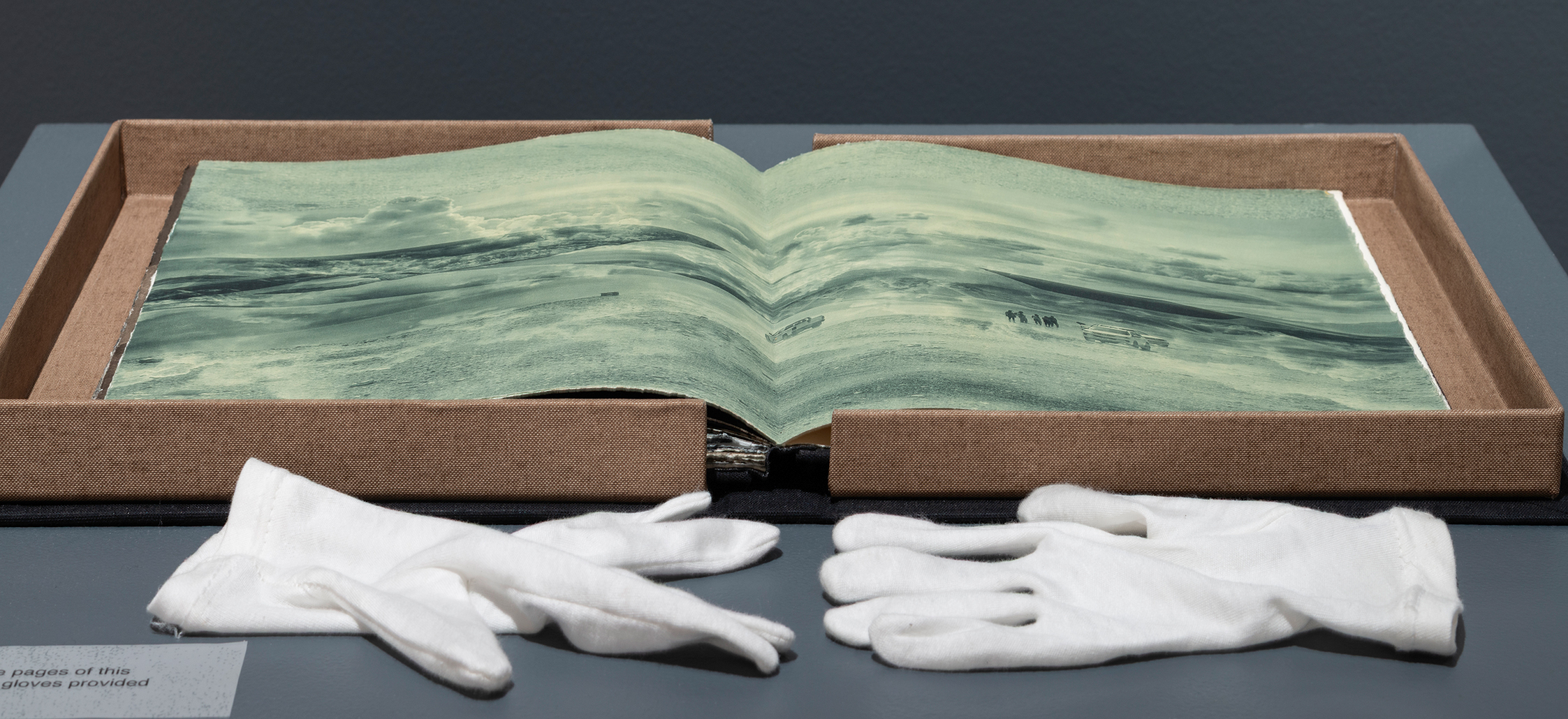
Silvi Glattauer‘s work, which won the $5,000 Highly Commended Prize, is already familiar if you have read the recent post here on her show earlier this year at PG Gallery. The framed image is exhibited with her exquisite artist’s book made with prints from the whole series of polymer-plate photogravures.

Glattauer’s original photographs for Dissolving Landmarks were made in the remote and arid Puna de Atacama that spans her native Argentina and neighbouring Chile. During the latest of her tours there to conduct group workshops, she challenged herself to make multiple exposures, turning the camera upside-down or sideways to produce disorienting imagery to match the experience of this otherworldly environment—here the clouds appear under the mountains, superimposed on the gravel of the road. Visitors to the exhibition may don white gloves to leaf through the pages of the book Silvi bound herself, in a box of her own making.
Local artist Emily Fong, who won the $3,000 Emerging Artist Award, entered a complex and interactive multi-media work incorporating 3D printing and manual sculpture, printed in a box printed from a drypoint gravure made on a Tetra-Pak plate (an unfolded milk carton), accompanied by a reel of her photographs of the Dog Rocks boulders on an iPad playing a sound-track of human breathing, and also a block of found sandstone. The temporal skull bone is 3D printed and surmounted by the moulded ear. Visitors may pick up the sculpture to find behind the bone a USBC connector which plugs into a corresponding socket on the stone. That bizarre linking, against the background of breathing sounds, prompts meditations on consciousness, and the relationship of the human with landscape to which our bodies one day must return, as bone turned to stone.


The ingenuity displayed by the printmaker finalists in their use of our medium—photography in its broadest sense— is inspiring to view. Here is a walk-through of some of note.
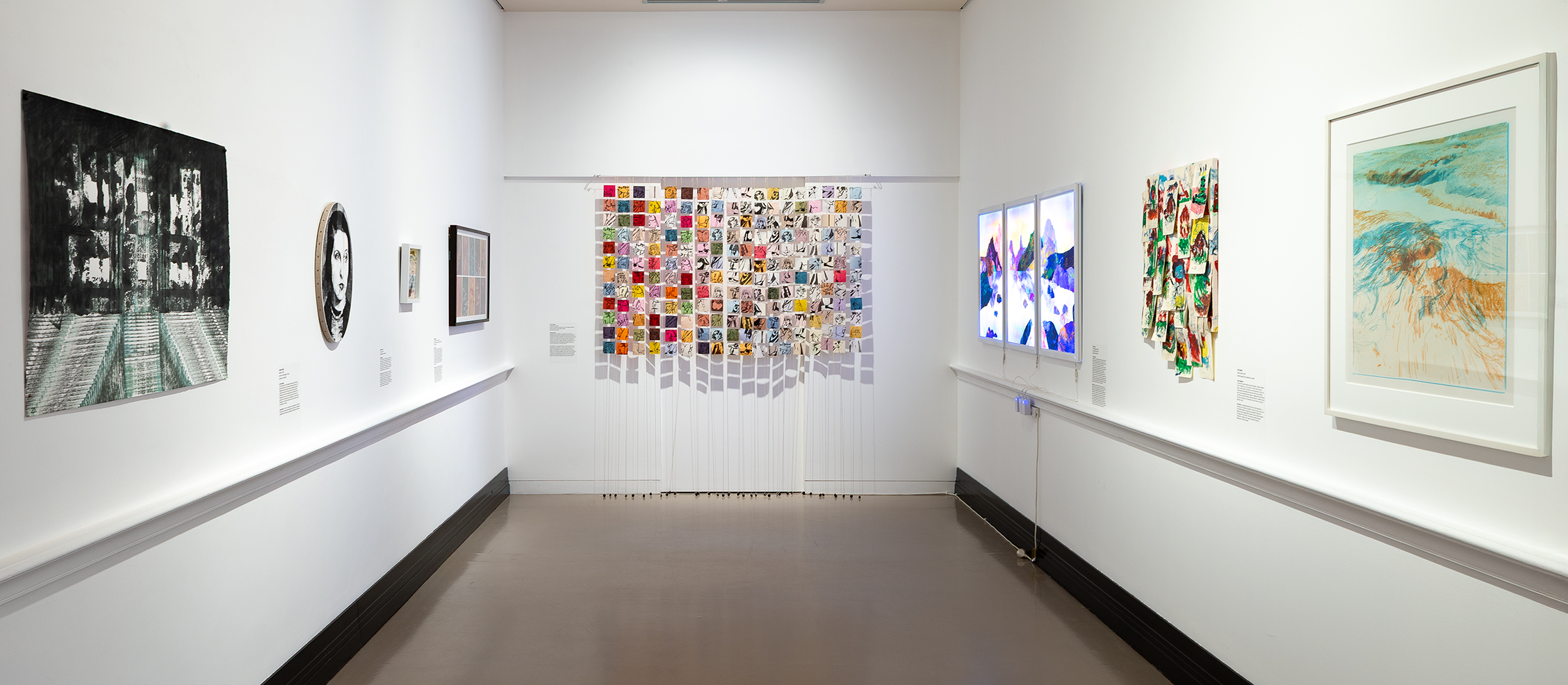
In the small annex, the Benefactors’ Gallery off the main space, are found a variety of formats and media including a rear-lit lenticular-screen triptych landscape, small unframed prints suspended in a grid, and others collaged directly to the wall, amongst more conventionally framed works.
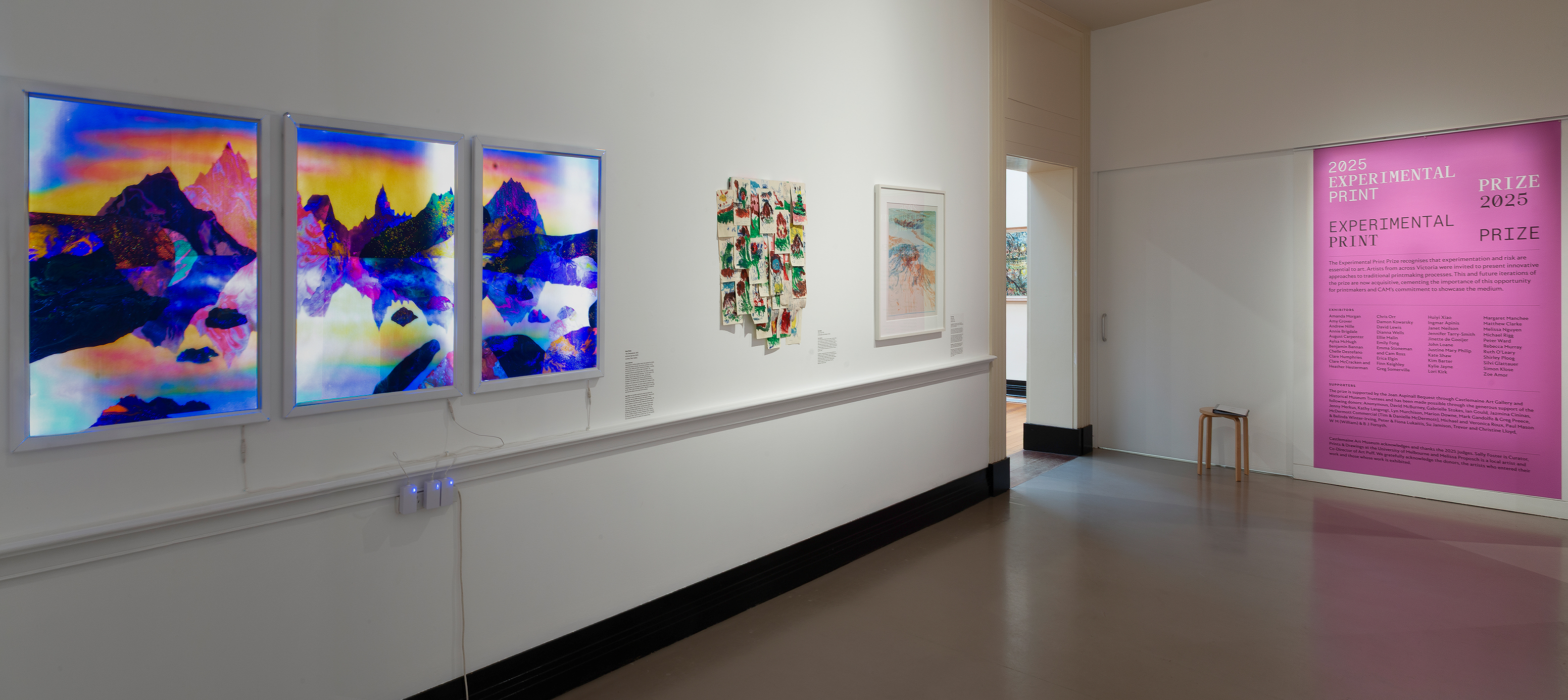
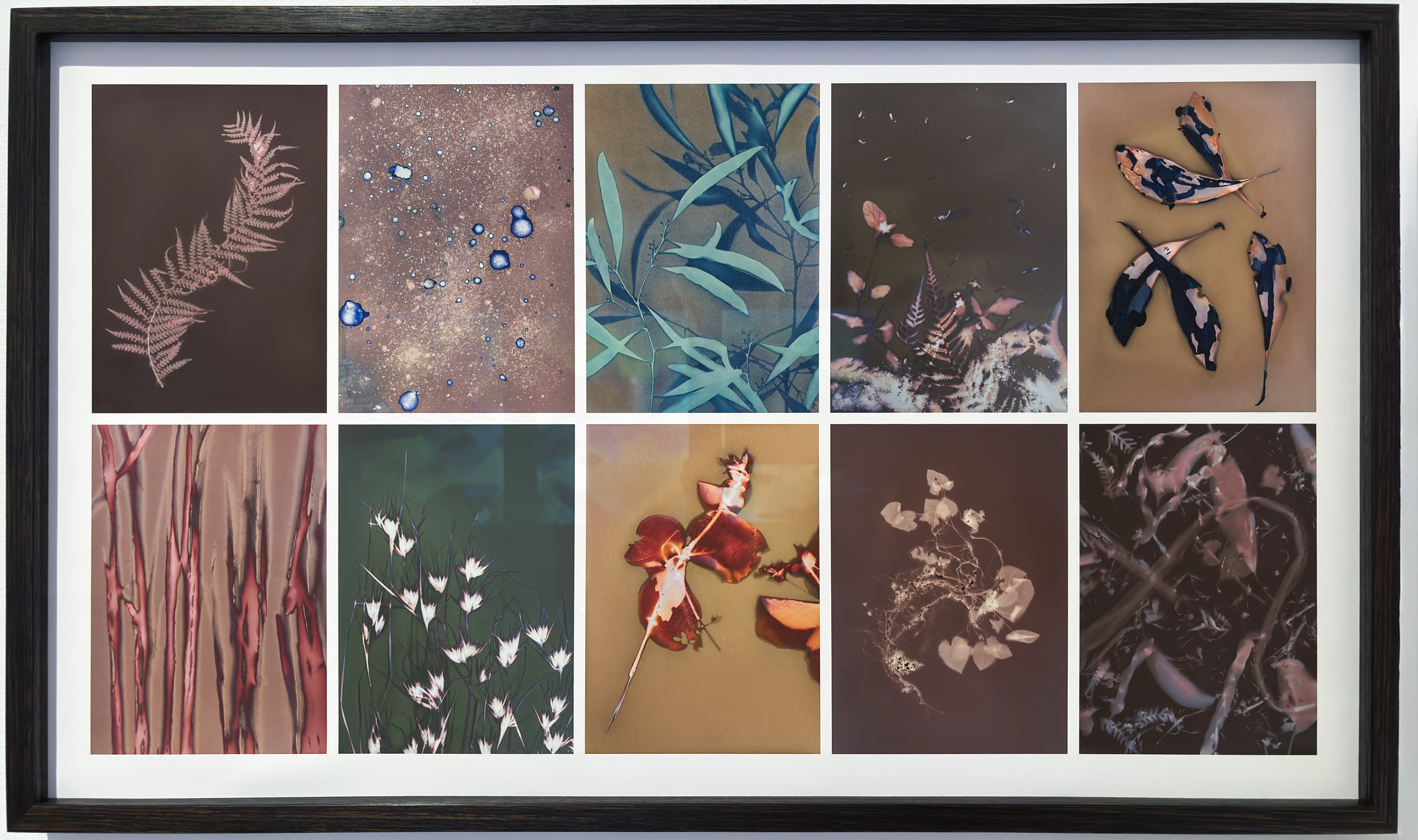
Among them are two photo-based entries, one being a symmetrical array of richly-hued lumen prints—or copies of them, because, as the artist Rebecca Murray explains in the accompanying wall notes: “the original prints continue to be light sensitive” so must be reproduced or they would not survive being spotlit over the duration of the exhibition, which continues for four months until 1 March.
The lumen print’s ephemeral nature of course might have presented a radical strategy in the context of the Prize had the originals been presented and allowed to fade during the course of the show, because Murray’s approach is otherwise deliberately non-interventionist. Contact-printing on-site with sunlight on expired photographic papers from “tiny specimens … collected from my garden and the surrounding forest with care, soil; indigenous and introduced plants, termites (deceased after taking flight), bark from mountain ash trees (fallen in wild wind storms), new growth, roots, raindrops…”, Rebecca works on the ground beneath the tall dense stands of temperate rainforest trees of Corhanwarrabul (the Dandenong Ranges). There, poignantly,
“signs of life, death, deterioration and regeneration are everywhere. Easily seen in decaying leaves, new growth and fallen trees. Sensed too, through birdsong, sunshine and smells of eucalyptus and damp earth. Deep in the soil a complex world of decomposition, recycling and transformation lies largely unnoticed. Ever more discernible in the forests of Australia are the cumulative effects of colonisation, industrialisation and a warming planet, impacting the undergrowth and all species that depend on it.”
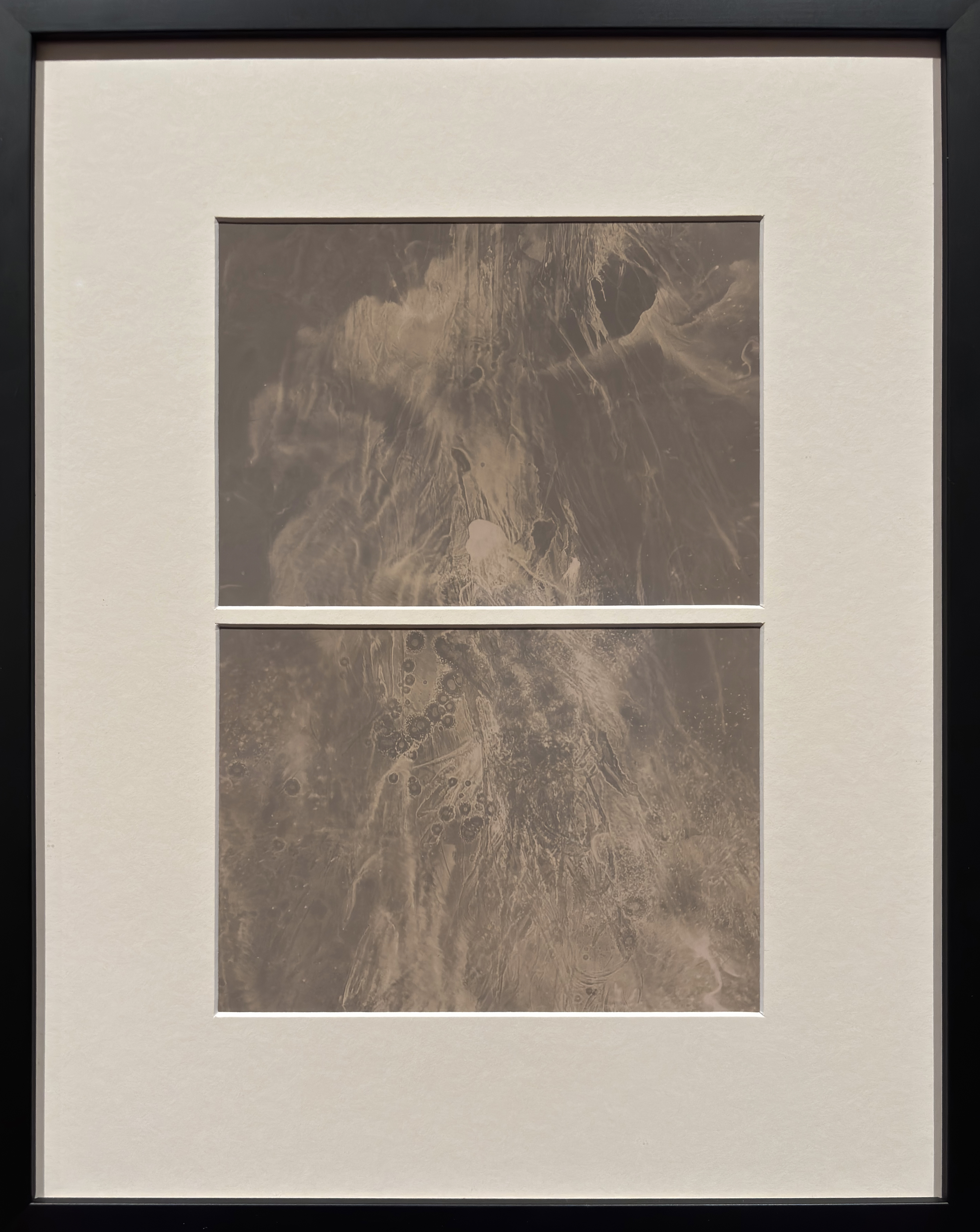
Likewise, Shirley Ploog, a Victorian regional artist from Barwon Heads, produces her works in a collaboration with the natural world in a harsher environment— the salt lakes of South Australia. Through the Artist in Residence program at Ballara Art Retreat on the Yorke Peninsula she made her monochrome lumen prints on silver gelatin photographic paper, producing results more austere than Rebecca Murray’s imagery. Ploog’s natural materials are limited to “salt, lake water, light and found organic matter–to create lumen prints that hold traces of climate, time and chance.” Indeed, there is a flow, both violent and slow, between the two images, of tide, wind and growth, such that the diptych prints appear to be cut from one larger, but for subtle, perhaps temporal, differences. Ploog says “I walk, observe, then imagine,“ surrendering control to the chance rhythms of nature in a ‘dialogue’ of intentional positioning of the found materials with transparencies of her paintings on the paper, and the environmental conditions that affect exposure:
light and time complete the image. The resulting diptych is a co-creation with nature—a record of fleeting interaction that echoes the fragility and resilience of the landscape itself.”
How might Ploog have achieved the preservation of the inherently unstable lumen print without making copies or scanning them? To fix lumen prints requires experiment and trial and error, which is all part of a process using recipes that some practitioners guard jealously.
Science-based environmental concerns are given experimental artistic expression in Bendigo-based Justine Philip‘s Te Wähipounamu, from her exhibition Museum of Monoculture over 8–21 October this year at Dudley House in Bendigo. Having studied photography at RMIT (as did Rebecca Murray), and graduating in 2009, then in 2016 completing a PhD in Ecosystem management at University of New England, Justine understands the close relationship of science and art that existed until the early 2000s, as exemplified in the Bendigo School of Mines, which from its founding in 1883 taught both, since drafting and illustration skills were then essential to industry. In the 2oth century, as the two disciplines separated across the education system, Bendigo’s graduates were mainly artists such as painters Inez Abbott, Madge Freeman, Agnes Goodsir, Dorothy Leviny, and printmaker, illustrator, muralist and stained-glass artist Christian Waller (who was born in Castlemaine).
Justine notes furthermore that:
“since the late 1940s, the hyper-productivity of our modern food and fibre production system has moved far from the public gaze. The scale of operations, simplification of biological systems, and the chemical changes to waterways and soils has been extreme.”

The work depicts a helicopter dropping pesticide from a hopper over the spectacular, much-photographed Te Wähipounamu UNESCO World Heritage area on the west coast of NZ’s South Island. On the North Island, in the farming district Matamata, Justine was born, the year after Rachel Carson published Silent Spring. She explains,
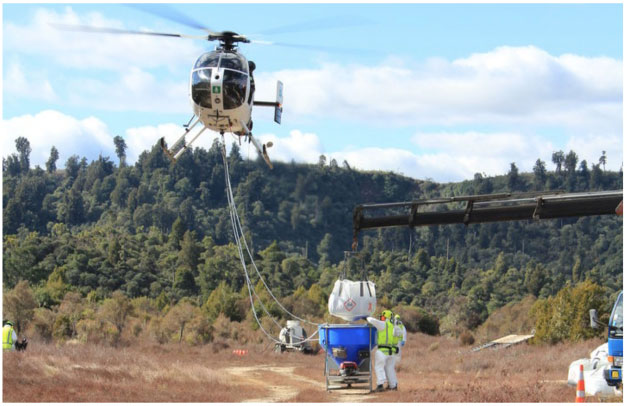
“in the alpine mountains and high-country, sheep farms have been regularly showered with broad-spectrum pesticides for 70 years, over which time native birdlife has gone from profuse to endangered. The background detail is from an 1888 intaglio etching of Mt Aspiring [Tititea] The helicopter is attached to a large bucket of cereal baits, dispensing the pesticide-an A1 hazardous substance-over the remote alpine region.”
Philip’s Human-animal studies at Melbourne University 2010-2013 and her several writings on the poison baiting of dingos, and in particular her 2021 “When Conservation Turns Violent: Examining New Zealand’s Use of Toxins in Defense of the Environment” in the journal Environmental History (from which the helicopter image is drawn) inform the work. New Zealand and Australia, she writes, are the sole countries worldwide to permit aerial baiting of wildlife: “There is so much support for their use that it is difficult to publish anything about the dangers of this technology.”
An Honorary Research Fellow with the University of Birmingham, UK. Justine is building a visual archive, the ‘Museum of Monoculture’, a body of images of modern agricultural technologies exposed through photomontage, using printmaking in the manner of “traditions of protest posters, and the posters of the 1920s British Empire Marketing Board” and incorporating archival material interposed with her own contemporary digital photographic records. Her screen-prints convey the impact that chemical technologies have had on animals and the environment. She makes four-colour bitmapped separations in Photoshop, each a layer printed onto large sheets of thin (65gsm) paper and exposed in the darkroom onto photographic emulsion coated on screens through which were squeegeed a mix of pearlescent inks and Daley Rowney Systems 3 acrylics.
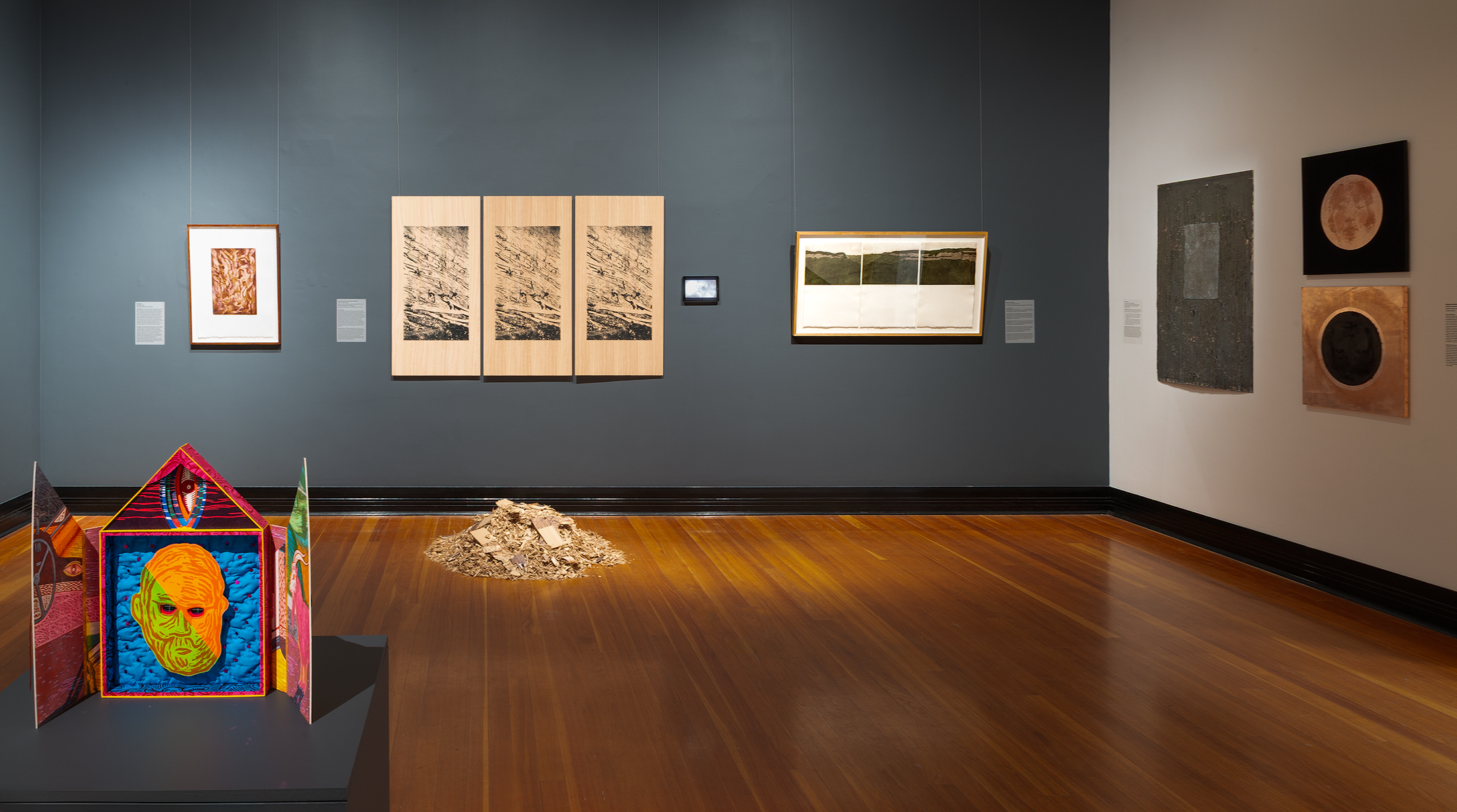
An confronting approach to exposing threats to our environmental is Ground Truthing, by the duo mixed-media artist and writer Clare McCracken and interdisciplinary artist/educator/researcher Heather Hesterman, which is accompanied with a video by Violet Sykes-Hesterman recording their performative action which makes this one of the most radical experiments in the exhibition: they sawed an edition of their digital print on eucalyptus composite plywood into strips that were fed into a wood-chipper!
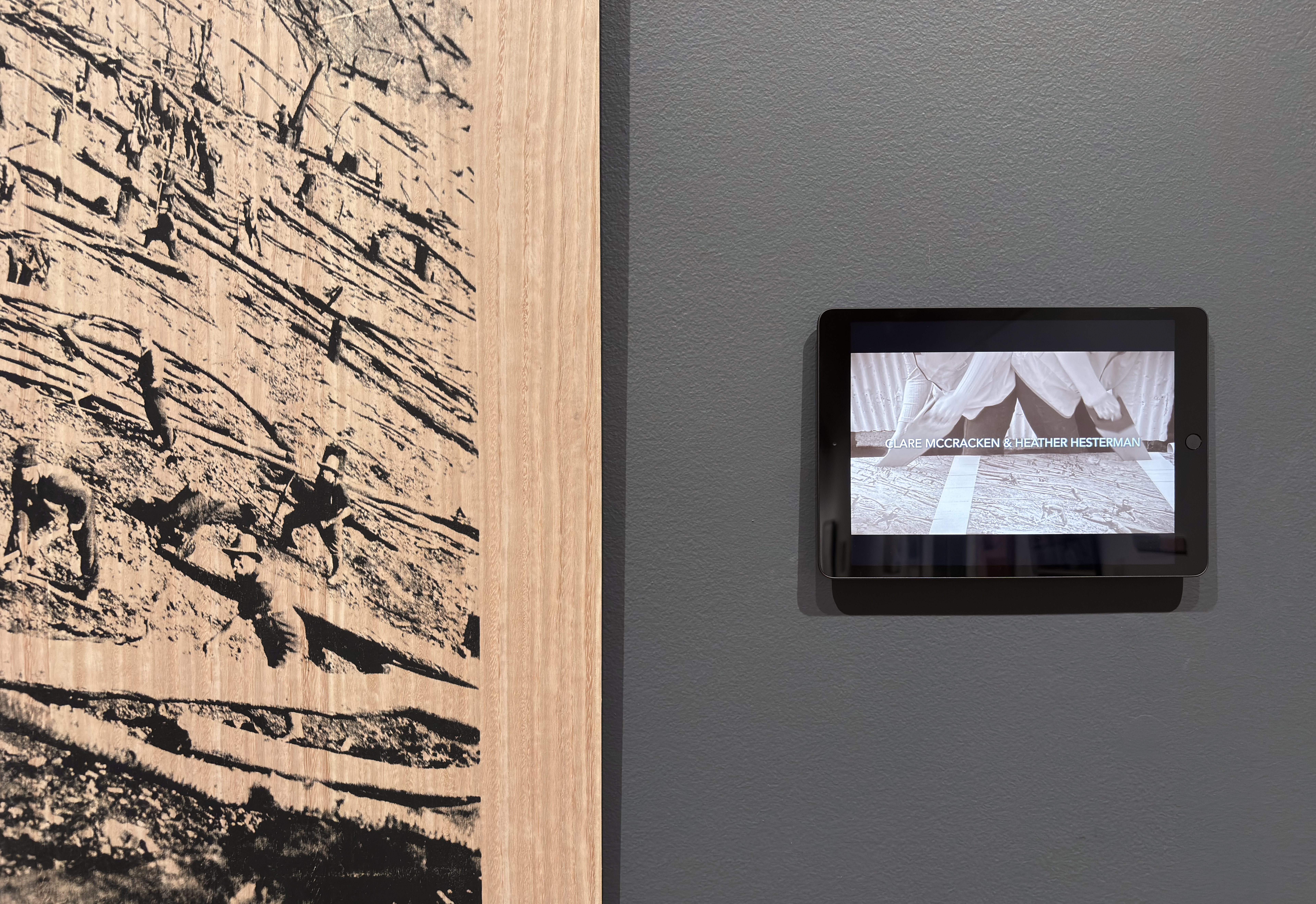
The detritus from their action is a pile of splinters mounded on the floor beneath the triptych of almost identical images depicting “susso workers” of the 1930s Great Depression clearing native vegetation beside the Ovens River for their government ‘sustenance payment’. Ironically the vast tracts were planted out with radiata pine. The photo of Braithwaites Pine Plantation (located beside the River) is printed onto plywood made in the local mill from the region’s plantations. The imagery and the action make visible the ongoing extraction of resources of the River and its watershed which include freshwater harvesting for bottled water and deep deposit gold mining recently established in the region against vocal local protests. The partners will repeat their destructive performance 30 times over the next few years, a frequency that equals the radiata pine harvest cycle.
Heather Hesterman, in her roles as educator, researcher and artist working with communities in installation, print-based media, and landscape design, promotes ‘chlorophilia’, a love of plants, by asking audiences to become less ‘plant blind’ by spending time amongst them. She is investigating how knowing plants might advance creative practices. Her partner in art, Clare McCracken, born in the foothills of the Victorian alps, completed a PhD at RMIT in 2020 as a recipient of the Vice Chancellors scholarship and in 2019 won an RMIT University Research Award in the Higher Degree by Research – Impact Category. She has has created over 30 temporary public artworks for sites across Melbourne, Hobart and Sydney and has used creative means in academic forums, merging research with performance practice and fieldwork, long-distance travel and audience-collaborative workshop lectures on place and mobility. For example, exploring mobility and Austaralia’s iconic “big things” entailed a 7,500 km road-trip with props (like a to-scale “big carrot”), and public lectures informed by that experience. She constructs mixed-media installations and immersive environments, works with photography, textiles and other visual forms in visceral responses to sites and landscapes. Much of her work is collaborative or participatory, involving communities or co-creators whose experiences become part of the artwork. Across these modes, her presentations operate as lived, sensory, and spatial enquiries rather than conventional academic outputs.
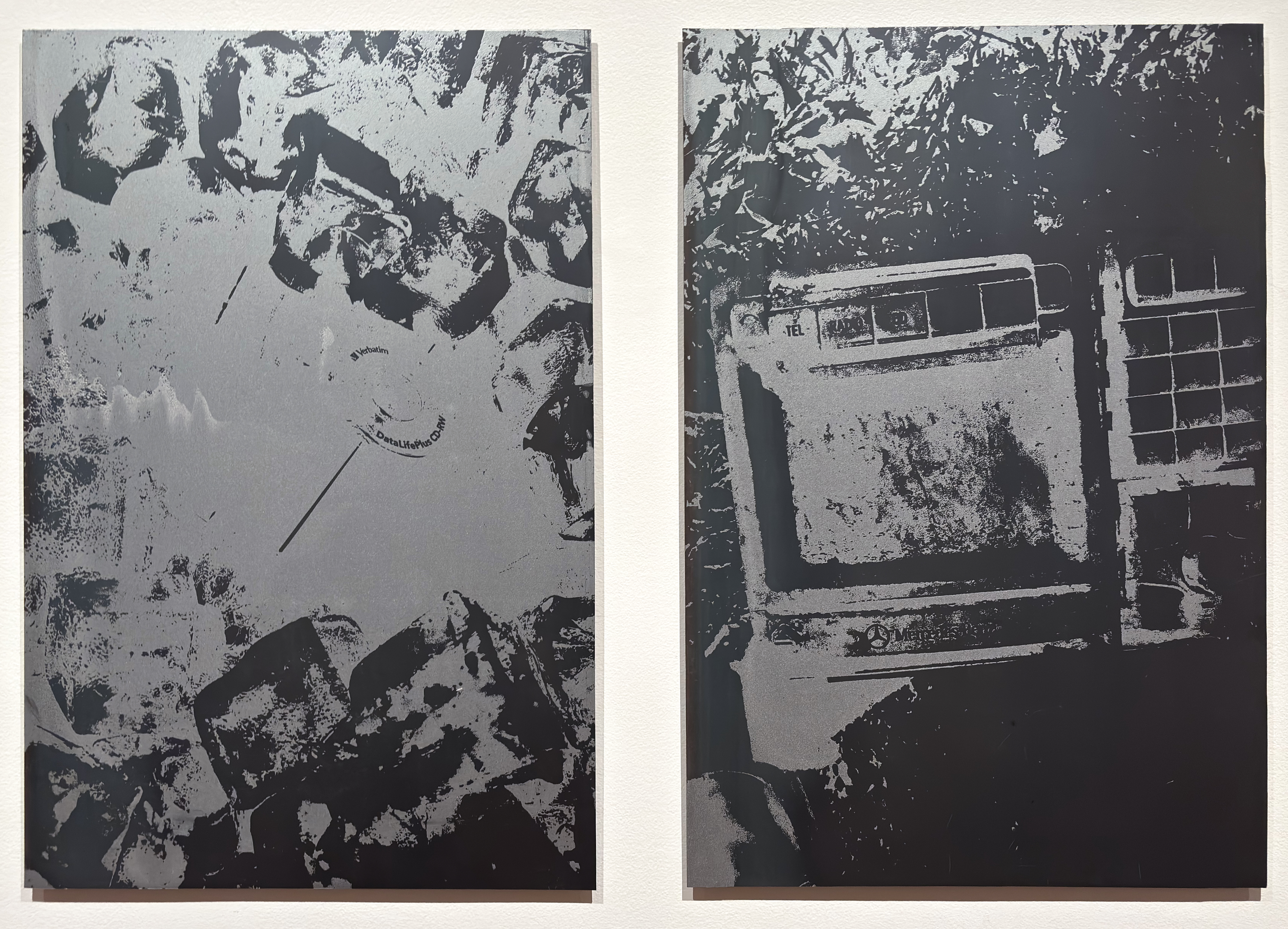
Emerging Castlemaine artist Finn Keighley, studying Drawing and Printmaking at the VCA, concentrates on another ecology, the post-human and technological acceleration—”loving and hating it for all it gives us”—the resulting e-waste which is his material. He also draws from a “visual archive drawn from the history (and present) of surveillance camera footage, Linux, computer components, radio spectrograms” from which he creates analogue screen prints “seasoned” with digital noise. The steel substrate on which he prints here for In noise II-III 2025 is the result of experiments with a range of surfaces and in optimising the inks for each. In the diptych he presents— incidentally self-titled “Verbatim Digital Life Plus CD-RW” and “Tel Radio CD”—cuboid forms, solid or hollow, in or out, on or off, which compete with traces of organic textures and the botanical. In depicting these texts on metal or plastic, the matt metal flattens the images to negatives in black, replacing midtones and highlights with machine grey, and frustrating the human eye’s sense of depth. Negative too is his response to any notion that futurist digital innovation is utopian.
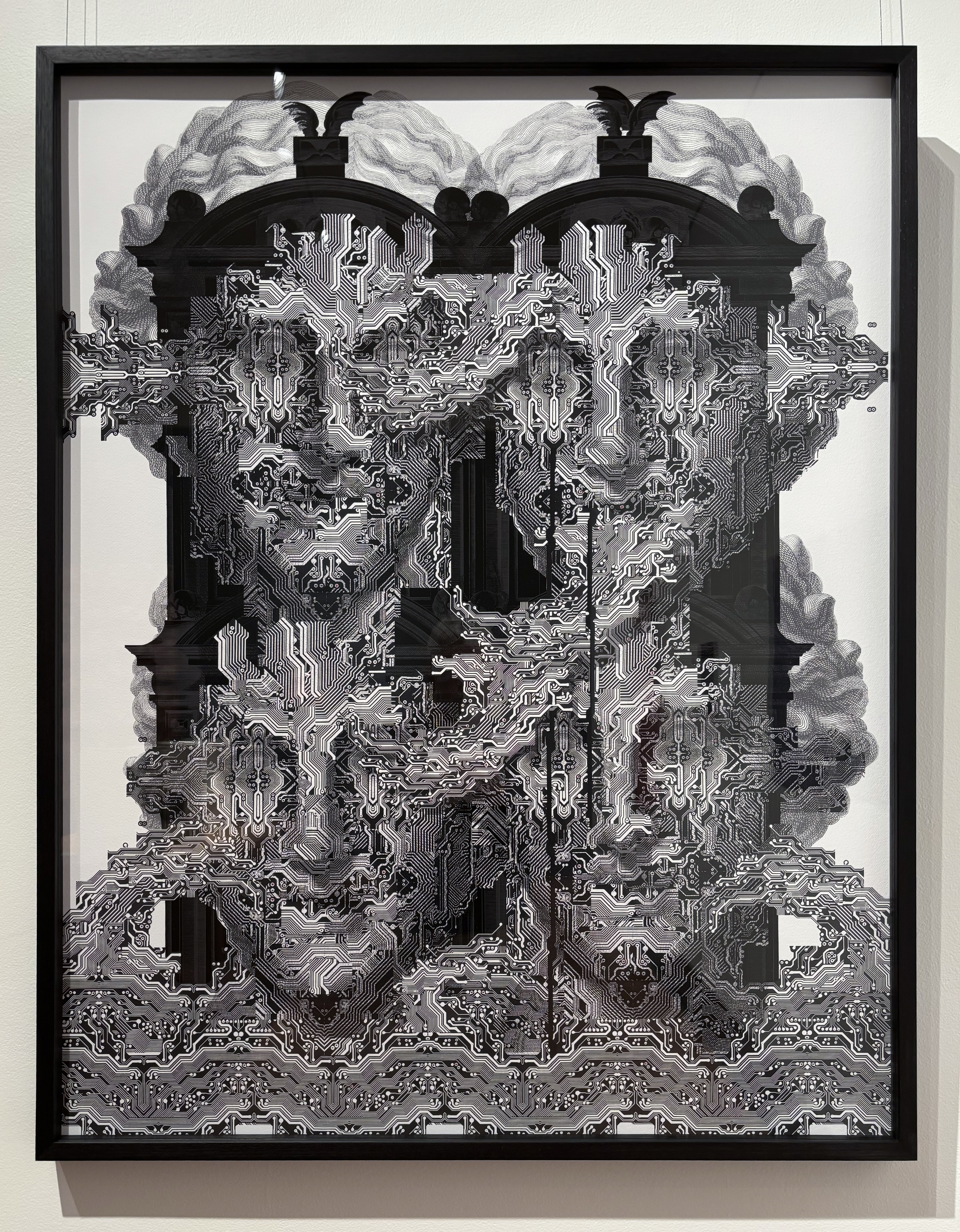
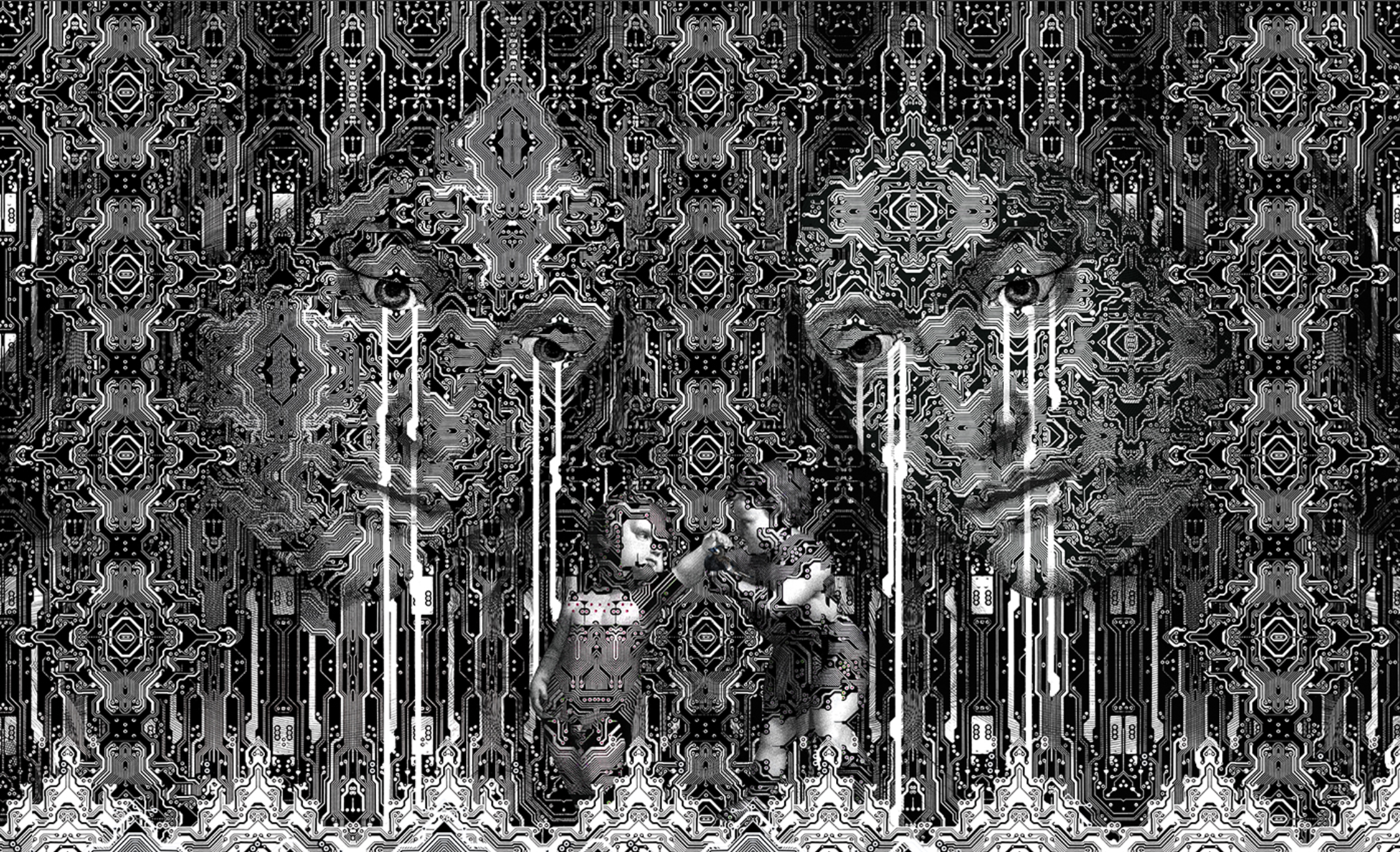
Another stream of thought evident in numbers of works submitted for the prize is identity and personal history. Nimbly knitting persona with digital concerns and technology is Chris Orr‘s Quadrilogue in pigment inks on Canson Arches Aquarelle. Satisfying in its layered and broken symmetry, it incorporates an engraving of a classical sculpture, a head of Venus, sliced through by a darker-toned plane of Renaissance architectural entablature, it is a development of his submission as a finalist in the last Experimental Print Prize which was based on Renaissance art.
It responds topically and innovatively to what Orr calls the “Al ‘slop’ and slurry currently discharged on our screens” which drowns us in “a deluge of artifice, swamping and engulfing our senses.” He represents that by ironically submerging (and merging with) a vintage engraving depicting an ideal of feminine beauty beneath high-res scans of motherboard components that weave, in a “cyber baroque confection” like the serpent of Laocoön, over the passage of the engraver’s burin, colonising the antique just as Al cannibalises creativity itself:
I cannibalise the components that steal from us, while simultaneously using that very technology to create my art [out of] the initial chaos as I try to confine, synergise and condense my thoughts into comprehensive narrative by knitting together the thousands of motherboard sections. This work is a cerebral quadri-sectioning of that noise; a jaunty, mechanised and animated narrative; a four-way conversation between myself, art, Al and the viewer.
An established artist printmaker of European and Aboriginal descent living in Melbourne/Naarm, Orr intersects technology and tradition with notable success, as winner of the Ursula Hoff Institute Award 2023 (for Served bold), and People’s Choice Award at Banyule Award for Works on Paper 2023 (for White noise), and with works acquired by Geelong Gallery and the ACU Art Collection, and he has exhibited at the iconic Bakehouse Art Project and was shortlisted for Castlemaine Experimental Print Prize twice, Geelong Acquisitive Print Award and Banyule Award for Works on Paper.
Andrew Nille’s monochrome photo-screen print Merline is from scans of a found image of the artist Baladine Klossowska (1886-1969) lover of the poet Rainer Maria Rilke (1875–1926) whose pet name for her was ‘Merline’, the feminine of Merlin, the sorcerer. Nille explains that he placed strands of hair over the image when he scanned it and that “screen-printed onto primed linen, the unstable reproductions captured through an experimental process of scanning were layered with uneven amounts of ink during printing”. Thus the hairs become fissures crossing Klossowska’s intense and soulful features.
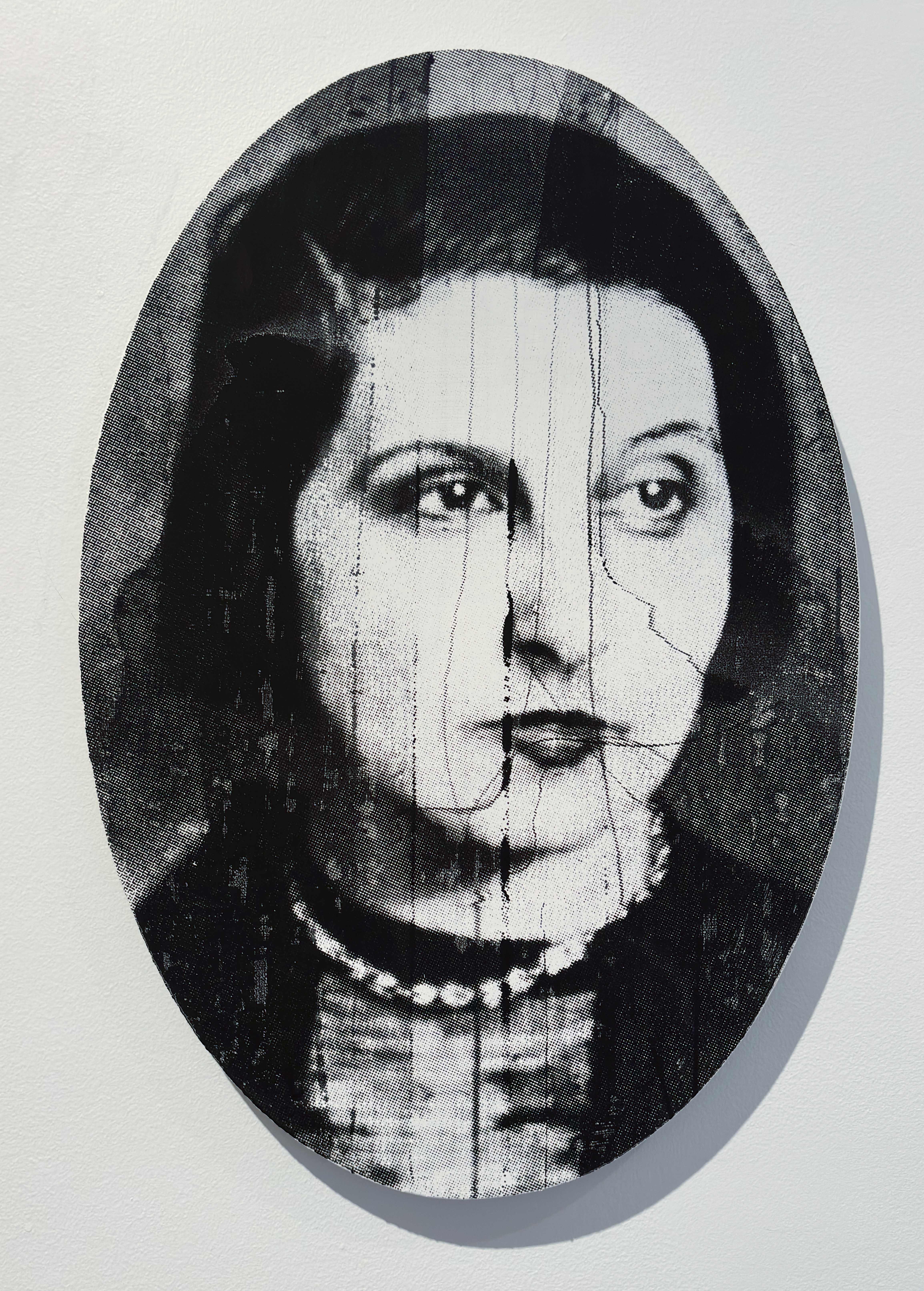
Nille’s intention is to speculate “on the unknown influence she had”, this “muse to a well-known poet and the mother [with art historian Erich Klossowski] of two artists [Balthus and Pierre Klossowski, who was also a writer and translator] whose work defined issues in representation.” Rilke wrote in 1892, at seventeen, a love song, his Leibesleide
How shall I hold my soul in a way
that it does not touch yours? How shall I
lift it over you towards other things?
Ah, I would like to put it up somewhere
in some lost darkness
in some strange quiet place, that
doesn’t vibrate along when your depths vibrate.But everything that touches us, you and me,
takes us together like the stroke of a bow
that draws a single voice from two strings.
On which instrument are we strung?
And which violinist has us in hand?
O sweet song.
It seems prescient of his affair, started in 1919, with Baladine, and so transformative of Rilke in a period of depression. Are not the vibrations of “two strings” evoked in the quavering hairs that cross this print? This cameo, that love-locket, as it stands out from the wall, is it like the sounding-board of an instrument?
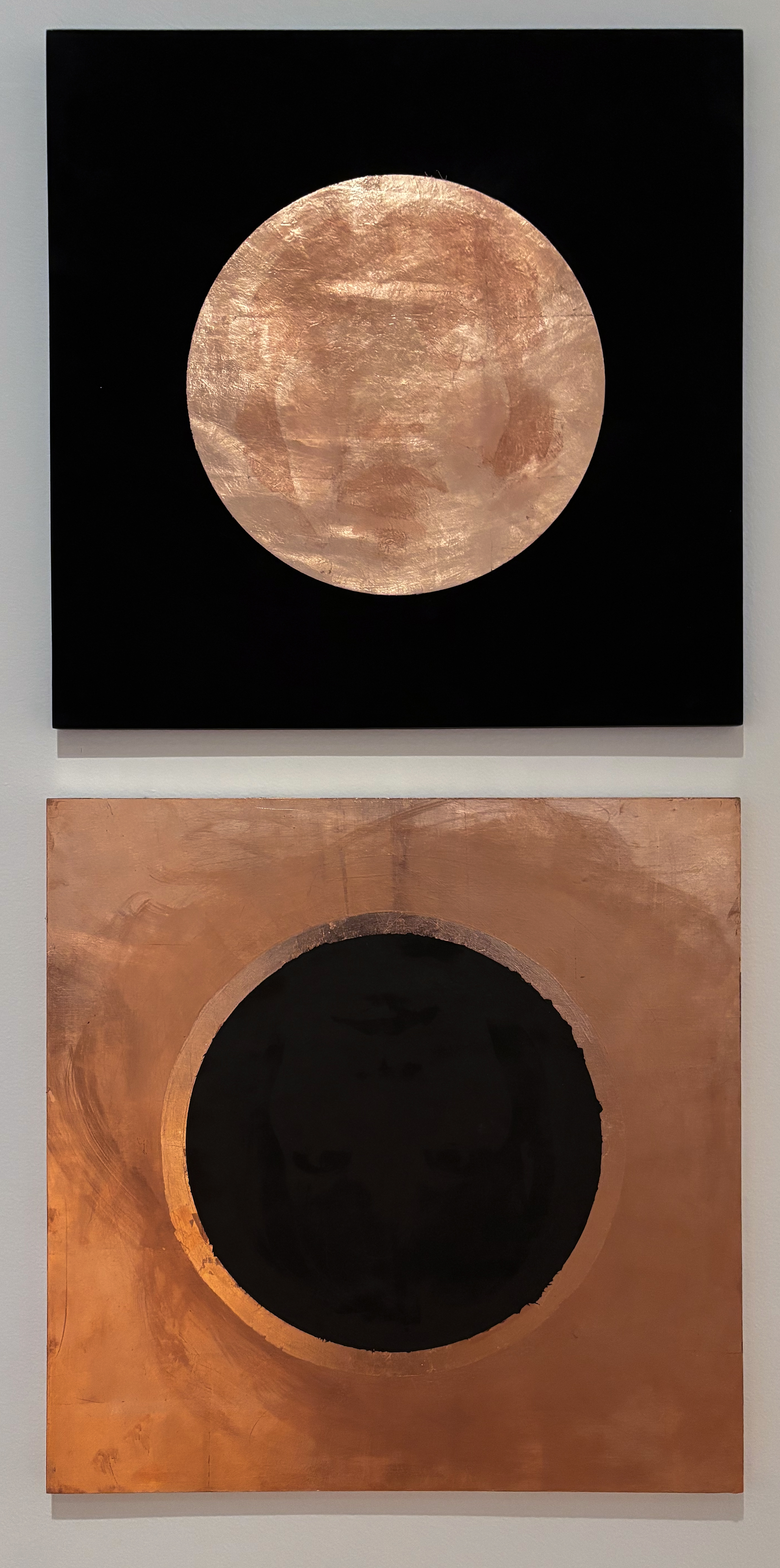
Likewise in a tondo format, Margaret Manchee‘s Bubble Revolution continues the circle motif that she inherits from her Chinese/Indonesian heritage and that was made three-dimensional in her previous entry in the Experimental Print Prize which won in 2023—here she flattens those kozo-paper maché bowls devoted to her Buddhist grandmother, but retains reference to her fascination with copper etching, but without a press, she resorts to hand-pulled Gelli plate printing.
These are self-portraits, reflective, compositionally and in their meditative intent, her face reflecting itself in a yin and yang, black and copper counterchange, eyes open, eyes closed, dark, light, revolving within their ‘ bubbles’, the private world of contemplation, two mirrors reflecting themselves ad-infinitum, “but not perfectly, suggesting a quiet tension between duality and non-duality.” To see these faces takes some effort on the part of the viewer to negotiate the burnished gleam of the upper image and to penetrate the ebony depths of the lower, and that enhances awareness of the symbolism—these are like an oriental version of the Russian Orthodox icon and like them, are on wooden panels, but in copper leaf instead of gold. Manchee explains:
“I am interested in the hierarchies within art practice-how certain materials and methods are valued over others–and I challenge this by using so-called ‘craft’ techniques in a fine art context. I enjoy working with humble and accessible materials to create aesthetically interesting work. Through making, I also discover and reconnect with aspects of my heritage.”
She says that the idea of the bubble also “speaks to how we all live in some kind of bubble, shaped by perception, habit, and the spaces we move through.”
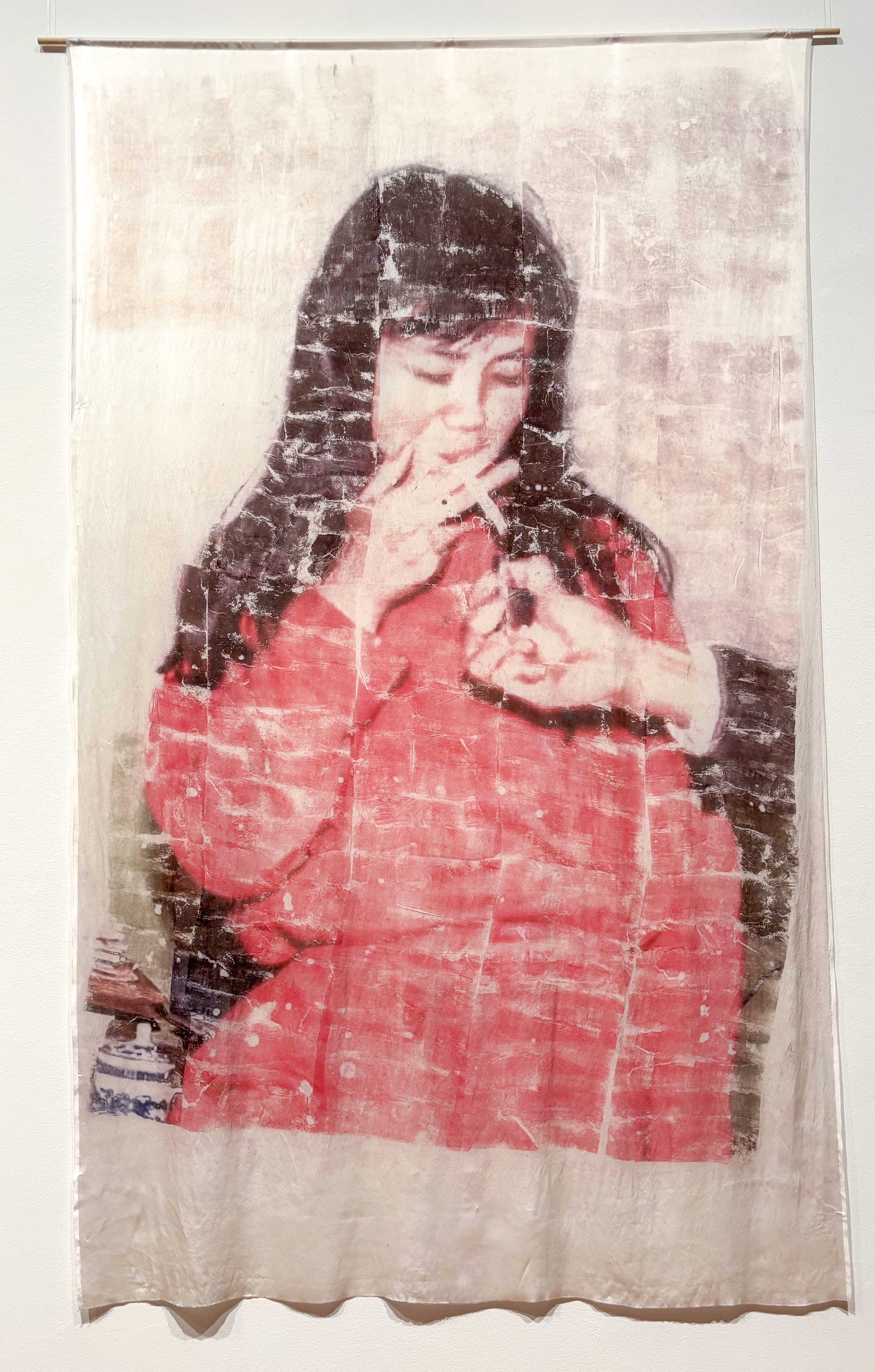
Melissa Nguyenin her The Artist’s Mother? challenges Western perceptions of immigrants of the Asian, and in fact any, diaspora. Melissa presents a woman who might be her mother, but is as she writes, she is: “a fictional memory made tangible” in her displacement, a ‘slippage’ that adopts the material quality of silk on which this is printed, and borrows from it that cliché, “the mystery of the orient” with which she titled a 2022 work subtitled “OPIUM POUR HOMME, the strength, the sensuality and the mystery of the Orient”.
Perfume is an invisible aura made tangible only through smell, though its ‘notes’ carry connotations, of Yves Saint Laurent luxury for example, or in this case the cheap $30 ‘dupe’ of prestigious $200 Yves Saint Laurent’s ‘Black Opium’; “Gardenia by Zara” by a Spanish fast fashion company. That is physically part of Nguyen’s print—her innovation is ‘perfume printing’, using fragrance as a release agent to transfer printed ink from paper onto silk. It is evident from deliberate traces left in the completed work that the application of this transfer process from the photographic image is done in patches roughly following a grid, but sliding awkwardly from this oriental scroll, ill-fitting:
“These imperfections manufacture authenticity; the degraded surface falsely ages the image, situating it in a past when this fictional mother might have been young. Perfume notes embed themselves in the silk fibres. Over time the scent dissipates, leaving only trace – the memory of something sweet or the ghost of presence.”
Lacan interrupts so sagely the stable relationship between signifier and signified in Saussure’s structuralist conception of language, arguing that there is “an incessant sliding of the signified under the signifier: a signifier leads only to another signifier, never to a signified.” Thus, as Nguyen, a Vietnamese Australian artist living and working in Naarm/Melbourne, and who most recently received the overall prize at the 2025 Churchie emerging art prize, asserts:
Both the photograph and the figure it depicts exist in states of displacement: misplaced within archives, severed from cultural origins, unmoored from fixed place.”
But, speaking of signification, since we cannot confirm that this is not Nguyen’s mother without her telling us, does the work ‘work‘? That is no consequence to our easy reading of this 1970s cliché scene of transactional mutual seduction, the lighting of a cigarette, the red dress, the besuited, white-cuffed male arm, and the questions implied—”Is she ‘available’?”, “Is he a lonely, maybe wealthy, businessman?”. Says Nguyen, whose ongoing work examines cultural dissonance:
“Like diaspora itself, the work preserves what fades: identity as construct, memory as performance, belonging as a perpetual question mark.”
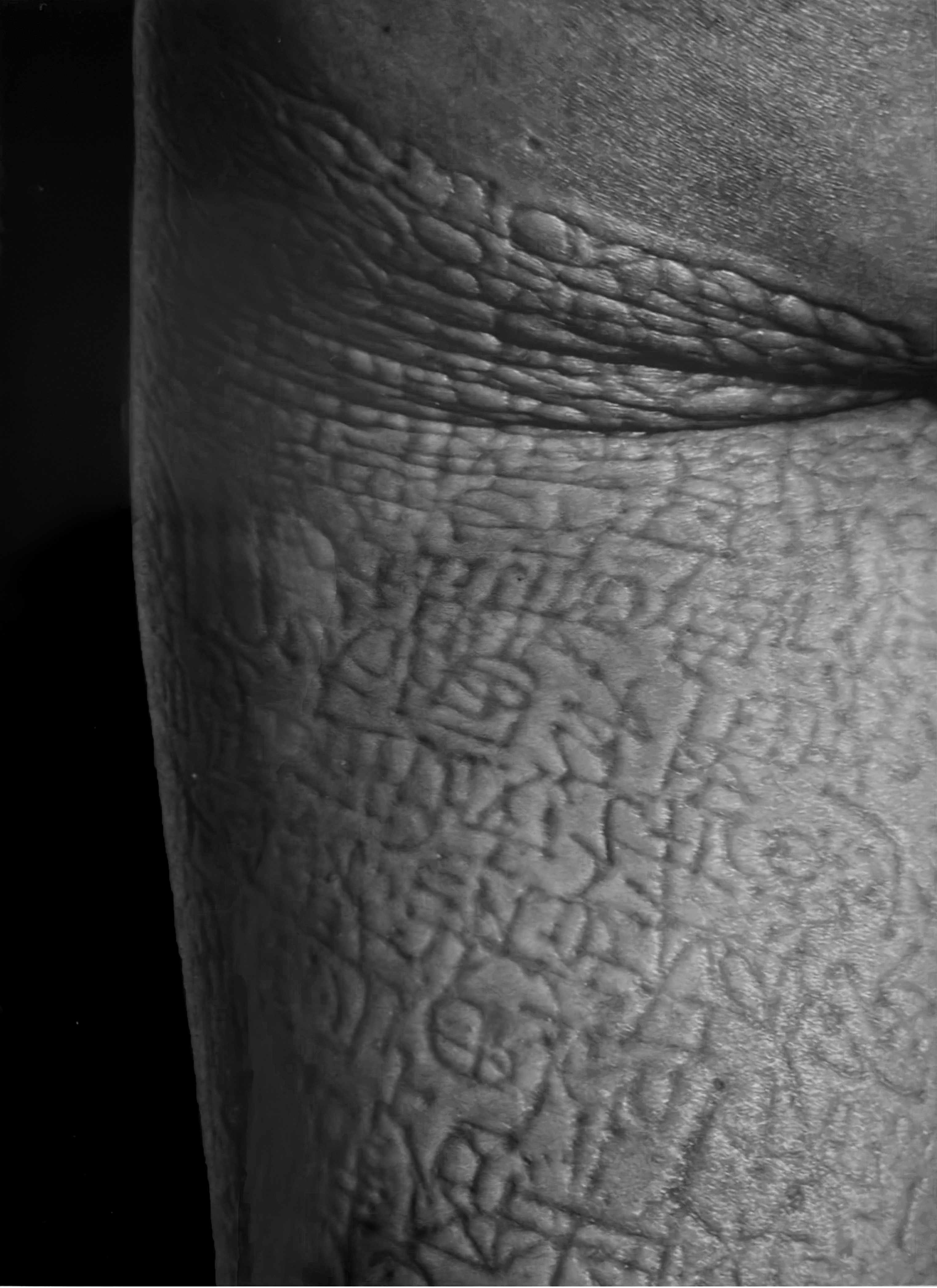
Huiyi Xiao a Chinese-Australian artist, recently graduated from RMIT, working across performance-based video, installation, and photography is also concerned with the transcultural and diasporic experience in her A body twice inscribed no. 5. In this instance the straightforward photography, reproduced as an inkjet print, merely serves to record the actual artwork, an ephemeral print made from a relief plate. A simple, and yet striking image, in my guiding at the Museum I have seen it attract double-takes and considerable attention and admiration.
To visualise the otherwise elusive ‘hybrid’ cultural experience in which “the perceived boundaries between East and West are not abstract, but intimately written onto the self” and to make “the invisible weight of ideology and economic systems palpable” Xiao finds a solution in the nature of the body itself, that all-over sense organ the skin, which intimately connects with our surrounds both physical and social, and on which our world leaves traces:
“Extracts from my Chinese and Australian textbooks are merged into a single, composite text, which is then 3D-printed and physically pressed into the skin. The body thus becomes the paper upon which these dual cultural narratives are indelibly stamped-a literal and metaphorical impression of the diasporic experience.”
Xiao’s auto-ethnographic, performed works on video are layered with confessional narration and ambient soundscapes, but this simple image vividly and concisely challenges the idea that we have to choose between “East” and “West,” and instead presents identity as something imprinted but mixed and evolving.

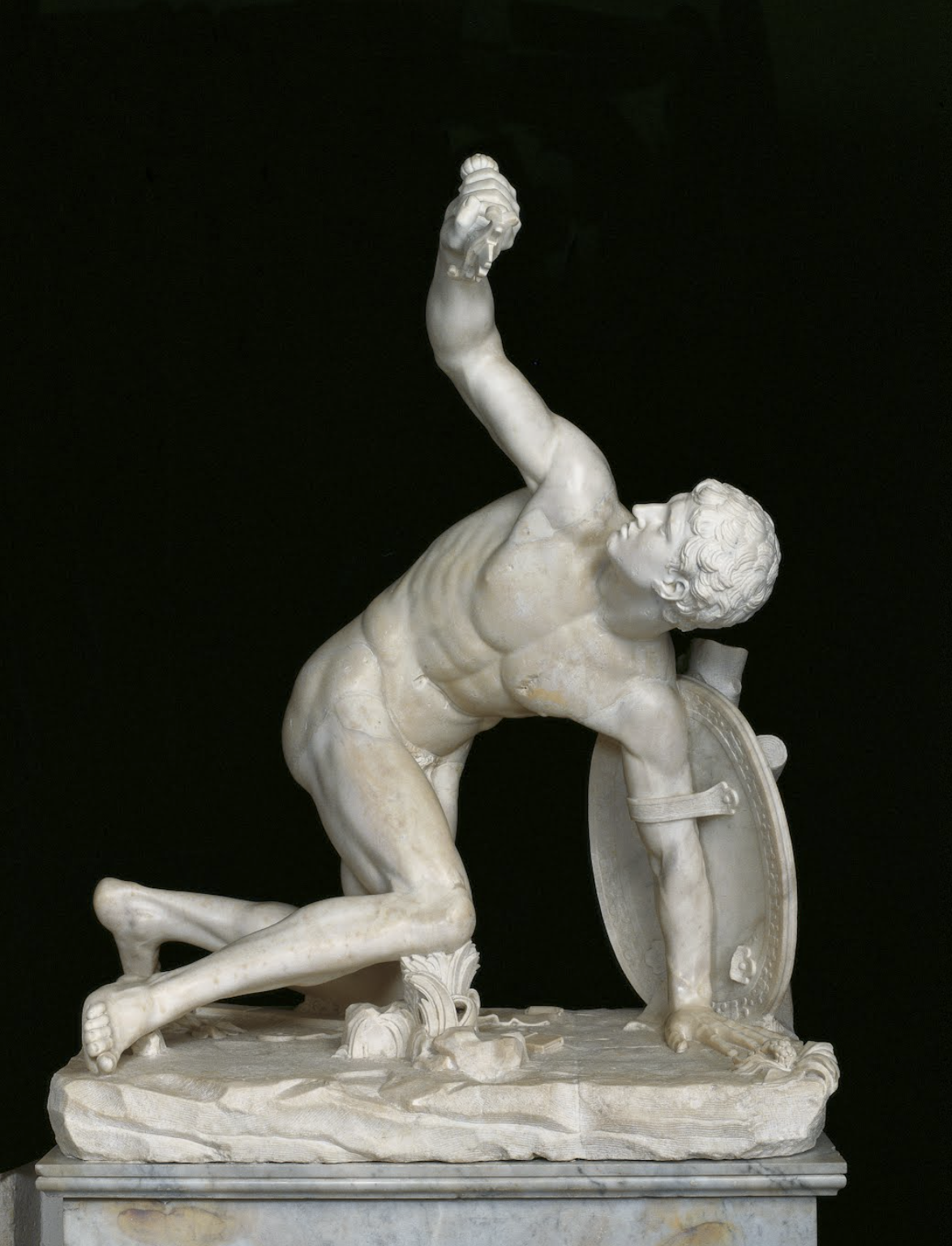
Ingmar Apinis‘ work Pansyfaust presents an hallucinatory fever dream, a homoerotic vision of a warrior collapsed and defenceless, his athletic anatomy stretched, twisted and distorted and growing weird appendages. It seems to stand three-dimensional against the blurred dot-screen background of nauseous colour clashes. Furthermore, the print itself is an object, a plaster slab onto which the digital print has been transferred using hydrofilm, a process that involves printing the image—which in this case has been digitally manipulated in Photoshop—onto the film then soaking that in a bath of water until it softens. Any object, provided it is water-resistant, can be pressed into the film, then submerged so the film wraps around it and adheres. Apinis has developed a means of applying the film directly to wet plaster forms for which he uses a wire mesh armature that is left to protrude from the slab: “it’s the tiny details that intrigue me the most in a piece, like this rippled edge that reminds me of a shell” he says. These hybrids are thus part photographic copy, fresco, small sculpture, and print.
The process reverses the original image and on close examination we find mirror-writing in the upper right, barely readable because it’s distorted, but legible enough to discover that this is a copy from a book or website, most likely the Google Arts & Culture site, where we read the AI-generated script:
“Statue of a wounded warrior. 1st century A.D. The torso constitutes the only ancient part of this prestigious (?) and famous statue. It seems to be an optimal (?) reworking of the Discobolos that Myron made in 460 BC. The interpretation of the statue as a wounded warrior in the moment of falling is the product of the reworking of the sculpture of Pierre-Etienne Monnot, who lived from 1658 to 1733”
Fauxfact it is indeed—the image is itself taken from a construction in which the Roman copy of the Discobolus torso is appropriated into a new confection, joined at the the armpits and upper thighs to new limbs, to become not an discus-throwing athlete winding up before the toss, but a warrior catching his fall with his shield arm while hopelessly attempting to ward off a blow with the hilt of his broken sword. Reversed in Apinis’ version, the image changes its thrust and the mutating, sprouting arm with its bud of hair becomes a tumescent, aggressive form. The image in the plaster seethes, bubbles and stretches voluptuously like a skin.
Apinis writes that his interest is in post-digital aesthetics and internet culture:
Pansyfaust part of an ongoing series called Fauxfacts, which employs a queer lens to speculate on the physical artefacts that contemporary society might leave behind for the humanities of a dystopian, post-Al future.
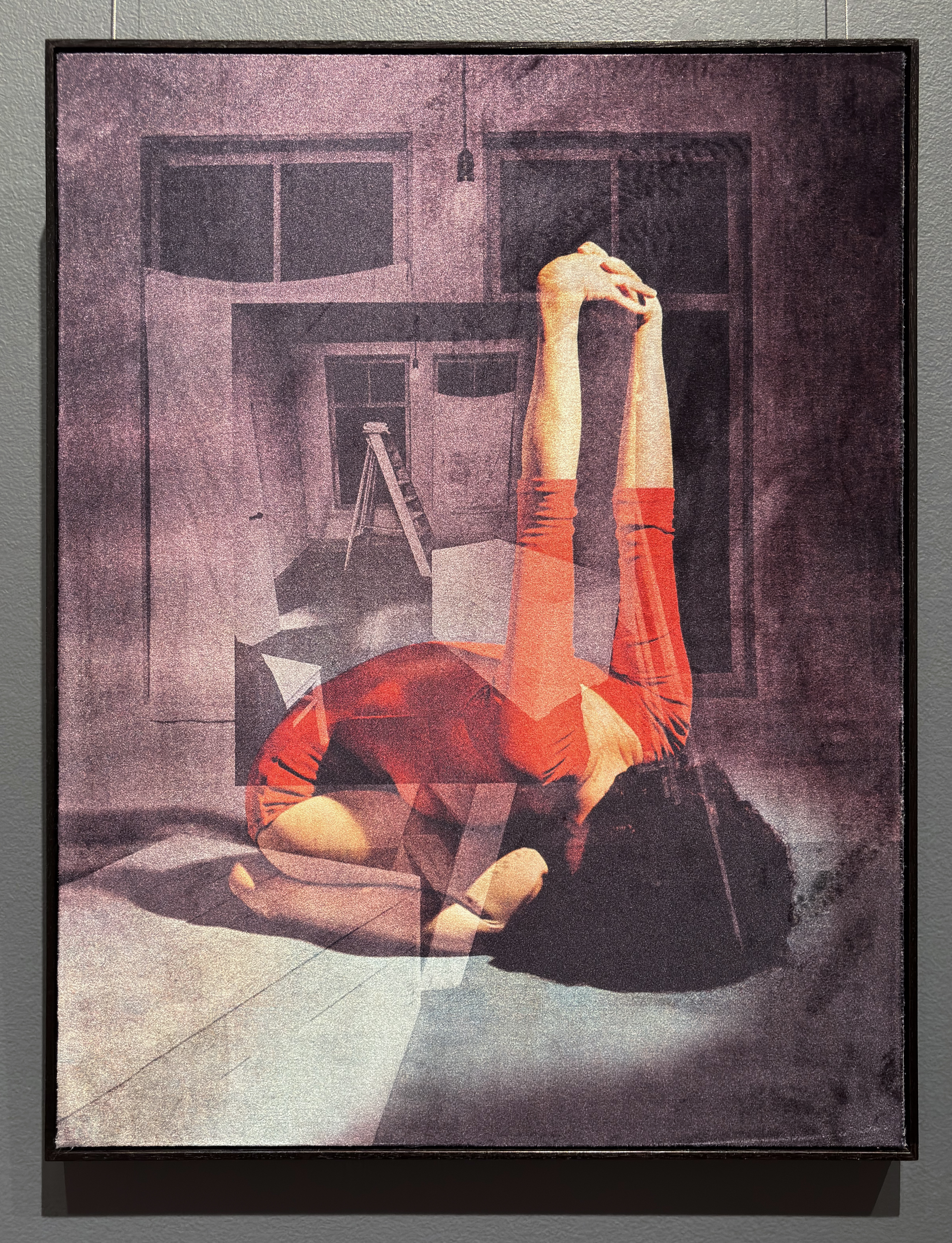
I have written previously about Aylsa McHugh‘s work in relation to her 2023 entry into the EPP, a finalist that won the People’s Choice award. The title of her 2025 Aonadh again salutes her heritage, and means ‘union’ in Scots Gaelic. Identity here is erased and a theatrical fiction brings an anonymous, faceless figure from a book of exercises onto a stage appropriated from a text on stagecraft. The superimposition sets a ghostly cubic form in steep perspective on the woman’s back between her up stretched arms that are seemingly reinforced by other transparent architectural elements from a reversed version of the inner stage that has been enlarged to overlap the edges of the image. Space shifts as the eye encounters other depth clues, so that they “refuse to settle into a single reading, offering instead a space for personal projection of meaning.”
Part of McHugh’s experimentation involves the substrate on which the image has been deposited by the dye sublimation printer. In 2023 that surface was aluminium which enhanced the stress of the extreme acrobatic contortion of the, again anonymous, female figure against vertebra-like stairs. Here the figure seems buried within herself, the mood and tonality softened by the velvet and the way the duplicated stage spaces telescope into each other.
A graduate of the VCA (2002), Aylsa originally studied sculpture and is one of several of this years EPP entrants—Ellie Malin, Dianna Wells, Chelle Destefano, August Carpenter, and Rebecca Murray—who benefitted from the workshops at Baldessin Press with Silvi Glattauer.
The Experimental Print Prize is well worth photographers’ time in visiting, to experience works of photography as objects and in its heritage as as a branch of printmaking. It may prompt thoughts about entering too, in 2027.
The exhibition continues until 1 March 2026 when the People’s Choice Award will be announced.


 On This Date in Photography: by James Mcardle