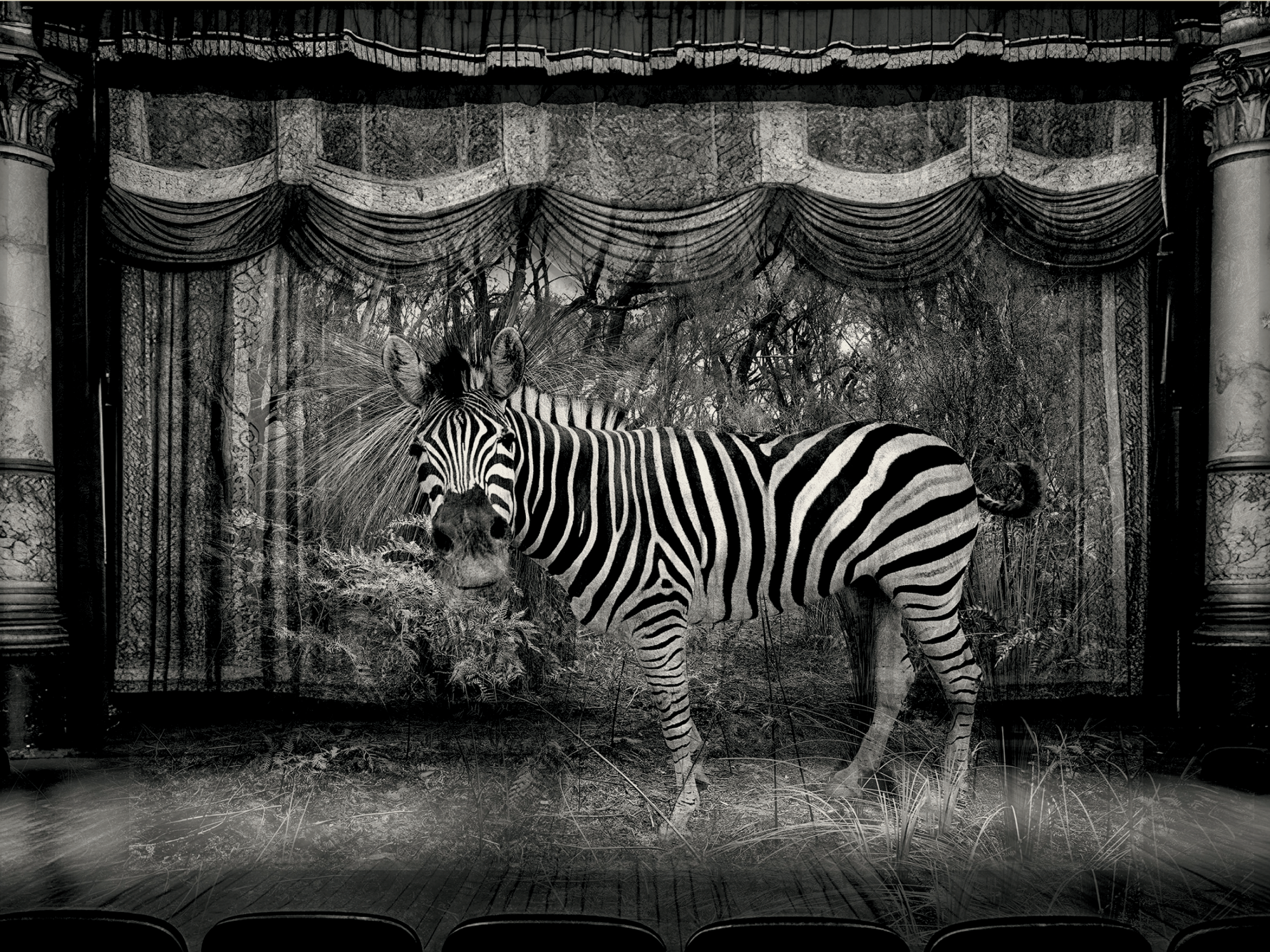
 The latest exhibition presented by the Prahran Legacy Curatorial Team was opened today at the Ballarat International Foto Festival by Michael Shmith, son of Prahran lecturer and head of the photography department there, Athol.
Michael is the remaining familial connection that we, the alumni, particularly those of the 1970s, have to our beloved mentor, but that is not the only reason we invited him to speak; he is a contemporary of the 1970s alumni, a senior Age newspaper journalist since 1981, having returned to his homeland from Fleet Street, and from 2010 to 2017 he was the paper’s opera critic, only resigning, in protest, over the paper’s dwindling coverage of the arts before writing for the Australian Book Review and authoring his own books, his latest being Merlyn (Hardie Grant, 2021), the life of the widow of Sidney Myer.
Michael is currently working on a joint biography of his parents, Athol, and Patricia Tuckwell (violinist sister of renowned French horn player Barry) who, when she married, became ‘Bambi’, recognised widely as the country’s (and Athol’s) foremost, and most elegant, fashion model.

There’s a phrase that can be found first recorded in the UK Commons and Lords Hansard, the Official Report of debates in Parliament, of 1804;
“This is a serious matter, and I will not mince words in dealing with it. In my opinion — No, I will not say in my opinion at all — I charge the Government with having”…blah blah.
But here, in the transcript of his speech, you will find that Michael Shmith, fine journalist that he is, does mince his words; a critic of performances musical and operatic, he makes them mince, sashay, bump and grind as they parade across the page, leaping and pirouetting as his meaning gathers and shapes around them like the serpentine colours of Loïe Fuller.
My fondest example, of course, is his essay, which in various iterations appeared in the National Gallery of Victoria magazine, and on the centenary of Athol’s birth in The Age of 1 August 2014, and prior to that, in longer form as his contribution, ‘The last time I saw Paris,’ to the NGV’s The Paris end : photography, fashion and glamour of 2006, detailing his visits after school to the Rue de la Paix building in the Paris end of Collins Street, where Athol had his studio. A sample? Of his then long-dead father he remembers “…the omnipresent cigarette (Athol’s equivalent of the eternal flame), smouldering to extinction between the index and middle fingers.”


So, to Michael’s opening address:
“Thank you, and good afternoon to you all.
“When Jim McFarlane and James McArdle (J&J for short) asked me if I’d like to open this exhibition, I had no qualms in accepting. I may be a non-professional photographer, but for various reasons –aesthetically and hereditary for starters – photography has always been a crucial part of my existence. I have always had a passionate love of its history, significance, beauty and power – and there is much of that around us today. Not just in this room, but across the wonderful cultural city that is Ballarat.
“After all, as the son of Athol Shmith, I was exposed to photography practically straight from the cradle. I must have been one of the most photographed babies in Australian history. Also one of the ugliest. My mother once described me in print as looking exactly like a marmoset.

“Much of my childhood, boyhood and youth was spent in the Athol Shmith Studio, on the first floor of 125 Collins Street, in the company of golden picture-frames, hulking enlargers, lights large and small, background papers of different hues, yellow Tri-X Pan boxes, lens hoods, pulleys, ropes, Nikons, Hasselblads … and the rest of the cumbersome and mystical apparatus a studio photographer then required. It was there that I absorbed by osmosis the alchemy of photography, as distinct from anything more formalised.
“At times, I witnessed my father at first-hand as he worked in the darkroom. There hung in the air the miasmic aroma of Old Spice, black coffee and the omnipresent Peter Stuyvesant (one of the three on the go at any one time). Athol hunched over a print, like a conductor over a score, his hands and long fingers weaving and wriggling under the enlarger’s pale glow, cajoling subject, light, shade, mood and period into a single defining image.

“Athol, in terms of his profession, was a working photographer who ran a business as well as a studio. A practical man as much as a craftsman – even if, for memory, he left corporate operations to his brother, Clive. Athol far preferred the studio than his own tiny desk in the corner of the secretary’s office. He worked at his desk occasionally, but would more often take naps underneath it, his legs sticking out.
“Much of Athol’s career was, by necessity, devoted to advertising and commercial photography – the way most photographers have worked to this day.
“Athol was really busy. It was not beyond him to do a shoot involving small children clad in colourful next-season rompers in the morning, dash out in the afternoon to do a wedding – one of the thousands he did throughout his life – and come back to the studio to organise next day’s location shoot of a new-model Holden just off the line at GMH at Fishermen’s Bend.
“Athol, it must be said, relished his commercial work, but it was a means rather than an end. Rather than feeling ashamed that commercial was (to quote his confrère from across the border, Max Dupain) ‘superficial gimmickry’ that made money and paid the rent and after that, nothing, Athol celebrated it for the innovation and cultural advances it always offered. It was a useful way of incorporating his innate artistry into everything he did. As his mother, Genetta, once said, ‘We must make allowances for Athol. He’s artistic.’
“Then, in 1971 – out of the blue, as it appeared to me at the time – in a dramatic move, my father joined the Prahran College of Advanced Education, to head its still-fledgling photography department. There, he worked with two remarkable men: his long-time business partner John Cato and the émigré photographer, Paul Cox.
“You could not have imagined three more different people. If they walked into a bar, the room would fall silent. Athol, the intensive, always immaculately-tailored man, and a social gadfly who really wanted to be Fred Astaire; John, that visionary of the Australian landscape but at heart a down-to-earth family man, who, after work, always caught the train home to Bonbeach to be with his wife, Dawn, and their two sons; and Paulus, that black-clad, sandal-wearing, pipe-smoking genius who brought a streak of European verismo to his peerless work as photographer and then acclaimed film-maker.
“Before long, under this extraordinary, triumvirate – none of whom received any tertiary education – the basement level of a recently-purpose built five-floor building on the corner of High and Thomas streets became a crucible of young emerging photographic talent. What was later so pertinently described by Paul as ‘Australia’s Bauhaus’, would initiate an evolution in photography in Australia, from the purely commercial to acceptance as an artform in its own right – as the curator of Long Exposure, Merle Hathaway, writes in the catalogue.

“Evolutionary, certainly. But was it revolutionary? As far as Athol was concerned, his professional revolution had taken root two decades earlier, in the early 1950s when he and several other prominent practitioners in Melbourne and Sydney broke away from their representative body, the Institute of Photographic Illustrators – ‘A gutless set up’, Max Dupain again – to pursue their own radical and informal agenda, or, as Athol put it, they ‘substituted board minutes with photographic prints’.
“Very much part of this ethos, and something that made its mark early on at Prahran, was camaraderie. Just as good conductors regularly remind musicians to listen to each other, so too did those Prahran maestros encourage their students to learn from each other as well as their teachers. My father, always a social butterfly, encouraged this mutual rapport. As James McFarlane recalls:
We might regard Athol with reverence, but he would soon show he loved to have fun, to act the fool.

“That was my father in a nutshell. He was a very funny man. What I didn’t know until recently was that he invited the imperiously theatrical Melbourne gay icon, Frank Thring, to open an end-of-year student exhibition. ‘Oh, Athol, fuck art. Let’s dance,’ said Frank, in Pontius Pilate tones, seizing Athol and launching into a tango. The students went wild.
“Behind Athol’s endearing sense of the absurd, though, was the more meaningful intention of educating of the next generation of photographers. Maybe without even realising it, Athol, John and Paul were spearheading a way of communicating through informality, the sharing of practical knowledge and skills, and many field trips. Or, as Athol always described any trip more than a metre from the Studio as going on location.
“One student, Suzanne Budds, recounted:
… all was well in our world in the basement of Prahran when seeing Athol asleep in his car at lunchtime, Paul [Cox] puffing his pipe, Bryan (Gracey’s) leather pants and Derrick (Lee’s) jacket.
“Stella Sallman remembers being surprised how informal and casual courses were:
The lecturers were almost part of the group. It took me a long time to get used to that. None of them were trained teachers and perhaps that’s why.
“Bill Henson agreed, saying:
They’d never been professional teachers, so they weren’t like people working their way up the academic ladder. None of the teachers at Prahran were like that. They were practising artists – that was the genius of the place.
“This would percolate, maybe from the basement upwards, throughout the building. As Christina de Water says:
The freedom to smoke in class and seamlessly traverse the realms of printmakers, painters, sculptors and graphic designers within the Art Building fostered an insightful cross-pollination of ideas and perspectives, fuelling our daily quest for the novel and unexplored.

“Who could possibly have foreseen during these heady times the extraordinary lasting and beneficial effect Prahran would have on Australian photography? Who on earth could have predicted that those twenty-two years, from 1968 to 1991, when the college merged with the Victorian College of the Arts, would produce an alumni so large, so distinguished, so diverse and still so productive? No one could have known. As Jim McFarlane says:
At Prahran, nobody told us that, through photography, a fulfilling, stimulating and fascinating life awaited us!
“It did, Jim, and it still does. To my surprise, and no doubt to the cumulative shock of that host of one-time Basement boys and girls, including those here today, age has been creeping up on one and all. But Prahran were the halcyon days –golden, perhaps even silver-nitrate, days, to be cherished and never forgotten.
“While technology must and can be embraced, I take nostalgic heart in the thought that my father, bless him, would never have heard of many words in the modern lexicon: to him, Photoshop was where you bought film, and JPEG something to clip to a Hill’s Hoist.
“But rejoice! It is hard to think of another period of Australian art that has led to three major exhibitions within the last six months. Each succeeding exhibition has taken us a little further along the road. The Basement: Photography from Prahran College (1968-1981) at the Museum of Australian Photography; Beyond the Basement, at Magnet Galleries, which featured the work of students of the 1980s; and now Long Exposure, which contains almost two-hundred contemporary works by fifty of the Prahran alumni. The catalogue includes brief artists’ testimonials – first-hand proof of how Prahran formed and sustained them. Here are three:
“Luzio Grossi:
I live by Prahran’s spirit and what I learned there: “There are no rules in photography–only guidelines. If there is a rule, break it.”
“Duncan Frost:
Prahran Photography in 1970 inspired me, building confidence in what I could do with a camera; I am eternally grateful.
“Linda Jullyan:
The friendships, inspiration, and bold creativity of Prahran and a passion for photography still shapes me.
“The saddest image of the Prahran years, not on display today but reproduced in The Basement catalogue, is by the late Jon Conte. Prahran Tech coming down was taken in 2017 as the hardhat brigade and their dinosaur cranes moved in, busily and dustily consigning five floors and a basement to historical obscurity. In the bottom right corner, partially obscured, is a ONE WAY sign.

“Prahran may have gone in physical form, but no wrecking ball, thunderstorm or earthquake could ever destroy its legacy or the profound significance it holds in the lives of some of our finest photographers, many of whom are on show in this room today. To all of you, I say: Athol Shmith, John Cato and Paul Cox, three great men whom I knew and greatly loved, would have been incredibly proud.
“I am honoured to have been asked to talk to you today, and I declare Long Exposure open. Thank you.”
Merle Hathaway, our curator, was thanked with a gift of flowers by another of the team Colin Abbott…
…and cards and gifts distributed to the other members, Phil Quirk, Mimmo Cozzolino and James McArdle. Deep gratitude was expressed too to the BIFB team Vanessa Gerrens and the man in charge of the more aerial installation of the show, Stephen Payne, and the owner of the Miners Tavern Laurie Nigro.
Photographs were taken of all the alumni who were able to attend…

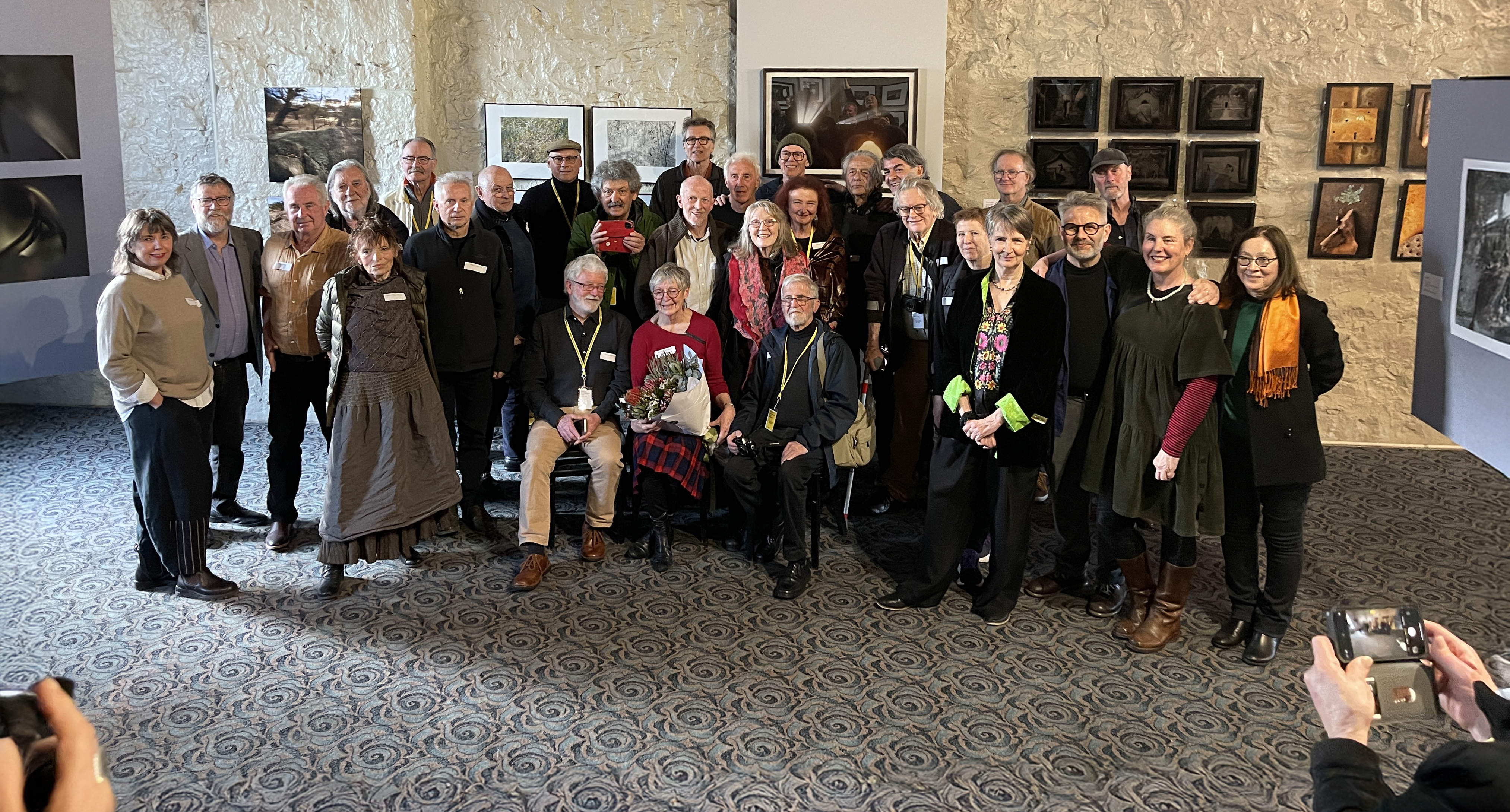
…and as we departed for the North Star hotel for a convivial, nostalgic, joyous dinner, some lingered over the exhibition…
A catalogue of the exhibition Long Exposure: The Legacy of Prahran College is available to download here, and details of the exhibition at the Ballarat International Foto Festival are here.


 On This Date in Photography: by James Mcardle
great piece.
LikeLike
Wondeful read – looking forward to the biography.
LikeLike