 For some, an early path in photography winds into other spheres; in this case into a fascination with interior and fabric design, and academia.
Photographer turned design historian Dr. Nanette Carter was born in 1954 and her father and his younger brother had a darkroom as young men and used to develop film and print photos as a sideline in the 1930s. She studied first year photography at Prahran College of Advanced Education in 1974.

Carter has remained close to fellow Prahran alumnus Rod McNicol and after both had left the College, sat for him in 1978 for his series Permanent mirrors. Despite deliberate constraints McNicol exerted on on his portrait subjects, Carter, with steady gaze and a tilt of her head, in return asserts on his camera, and on us, an intelligent, patient curiosity.

While grateful for what she learned at Prahran, especially the technical and lighting instruction by Bryan Gracey, Carter was keen to explore historical and alternate processes for creating photographic prints, something not compatible with the Prahran curriculum at the time. She transferred to the Phillip Institute of Technology where Henry Talbot was Head of Department with a flexible approach and where she found Mark Strizic a committed teacher. Both encouraged her work in gum bichromate, cyanotype, ambrotypes. Aside from photography classes, she participated in Ann Stephen’s women’s studies course, completing her Diploma in 1977.

From 1978 until the early 1990s when she stopped exhibiting, Carter survived on commercial photographic work, later including publicity for The Australian Ballet, and some teaching.
An exhibition of nude photography included Carter’s work at the Church Street Photographic Centre, Richmond. The show featured offerings from Joyce Evans’ collection of vintage and modern internationals Frank Sutcliff, Bellocq, Brandt, Callahan, White, Weston, Kertesz and Cunningham, and Australians including Dupain and Shmith. Tony Perry who was then teaching at Photography Studies College, wrote under the punny banner ‘First the good nudes’ in The Age of 22 December 1978, that he was pleasantly surprised by
“a series by young Melbourne photographer Nanette Carter. Her work is unaffected, clever and exhibits a subtle sense of humor. While it is unwise to bestow fulsome praise on the strength of three pictures, they do suggest a visual strength that could be easily maintained and far outstrip the work of other young photographers represented in this show.”
In 1980 Carter completed her Post Graduate Diploma in Fine Art majoring in photography, also at the Phillip Institute of Technology. Like Carol Jerrems (who had taught there briefly up to 1975), her practice explored feminist issues from an autobiographical perspective, but was performative rather than journalistic; Prahran alumnus Geoff Strong surveying the year 1980 in photography noted the closure of Evan’s Church Street Photographic Centre ‘due to financial problems’ where
“there were some interesting exhibitions from new photographers, especially Nanette Carter and Chris Koller, graduates from Prahran College. Both managed to blend some interesting symbolism into decidedly humorous theatrical portraiture.” (Geoff Strong, The Age, Saturday 19 December 1981 p.19)

These are constructed images which carry words embedded at the time of exposure. Carter’s interest is in the conflicting indexes of the picture and the text.


Does Proof hark back to Duane Michals’ This Photograph is My Proof of 1975? His exhibition at The Photographers’ Gallery near Prahran College was not until 1981, and Michals handwriting is a postscript added later, an interpretation, while for Carter’s self-portrait she inscribed her face before the picture was taken; we can see how the print follows the contours of her face. A precaution that wedding and portrait professionals would take was to stamp PROOF over the sample image to render it useless to clients who would have to order and pay for a clean print, in effect cancelling it. Carter’s Proof cancels its value as a portrait; her eyes are closed.

The ‘language of flowers’ which we might read so readily in Olive Cotton’s Windflowers of forty years before, on the cusp of Modernism, is subverted.

Museum of Australian Photography, City of Monash Collection
Carter’s title, Ignore these Messages, is crucial in inviting the viewer’s close reading. We discover that the spadix of the calla lilies are rolled paper covered in print. Is this a passive-aggressive challenge, the emotional blackmail of a rejected lover perhaps? The messages that we are told to ignore, but now cannot, are delivered in flowers that themselves bear contradictory symbolism; ‘calla’ from kalos (καλός) means ‘beautiful’; and the flower is associated with rebirth and resurrection, but also with death. But the messages are readable. Even closer inspection of them reveals scraps of biblical tracts from Corinthians and Revelations; “…thus be robed all in white…his name… the roll of the living…Father and his angels…” of the kind forced upon you by a door-knocking proselytiser. Any uncomplicated interpretation is conflicted and confounded.
With the closure of Church Street, Carter’s was the first exhibition for 1981 at Christine Abrahams’ Axiom Gallery around the corner, beside paintings by Polly Courtin, drawings by Tim Bass and landscape photographs by Tom Psomotragos. (The Age, Wednesday 4 February – 1981 p.10). Tony Perry found, in comparison to Psomotragos’ “pedantic scrutiny of ‘the miracle of nature”, that her work was;
“…inventive and interesting, if at times a bit naive. Using a personal symbolism, Carter has constructed a series of visions which generally strike a humorous note. At times she tends to scrape the bottom of the existential barrel as in Politics Now, a “portrait” of an empty dinner suit with a chequerboard face, or Suburban Offering in which a chef offers a tray of domestic items; toy TV, refrigerator, dining setting and so on. Both themes have been bludgeoned to death in practically every medium and have become quite tiresome. The need to produce such parodies seems to stem from the “look good and have an opinion” syndrome. But Carter’s photographs are generally more subtle than these, with the simply arranged shots tending to be more successful.” (Tony Perry, The Age, Wednesday 25 February 1981)

The Mother, and Nevermore are certainly subtle to the point of enigma. There are ‘chicken feet’ cultured pearls, and also the matriarchal figure of Baba Yaga whose house stands on chicken legs. In Reimund Zunde’s 1981 Photography: An Approach for Secondary School numbers of photographers, several of whom were Prahran College graduates, discuss one of their pictures. Nanette obligingly provides the required technical data for The Mother (titled La Mere in the book): Rolleiflex, Kodak Tri-X, Kodak HCl 10 film developer, Agfa Record Rapid paper in Kodak Dektol developer. However, in place of an explanation or account of her approach, she copies a paragraph from Proust’s Swann’s Way. It is the passage immediately after his account of vivid childhood memory springing from the smell and taste of a crumb of Madeleine biscuit soaked in tea. Like photographs, fragile things, sensory impressions, though fragile, hold an essence that faithfully preserves the vast structure of recollection.
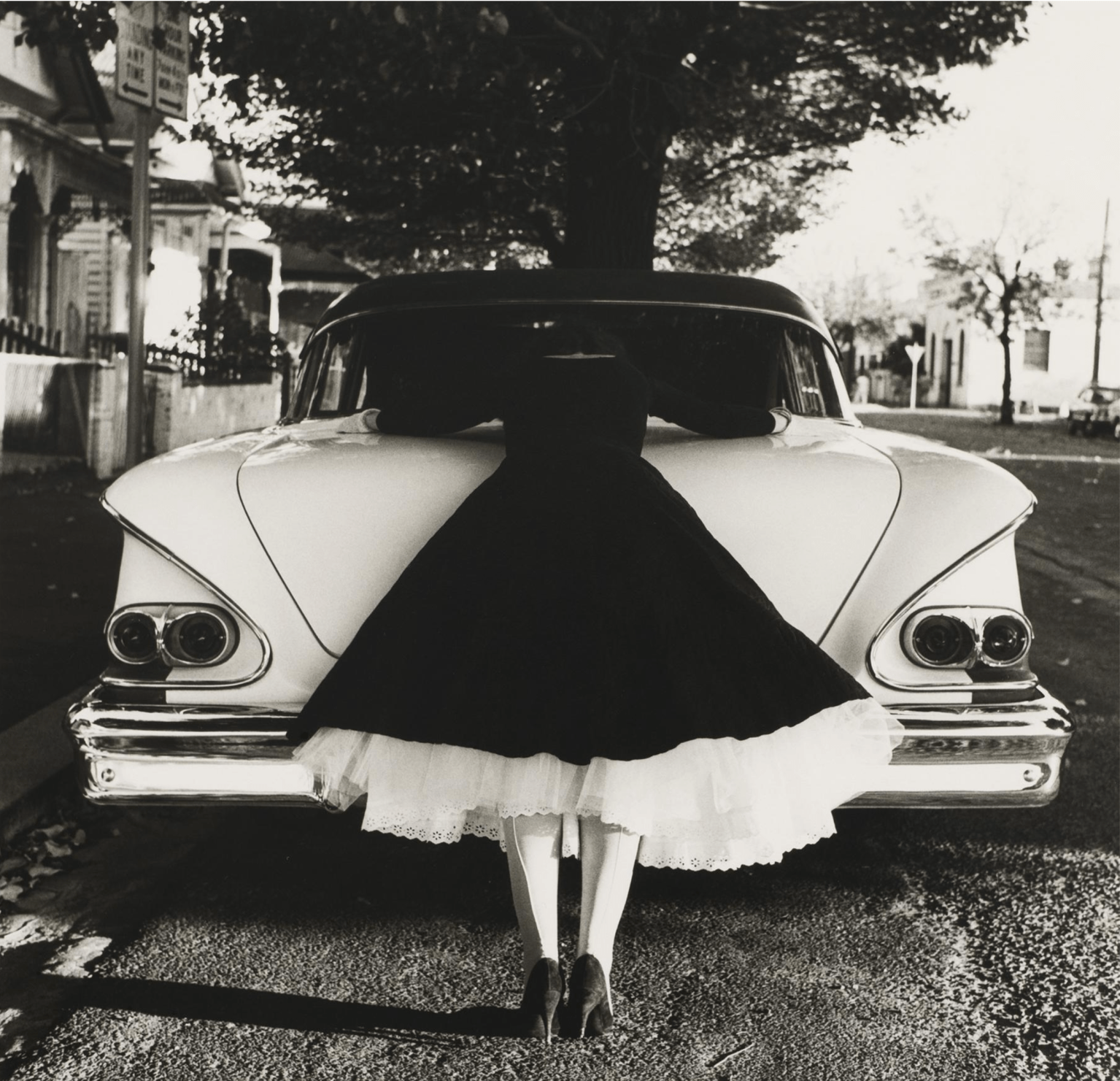
Perched on a bust of Pallas, ‘Nevermore’ squawks Poe’s raven, as black as ebony, as is the dress Carter wears here. Nevermore the finned sedans of the 1950s and stockings with seams in suede stilettos? Nevermore the subjugation of women? The picture returns only questions.

Museum of Australian Photography, City of Monash Collection
After showing with Peter Charuk at Developed Image Gallery in Adelaide, she joined partner Chris Köller in Japan where they made Kyoto their home between August 1982 and January 1984. Booming economic growth in the country brought opportunities for Australians to live and work there and many took up teaching English as more Japanese citizens were conducting business with Americans, Europeans and Australians. Köller took a job through a private school teaching conversation and English idioms to students and workers. The couple successfully held a show of their Australian work at Gallery Dot in Kyoto, while Nanette explored new subjects; Japanese landscape and Buddhist festivals, and closeups of women which Alison Broinowski considers ‘enigmatic’ in posing “questions about concepts of beauty and tradition as both confiner and liberator” (Alison Broinowski The Yellow Lady : Australian impressions of Asia, Oxford University Press, Melbourne). Reviewer Rebecca Lancashire commented on these portraits when they were exhibited in 1991 in Women’s Images of Women amongst photographs by seven other Victorian women at the Westpac Gallery of the Victorian Arts Centre curated by Joyce Agee;
“Nanette Carter’s headshots of Asian women are disquieting. In one, the subject has blinked just as the camera snapped. In this way the exhibition also nudges conventional photographic practice; the notion that eyes should be open and rules about the positioning of a subject within the frame.” (Rebecca Lancashire, ‘Women as they are seen by women photographers’ THE AGE, Wednesday 13 March 1991)

Returning in 1984 Nanette completed a Bachelor of Arts at La Trobe University, while continuing to exhibit. In 1987 she was included in the survey Living in the 70’s : Australian photographs at The Australian National Gallery, Canberra and in July 1992 she joined Köller and Polixeni Papapetrou for a show of travel imagery at the Victorian Centre for Photography (now the CCP) for a show For my part, a title that for the 3-page catalogue was rendered in full; I travel not to go anywhere, but to go, I travel for travel’s sake the great affair is to move.
In July-August 1992 at Westspace Gallery, and again with Polixeni Papapetrou and also with Tony Nott she exhibited in The First Age : an exhibition of photographs of children and childhood experiences with a catalogue essay by Kevin Murray of whom Robert Nelson wrote;
“The show by three photographic artists at Westspace is centred around a clever essay by Dr Kevin Murray, who is well qualified for the job. He’s a narrative psychologist as well as an art theorist; but his special talent for the task is more poetic than professional. Using the images with sensitivity, he plays out witty scenarios to explain our oblique communion with children. …Nanette Carter strikes a strident note with child-abuse and murder of adults by children. Her works look predictably sinister.”
(Robert Nelson, ‘Behind the chauvinism of adulthood’ The Age, 2 August 1995)

Catriona Moore in her 1994 book Indecent Exposures: Twenty years of Australian feminist photography (Allen & Unwin, Power Institute of Fine Arts) is critical of the 1980s shift in representation of the female body from earlier positive depictions to “masochistic exercises for the camera” in “off-key performance[s] of cloying compliance….Instead of rejecting feminine stereotypes [it becomes a] game of over-identification followed…and a sense of claustrophobic closeness pervades each episode,” a position she attempts to justify through Carter’s work;
“Puberty threat illustrated … social anxieties through a mock ethnographic study of an imaginary puberty rite. Carter’s celebratory tableau delivered a grim possibility: a little girl offered up to a bleak future in a frilled bassinet. In strict central core formation, the little girl is ringed by a menace of tampons arranged as a supermarket ‘vagina dentata’. Aesthetic and social codes of innocence and maternity (the threshold of womanhood) are undercut by corporeal malevolence. The simulated shame of an unspoken sexuality and a perceived lack of bodily control echoed cultural discourses on the female body as an unknowable threat requiring punishment or banishment. Frilled tulle and sprinkled confetti claim Carter’s menstrual cycle as a domestic treadmill. In this context, mock hysteria seems an appropriate response to the point where biological and cultural experience join in a web of oppressive cultural significations.”
Nelson reviewed Christopher Koller’s August 1999 show Milano at Temple Studio, 36 St Edmonds Road, opposite Prahran CAE, noting that “The moodiness and sensitivity in these works are well expressed in an elegant catalogue essay by Nanette Carter. It provides poetic examples of the military and fascist backdrop in the history of the gracious town.” Nelson goes on to write that “Koller’s appreciation of the symbolic flair of the city extends to its coercive undercurrents. In this way, the symbolic content of the work is deconstructive: it hints at the in-built repression behind the glamor.” (Robert Nelson ‘Politics, ambiguity and the divine light’ The Age, 25 August 1999).
That essay marks a change in direction for Carter who, apart from inclusions in surveys, no longer exhibited new photography. Asked whether her move into a more academic career path was the result of a disenchantment with Australian photography, or had her shift of interest to design perhaps revived from an earlier fascination with it, she responded;
“I did have an earlier fascination with design which became more important. My training in photography has been very useful in teaching design history, about issues in contemporary design and in researching Australian design history.”
She completed a Master’s degree in Art History in 2000 titled ‘Modernist furniture and interior design in Melbourne 1930 1939: a critical evaluation.’ She subsequently researched and wrote on postwar interiors by designer and artist Clement Meadmore.
Carter found herself becoming a recognised commentator on design: for an article ‘Boldly go into cyberspace, stores urged’, in the Sydney Morning Herald 27 May 2003, Jenny Sinclair, inquiring into online shopping, consulted Carter who made several pithy observations; that established retailers, anxious about the power of their brands in cyberspace, tend to cling to the design feel of their physical stores and should view their web presence as more than an extension of their bricks and mortar; she pointed to the success of ventures like Amazon deliver innovative online shopping experiences by creating new relationships with shoppers through personalisation and suggestion; and ventured how Australian stores, including Myers, limited functionality on their websites, and might better adopt designs beyond the visual, to soundscapes, for instance, to create a compelling imaginary space.
 Carter’s paper ‘She’s a store, she’s so much more: Sportsgirl the brand and the social construction of young women in 1960s Australia’ was delivered at the Design Research Society International Conference at Monash University in November 2004 and surveyed the rise of one of Australia’s first youth fashion brands through its origins in the 1960s flagship store and its newspaper advertisements in Melbourne to show how Sportsgirl challenged traditional societal roles for young women by promoting independence and adventure. Setting out the strategic decisions of the Bardas family, it shows how Sportsgirl’s innovative marketing and design revolutionised Australian fashion. The brand’s interior design, merchandising, and advertising reflected the aspirations of a generation of Australian women.
Writing Parallax, a 2005 catalogue essay on Sarina Lirosi, Carter continued to comment on photography, and was then undertaking the curatorship of Savage Luxury: Modernist Design in Melbourne 1930-1939, in 2007 at Heide Museum of Modern Art. Her interest had first been aroused in the previous decade when researching Fred Ward for her Master’s thesis. He was a 1930s Melbourne designer of modernist furniture, raw in its materials and with simple, graceful lines which she believed had laid the groundwork for Australian modern design, in a radical challenge to the notion that it only appeared in the post-war period. She also brought to it her feminist perspective; “You could argue much of it was masculine in its denial of traditional femininity, but it actually helped women who wanted to lead a modern life, the ones who didn’t want an embroidered doily, thanks very much.”
A connection to Heide was revealed when she discovered that Ward’s furniture had been sold through Cynthia Reed’s interior design store she’d taken over from Ward in Little Collins Street in the 1930s. This store played a pivotal role in a radical shift in Melbourne’s design scene, embracing European and American modernist influences after the Depression. Heide, the Bulleen farmhouse, was bought in 1934 by Cynthia’s brother John Reed and his wife Sunday who knew all the important artists, architects and designers of the period. Ward had shared a house with John, and artist Sam Atyeo was Cynthia’s friend and was later introduced to the Reeds. (Mary O’Brien ‘Luxury born of lean times’ The Age, p.19 Jul 21, 2007)
Carter’s exhibition was the first comprehensive survey of this design revolution and she managed to procure for it prized textiles and furniture by Michael and Ella O’Connell, Frances Burke and others, from collections including the National Gallery of Australia, Heide’s own (especially of paintings, including those of Ian Fairweather, whose debut exhibition was held at Reed’s shop), the National Gallery of Victoria, and RMIT’s Frances Burke Textile Resource Centre (Design Archives).
Installations of room setups echoed shifts in social mores, and highlighted the contemporary relevance of informal and spacious interiors furnished with simply designed functional objects. Thus recreations of a 1930s milk bar, “A Society Lady’s Sitting Room” and “A Single Woman’s Apartment,” illustrated the integration of modern technology and the changing lifestyles of the time. Photographic installations featured Melbourne apartments and hospitals designed by groundbreaking architects. (see: Jacinta Le Plastrier Aboukhater. ‘An era re-invented’, The Age 11 July, 2007 p.7; and Herald Sun 15 September 2007)

Carter titled Savage Luxury after French thinker Jean Baudrillard’s term denoting a rejection of bourgeois ostentation to emphasise the profound effect that material culture has on social life (Baudrillard, Jean. Pour une critique de l’economie politique du signe, Gallimard 1972). The 1930s were an historical pivot when modernist design ideas from Europe were embraced for their socially progressive impact amidst the 19th-century conditions in the aftermath of the Great Depression, when Melbourne’s first Ideal Home exhibition, with modernist solutions for domestic life, was held in the Myer store’s furniture department in 1934 and Carter surveys the community of creatives of the period; architects Roy Grounds, (Acheson) Best Overend, Geoffrey Mewton, Norman Seabrook, Mary (Mollie) Turner Shaw and Arthur Stephenson; furniture designers Fred and Elinor Ward; designers of printed furnishing textiles Michael and Ella O’Connell, and Frances Burke; artist/designers Sam Atyeo, Gert Sellheim, Loudon Sainthill; and artist’s muse, writer and design consultant Cynthia Reed.
Mary O’Brien in The Age considers how Savage Luxury offers a unique insight into modernism in Australia and Melbourne’s role as a design leader, and that it was the first to focus on the decade rather than an individual, putting everything into context and bringing many of the leading personalities of the decade to life as real people. She quotes Nanette; “I’m not so keen on those decorative arts exhibitions that show what rich people had in their homes. I’m really interested in seeing how design affects a whole range of people from different categories.” This was the “thrifty ’30s when magazines such as Home Beautiful and Woman’s World were urging people to buy things that were plain, simple and homely. “Unemployment was bad in Victoria and there was a sense that something had to be done. They were trying to recreate the world in a better way…We [now] are living beyond our means physically and the idea of simple furniture, locally produced and smaller living spaces has a lot to offer us as to how we need to change the way we live.” (Carter in Mary O’Brien ‘Luxury born of lean times’ The Age, p.19 Jul 21, 2007)

Against the grain of conventional academic writing, Carters’s essay ‘Milk Bar Moderne’ in the 2008 book Modern Times: The Untold Story of Modernism in Australia accompanying the Powerhouse touring show is fun to read and kaleidoscopic in concisely corralling the curves, clatter, chromatics and chrome, cologne, calligraphy, commerce, cubism, caramel, coffee and courtship that characterise these modernist institutions of the 1930s that drew inspiration from the American Prohibition-era soda fountain. Following the species’ postwar evolution into a mere corner store owing to the inroads of television, she evokes its last gasp in the 1950s Wintergarden Milk Bar next to the Ipswich movie theatre of the same name (in which No, No Nanette was screened in 1941, and which reminds one also of Köller’s 1987 photo sequence Before the Winter Gardens). Robert Nelson who rode his bike to Heide to review the exhibition and book Modern Times asks; “Did you know, for example, that a milk bar wasn’t just a corner store that sold ice-cream, newspapers and snacks, but was a stylish place where people sat or leant – as in an alcoholic bar – and consumed refreshments while conversing? Nanette Carter takes us on a snappy journey through these groovy places.” (Robert Nelson, ‘Unhappy ending remains untold, The Age p.19 May 6, 2009)
Carter next curated the exhibition Pen to pixel : 100 years of design education at Swinburne which was held as part of the Melbourne International Design Festival held over 17-27 July 2008, and edited and its catalogue, to which she contributed three essays; on architect (Edythe) Ellison Harvie (1902 – 84) who in 1920 trained at Swinburne Technical College and designed several modernist hospital buildings; another on Pop artist and critic Robert Rooney; on designer and Swinburne lecturer Tony Ward; and new media design practice SuperActionGo formed by three Swinburne graduates Marco Damiano, Jemi White and Ben Greig.
Having exposed them through her research, highlights of Carter’s Savage Modernism at Heide, the textiles by Michael and Ella O’Connell were made the subject of The Lost Modernist at Bendigo Art Gallery 26 Nov 2011 – 19 Feb 2012 by curators Harriet Edquist and Tansy Curtin.
Carter’s perspective on design for living was put to work in her 2012 essay for Christopher Koller’s Paradeisos at the Centre for Contemporary Photography which included his plastic Diana camera takes on gardens diverse as Sunday Reed’s garden at Heide and Sleeping Beauty’s castle at Disneyland. She wrote “Koller knows that all gardens, no matter how small or mundane . . . have the potential to transport us beyond the banality of the everyday” (Dylan Rainforth, The Age 18 July, 2012, p.15.)
That year Carter’s biography of Fred Ward appeared in the Australian Dictionary of Biography and in 2014 at the National Gallery of Victoria’s Mid Century Modern: Australian Furniture Design exhibition she spoke on ‘Modern Living: Influences on Australian mid-century interiors’. (The Age, 20 September 2014). At The Australian Council of University Art and Design Schools 2014 conference she presented with Dr Cherry Barlowe and Dr Simon Jackson a paper ‘Pod Tours: A pilot study that explores audio assisted excursions as a module for an online design unit’ which she described as a blend of conventional live lectures and film screenings, readings, discussions, research tasks, essay and excursion converging through technology in the form of weekly online synchronous discussions and wiki tasks in a ‘communal learning environment’ that motivates and facilitates the students’ independence.
Carter was then completing her 2015 PhD on the emergence of DIY culture in the postwar period in Australia, and given its scope, it was jointly supervised by the School of Historical Studies and the Faculty of Architecture, Building and Planning at the University of Melbourne. Consequently, it was Carter whom Ray Edgar consulted for his article Smashing the DIY ceiling on how women have embraced the property market and have traditionally been better at project management when it comes to home improvement. She commented that “Women were very active in project managing in the post-war period. Men were at work and the women were at home with the small children. Women had the time to do that. It also comes out of that expectation that women are managing the household budget. It got subsumed with that.” And when Ray reviewed architect Robin Williams’ award-winning St Andrews Beach Villa beach house he quoted Carter on her position that most Australians live in something between Williams’ villa and a two-room Japanese house, but that “flexible living spaces can help reduce the footprint of new homes and limit the scale of renovations. Taking on huge rooms isn’t necessary. If people were more proactive in seeking out design solutions from professional designers they might not need to sell up and move to larger homes; they could use the space they have.” (The Age,p.16 Jul 18, 2015)
In 2017 her research for Savage Luxury was revisited when four 1930s pieces by Ward featured in curators Isobel Crombie and Elena Taylor’s exhibition Brave New World: Australia 1930s at the NGV, especially her statement that “[The designs were] utterly different to the expensive materials and overt displays of craftsmanship and ornamentation seen in art deco style design, and the quaint, crowded arts and crafts-influenced decoration of the 1920s. (Ray Edgar, The Age. p.14 Jul 29, 2017)

When Sisto Malaspina, co-owner of Pellegrini’s Espresso Bar, was tragically killed on 9 November 2018 in a terror attack in Melbourne’s CBD, Nanette, known for her research into café culture, was sought for comment by ABC Radio.
Her entry on fabric designer Frances Burke was published in the Australian Dictionary of Biography in 2018 and she joined with Robyn Oswald-Jacobs in a project to examined Burke’s importance in Australia’s design and cultural history.
Incidentally her own take on fashion was retrieved by curator Gareth Syvret from the Monash Gallery of Art collection for his Dressing up: clothing and camera’ at Wheelers Hill, Melbourne 23 November 2019 – 9 February 2020 where she was included alongside Gordon Bennett, Polly Borland, Pat Brassington, Eric Bridgeman, Jeff Carter, Jack Cato, Zoë Croggon, Sharon Danzig, Rennie Ellis, Elizabeth Gertsakis, Christine Godden, Alfred Gregory, Craig Holmes, Tracey Moffatt, Derek O’Connor, Jill Orr, Deborah Paauwe, David Rosetzky, Damien Shen, Wesley Stacey, Christian Thompson, Lyndal Walker, Justene Williams, and Anne Zahalka.
Carter and Robyn Oswald-Jacobs received a Redmond Barry Fellowship in 2019 to work on a book manuscript and exhibition, a project titled ‘Frances Burke, designer and the fabric of modernist Melbourne.’
 Their research reached full fruition when Frances Burke, Designer of Modern Textiles, was published by The Meigunyah Press in 2021 and in the midst of COVID the Ararat Gallery TAMA featured them discussing their new book in a pre-recorded talk which explored Burke’s influential designs incorporating native flora, marine objects, indigenous artefacts, and pure abstraction, emphasising her impact on modern design and Australian life during World War II. Ararat Mayor Jo Armstrong encouraged attendance, saying”The authors are specialists in the field of textile design and bring a unique perspective to the conversation, highlighting Burke’s influence on modern design and on Australian life during World War II. Frances Burke is remembered as a sharp businesswoman, design activist as well as an artist…When many looked overseas for fashion inspiration, Frances went on to become a groundbreaking designer for Melbourne’s Georges Department store.

Burke was friend to and collaborator with Robin Boyd, Roy Grounds, Guilford Bell, Bates Smart McCutcheon, and others, who sued her fabrics on the interiors of lavish modern homes, sprawling community projects and whole company towns. Carter commented that “Houses until then were all crowded and stuffy, all browns and maroons, and then this new light and space and colour …Like many artists and designers before “cultural appropriation” was a thing best avoided, Burke also harvested motifs peculiar to Indigenous Australian and Pacific Island cultures. [Artists] saw that simply as nationalistic, especially during the war years it was, ‘Well, we’re fighting for Australia, its land and people’ and Aboriginal culture just got drawn up into that. It was part of the national identity.” (Janice Breen Burns, Sydney Morning Herald, p.13, Aug 3, 2021)
Given Burke’s connection to Boyd, in 2022 at the Robyn Boyd Foundation at Walsh Street South Yarra the authors discussed their research and book and again at the Geelong Art Gallery.
Nanette is now an adjunct scholar of the School of Design, Swinburne University now in Hawthorn but which once occupied the building which housed the photography department of Prahran College. She was acknowledged by Prahran alumnus Lynette Zeeng as a “colleague and friend,” and thanked for her “neverending assistance” with Zeeng’s 2017 Swinburne PhD.
[NOTE: This is a repost of the profile of Nanette Carter at Prahran Photography, a site devoted to the biographies of the alumni of Prahran College photography of the 1970s.]


A joy to read, especially the alliterative and onomatopoeic splendour of this sentence: “kaleidoscopic in concisely corralling the curves, clatter, chromatics and chrome, cologne, calligraphy, commerce, cubism, caramel, coffee and courtship that characterise these modernist institutions of the 1930s that drew inspiration from the American Prohibition-era soda fountain.” Thank you!
LikeLike
You’re very kind!
LikeLike