
 You of course know what a ‘photograph’ is, but what is a skotograph?
Marcus Bunyan alerted me to the paucity of information on John Watt Beattie in the Wikipedia article on that prosperous British-born Tasmanian photographer whose career spanned the turn of the centuries and Australian federation and to whom Jack and John Cato were related as cousin and nephew.
Best known as a landscape photographer and argued to be a pioneering environmentalist, in 1882 Beattie set up in partnership with the Anson Brothers who produced scenic views, and took over their enterprise in 1891, including their negatives from which he made prints, selling them under his own name.
In researching Beattie in order to add to the encyclopaedia entry I came across another John Beattie, who alas, as Gael Newton informs me, is no relation. This other John Beattie (1820-1883) was a Scottish photographer born in Kilnockie, Perthshire, and wrote in July 1873 to the British Journal of Photography on English spirit photographer Frederick Hudson whose spirit-pictures with his own daughter as a medium had convinced many;
If the figures standing by me in the pictures were not produced as I have suggested [i.e. real spirits appearing through the medium’s presence], I do not know how they were there; but I must state a few ways by which they were not made. They were not made by double exposure, nor by figures being projected in space in anyway; they were not the result of mirrors; they were not produced by any machinery in the background, behind it, above it, or below it, nor by any contrivance connected with the bath, the camera or the camera inside.
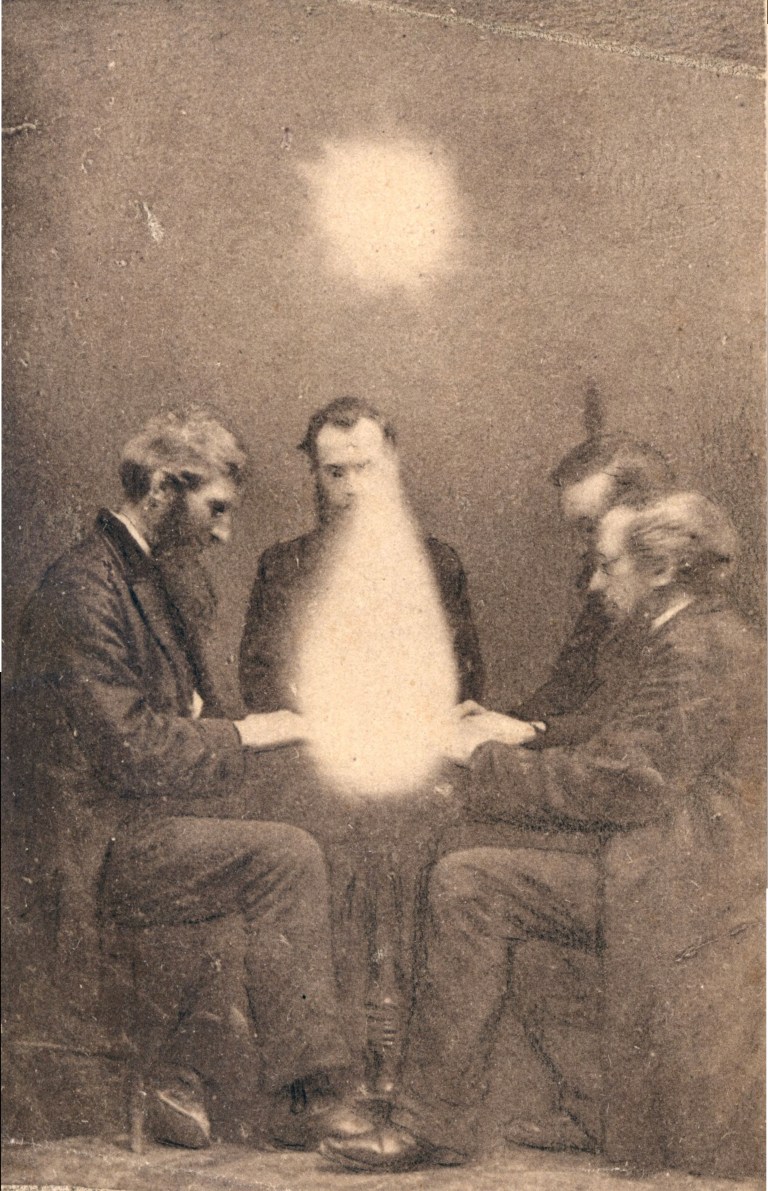
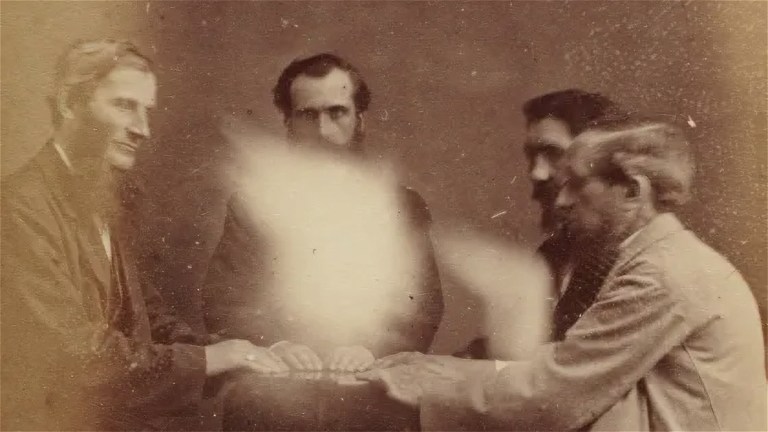
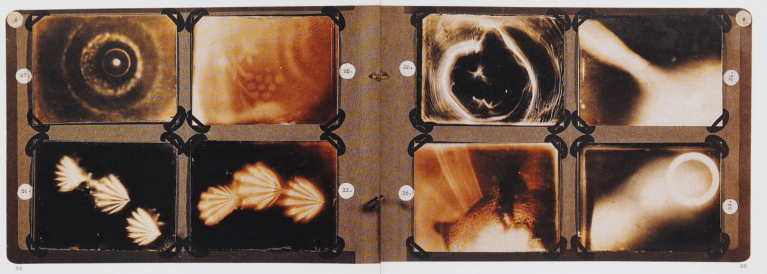
Prior to his writing, this Beattie had himself successfully experimented with spirit photography; abstract light forms appear in these 32 photographs which show Beattie seated at left (beside another, unidentified, in the second image below), Mr Butland (the medium) in the middle, and two witnesses. Dr Thompson and Mr Thommy on the right.

In Beattie’s son’s adopted country, the Melbourne Leader newspaper of 29 September 1900 notes the marriage in London’s Forest Hill Congregational Church on 8th August of the sole permanent war correspondent for the Sydney Daily Chronicle the Irish-born Martin Donohoe, and Miss Madge Tilley, also of Sydney, who had been Principal of Claremont College, Randwick.
Martin had reached London for his wedding only at the end of July on the Dunottar Castle, with a number of returned correspondents from South Africa’s Boer War. The Leader noted that he was “much broken in health owing to the hardships of a soldier’s life, and several attacks of malarial fever. However, he is now almost well, and three months’ travelling on the Continent with his bride should restore him to bis usual health.”
Born Margaret Tilley in Sydney in 1864, Madge Donohoe claimed to have been a suffragist from girlhood through her evangelical upbringing. I wonder did that also inspire her production of skotographs—’dark-writing’. Surely only a religious background could link, and only tenuously, two passions that are so much at odds. I wondered were there two Madge Donohoes.
Woman’s Christian Temperance Union membership in her twenties found her a position on its executive from 1890 to 1894, and from 1892 on that of the Womanhood Suffrage League (WSL) for the next seven years, a position that brought her a lifelong friendship with another Australian women’s rights activist Rose Scott. When she left in 1899 for London to marry, Madge’s identity in Australia as a pioneer suffragist diminished, while in her international career, as James Keating shows, her Australian loyalty was tested against new demands for women suffragists to embrace an intercontinental citizenship.
The Sydney Mail and New South Wales Advertiser on 17 Sep 1902 received from England The Lady’s Realm magazine for August and quoted its article on ‘Notable Australian Women’
“Of Mrs. Donahoe, it is said she is best known as Miss Madge Tilley in her native city of Sydney, where she lived till two years ago, and where she has a great reputation as a charming and elegant lecturer and platform speaker on woman’s suffrage and economic questions, is a contributor to various magazines under a pen-name. Being gifted with great powers of reasoning, choice language, and a graceful manner, she is said to be able to give points to 99 out of every hundred platform speakers of the sterner sex, and is withal one of the gentlest and most womanly of women. Being a notable linguist, and wishing to save her country’s speech from further deterioration by the disagreeable vowel corrupted accent which of recent years has been lamentably increasing, she read a paper on ‘The Australian Dialect’ before an association of University professors and heads of schools, which, appearing in the daily papers, led to hot discussions and many interviews with the writer, who became for the time being the most talked of woman in New South Wales—for, strange to say, the Australians as a race, like the Americans, are the last to admit that they can have any possible accent whatever.”
As such a ‘charming and eloquent lecturer and platform speaker’, she was the conduit between British and New South Wales suffragists, her fluency in four European languages making her an attractive candidate to represent the Australian Commonwealth abroad.
Ten years after she left Australia, Donohoe had attended seven international women’s conferences on subjects ranging from human trafficking, to suffrage, including on women’s victory in Victoria, the one state of the Commonwealth in which women were not enfranchised for the local Parliament, which had at last, in 24 November 1908, fallen into line with the other States; she considered herself an international ‘veteran representative’.
In 1909, Donohoe’s career as an international suffragist ended abruptly, as Keating notes; Vida Goldstein’s national vision collided with Rose Scott’s opposition to Federation and internal struggles paralysed Australian participation in the International Woman Suffrage Alliance (IWSA).
On a short return to Australian in 1913, Donohoe was interviewed by the Daily Telegraph, but as ‘A War Correspondent’s Wife’, unremembered for her work to gain women the vote;
“About my interests? My chief one is woman’s work. Before I left Sydney I was an ardent worker in the cause of woman suffrage. No, I am not a militant, though at first I agreed with the militants. But directly they started destroying property and endangering life they lost my sympathy. I am very proud of our women, because they set the example to the world’s women in getting the suffrage by the soft art of persuasion. … women of several countries in which I have travelled, among which I may mention Holland, Denmark, Germany, Austria, France, and Italy, have expressed surprise that, though we have the vote, and are eligible for Parliament, we have not yet elected a woman to represent us. But I have had to tell them sorrowfully that Australian women do not trust their own sex enough to put one of them in power. It is my opinion that a woman is needed in the Australian Parliament to voice the needs of women. If Miss Vida Goldstein, for instance, or any other woman of like capacity, stands for election again I consider it the duty of all women to support her, even if they do not happen to agree with her politics. Woman’s wants are the same the world over, and no matter what the political creed of the candidate may be, she would work in the special cause of women, children, and the home. In Sweden and Finland they have had women representatives for years. Personally, I should like to see our Miss Rose Scott in Parliament.”
She turned to journalism and writing short stories and, during WWI in which Italy equivocated before joining the Allies against Germany, penned a series of influential articles “The Australian Soldier as Seen Though Italian Eyes” for the The British-Australian,later reprinted as a pamphlet to raise funds for the Red Cross. She also wrote poetry; back in Australia on the first day of 1919, The Lone Hand printed;

Is this a hint of her new, or augmented, interest in spiritualism? Her husband was to die nearly ten years later, in 1927 when she was 64, so unlike other women converts, hers was not the result of mourning a prematurely-dead loved one.
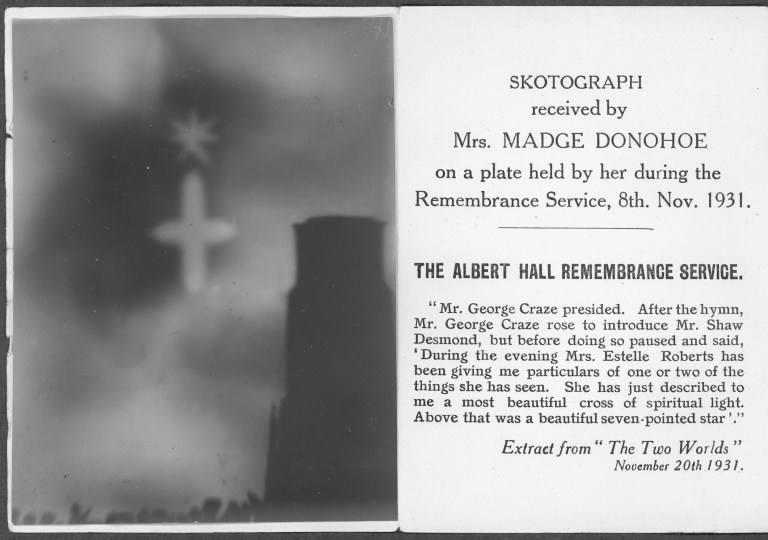
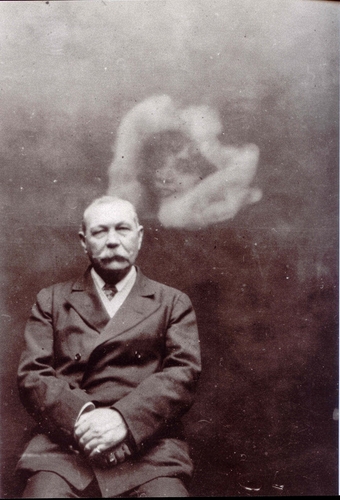
From around the time of writing Before Their Graves (and despite being known in 1902 for “great powers of reasoning”) she joined The College of Psychic Studies in London where she was a disciple of Ada Emma Deane, a teacher of spirit photography, and by 1921 began devoting herself to skotography; the term coined from the Greek by College member and investigator, Felicia Scatcherd for photographs ‘written in the dark,’ of spirits apparently taken without a camera or light. The word was mooted as that to be used for X-Ray photography when it was first conceived.
Pressing a packaged photographic plate against her face, generally at night, Donohoe “entered into communication” with the “unseen operators” by whispering letters or words which sometimes caused the package to move. In this way she obtained detailed instructions on making the photographs. By the late 1930s, she had produced almost 4,500 images; portraits of the departed, scenes of ‘the beyond,’ and ‘scripts’ in a coded language of dots or signs.

 Messages were sent to her from the late 1920s by the spirits of her late husband and by Sir Arthur Conan Doyle, who was awed by Donohoe’s experiments during his lifetime. In a series of several hundred images, the two spirits transmitted scenes from the life of the pharaoh Amon, as told to them by the pharaoh himself.
Her conversion was winked at in Australia by The Bulletin;
“News drops in from London of lectures by Mrs. Madge Donohoe, formerly Miss Tilley, of Sydney. The widow of the Australian war correspondent Martin Donohoe has been chatting of “Life on the Other Side.” Mrs. Donohoe, years ago, was attracted by the lure of spiritualism in the Conan Doyle style. Her lantern slides at one London lecture showed Skotographs, in which ancient history in the land of the Pharaohs was impressed on the screen with suitable messages from the dust of ages.”
In fact, Donohoe’s only contribution was to expose the emulsion to her brainwaves, before she took them to Harry Lansfield, the exclusive processor of her images; this anomaly explained as a ‘co-mediumship’ by credulous spritualists.
Really, though their origin in photograms of cut glass, perhaps printed though a layer of lightly fogged film for a mystic haze, is fairly obvious to anyone who has messed around in a darkroom, these are quite luminous, abstractly iconic images, and each has an aura that might be believed to be divine by anyone who wished them to be. Faces and figures, which we are hard-wired to detect, emerge from the blurred forms. 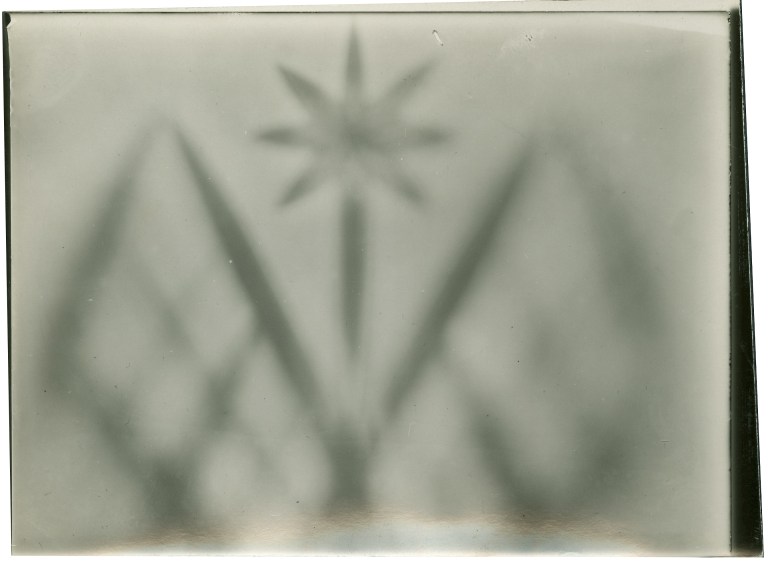
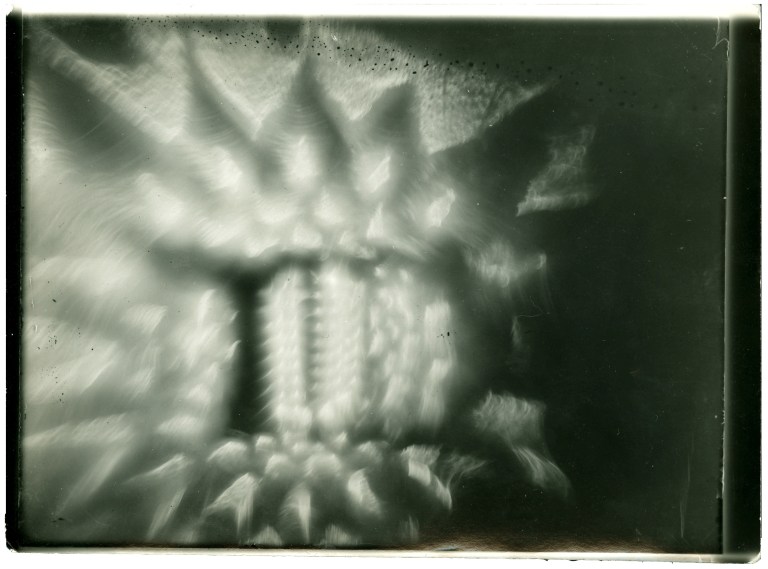

On the other hand, had a fingerprint expert examined marks that appear on some, like the ‘medallion’ below that the spirit of Conan Doyle bestowed upon her, they might be shown to belong to Lansfield and not Donohoe.

In her defence when accused of collusion with Lansfield, Donohoe observed that the content of many skotographs was directly related to things only she knew about: her personal history and, often, thoughts she had at the time, explaining them as thought photography. Her husband’s spirit almost daily presented her with flowers via a skotograph, and they were Waratahs, or other Australian native plants. That raises the possibility that these exquisite découpages were the work of Donohoe and not Lansfield.
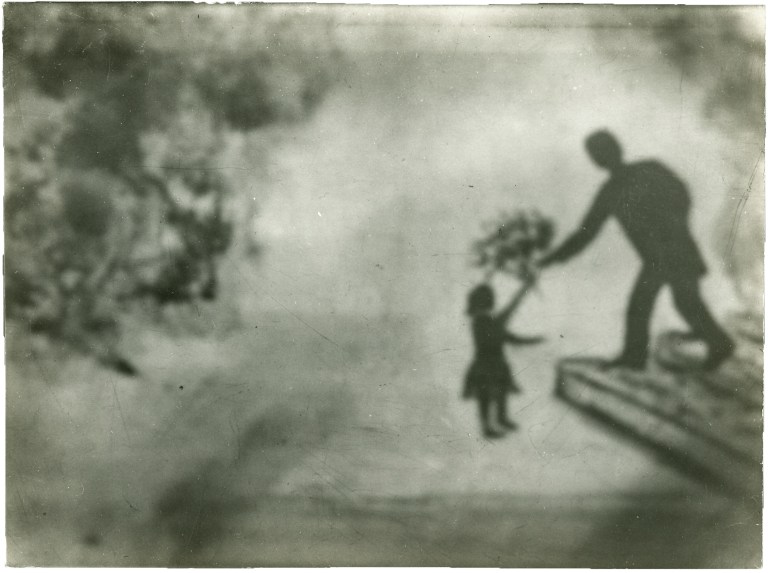
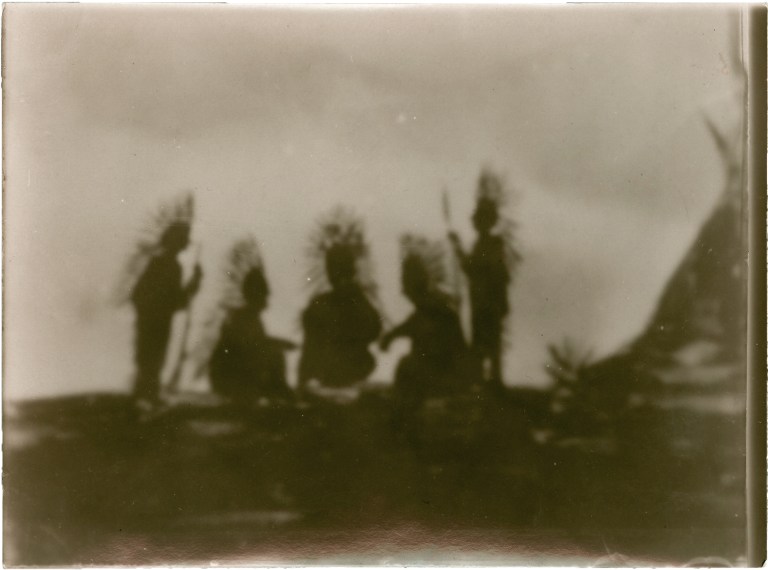
Such, more literal, but still soft-focus scenes of the afterlife are painstakingly produced with abundant particulars; the spirits appear modestly clothed and apparently have need for conventional architectural details like stairs. Others live the life of the American First Nations people, who like the Egyptians were a fascination of Donohoe’s.

An elaborate, layered stage-set is developed for the enjoyment of these dead children; a leafy flower-strewn garden, see-saw and in the background the tents of a bright fairground. Conscious of our audience, one waves a friendly, thankful greeting. If there were mothers of such lost babies who paid Donohoe for her visions, I can find no such record.
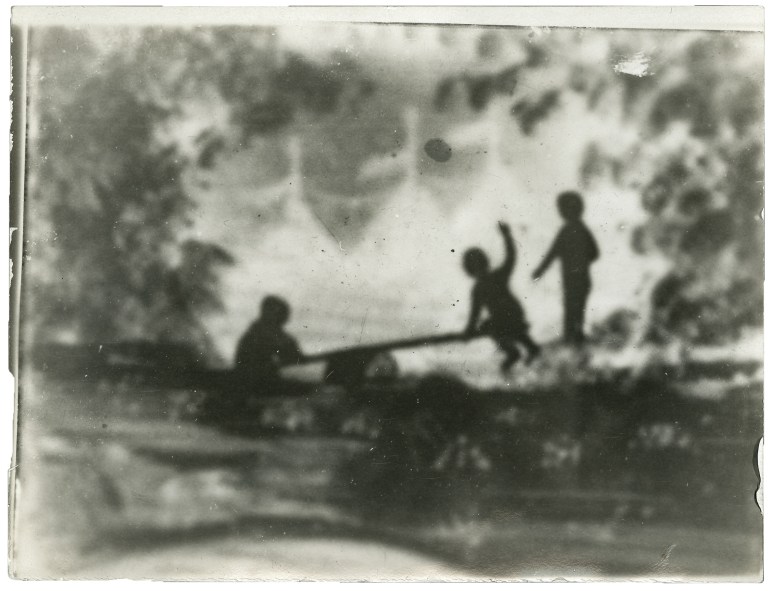
That cut paper is used, though perhaps augmented with stamping or montaged with a fuzzy negative of foliage, can be affirmed by comparing Donohoe’s scenes with Alice Lex-Nerlinger‘s photogrammed paper montages, produced contemporaneous to hers but that have a strident, feminist-socialist purpose.
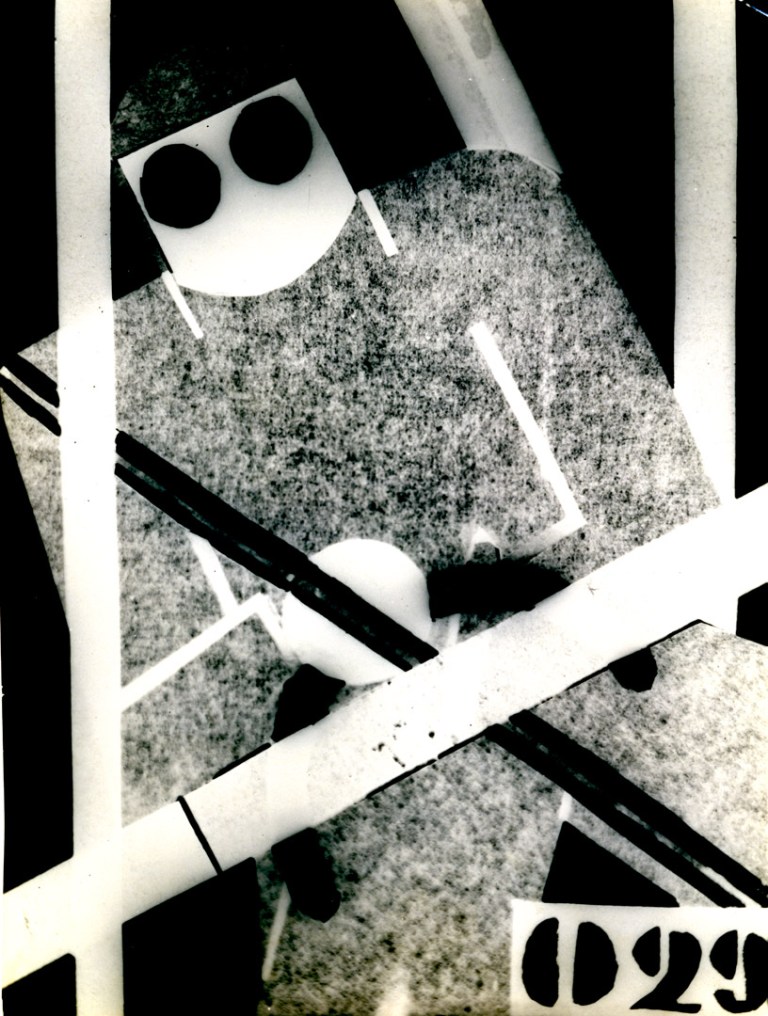
Other visions produced by Donohoe use lens-based imagery, like those of her mentor Ada Dean, but montaged with photogrammetry elements, which preserves a poetic redolence.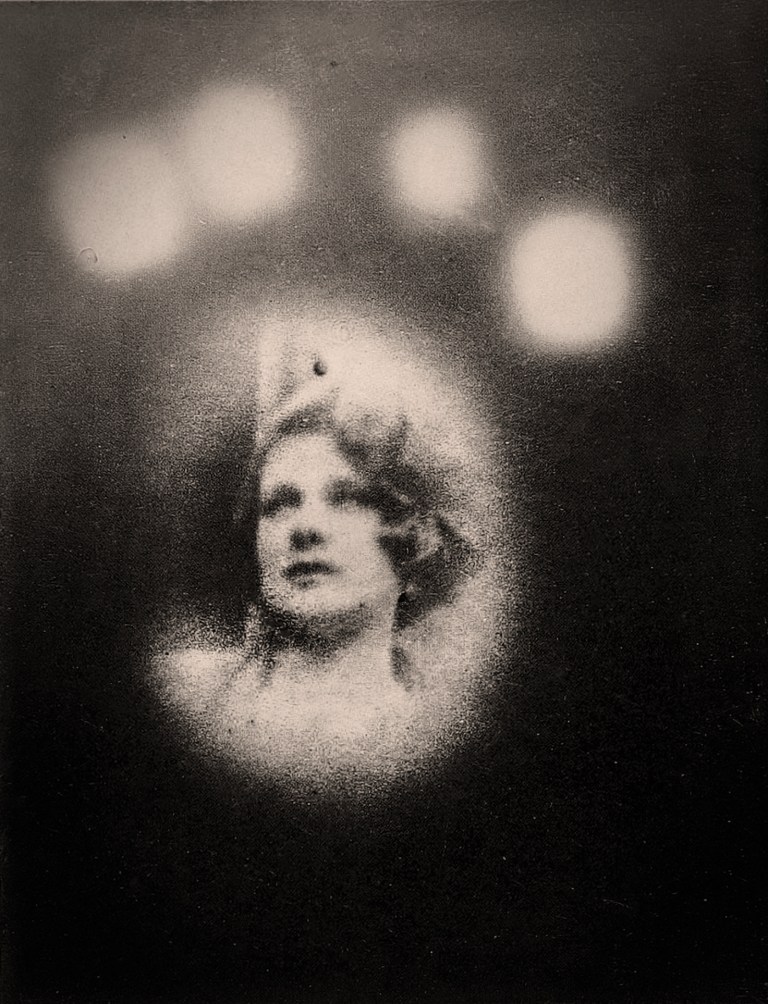
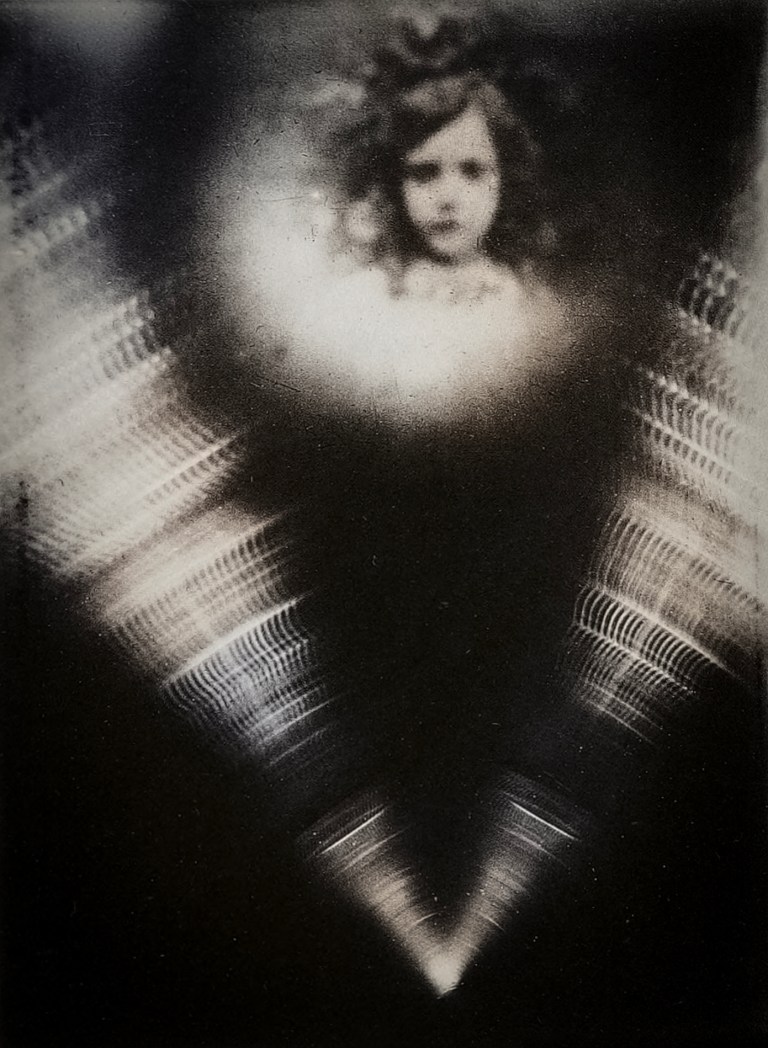
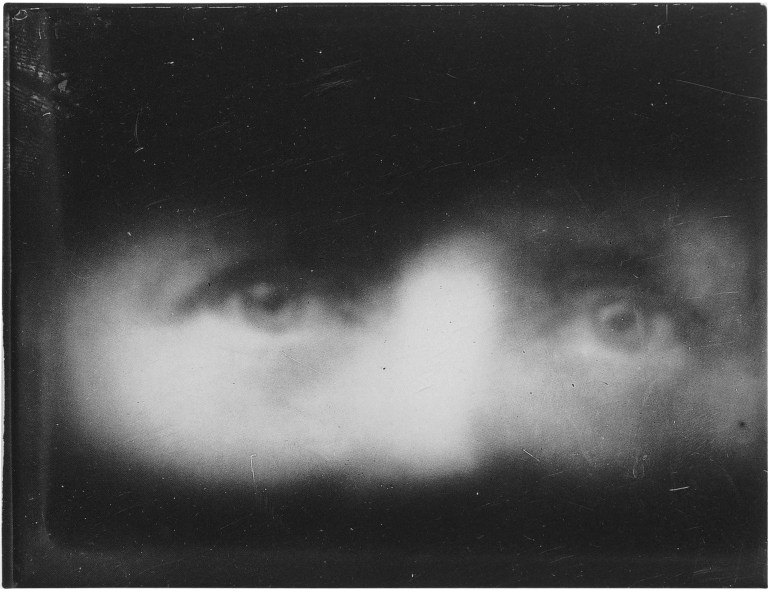
Of all spirit photographs, and perhaps because of her writer’s imagination, and sophisticated social awareness, Madge Donohoe’s are the most convincingly psychic, and loaded with her yearning for an afterlife.


 On This Date in Photography: by James Mcardle