Discover photography now, through its past. Click on any date to access a long read posted that day.
January 27: Discourse
Freda Freiberg (née Fink; 18 September 1933 – 26 April 2024), whose Wikipedia entry I have recently contributed, was an Australian academic, writer, and critic widely recognised for her contributions to cinema studies. Her frank and incisive voice also joined the critical discourse around photography in Australia.
Born into to a Jewish-Polish family in Kew, Melbourne, her mother was Miriam (Mina) Fink who as noted here, was “one of Australia’s most influential Jewish community leaders of the twentieth century”, whose early life in in Bialystok, Poland was tragic; Mina and her brothers were orphaned when their father died in a typhus epidemic and their mother committed suicide. At nineteen Mina married manufacturer Leo Fink who had migrated to Melbourne, where they arrived in November 1932 shortly before the births of daughter Freda and son Nathan.
Freiberg completed a Bachelor of Arts (1955) and a Diploma of Education (1965) at the University of Melbourne and taught English in government secondary schools. Within a few years she would move into film history and criticism, begin advanced studies of Japanese language, and establish herself as a leading Australian specialist in Japanese film and visual culture. While completing those Honours degrees she taught a pioneering course in film history and film criticism at Coburg Teachers College, and in 1981 lectured on ‘The Women’s Film’ at the Council of Adult Education.
In the late twentieth century, particularly during her tenure as a critic for The Age newspaper from December 1994 to June 1997, Freiberg’s writing provides a window into the period after Prahran College had amalgamated with the Victorian College of the Arts (1 January 1992) and when Prahran alumni of 1968–1991 were out exhibiting in the galleries she frequented. Freiberg’s photographic critiques also appeared in specialist journals Photofile, Eyeline and Metro Magazine.
Fellow critic Adrian Martin regarded her as formidable; “a feisty soul who never stood for any bullshit”, and who was unafraid of difficult subjects; while Jennifer Sabine remembered her as a “dynamic and fun” interlocutor. Monash colleague John Gregory “valued Freda most for the humanity of her outlook. Humanism, of course, came in for deserved criticism in the postmodern era. But I admired the way in which, for all her determination to participate in contemporary cultural developments, Freda was always a humanist in the sense that she always gave the more worthwhile achievements of the past their due.”
Freiberg’s approach treated landscapes, bodies, and portraits not as neutral subjects but as social and political texts or ‘inscriptions’ that require interpretation rather than passive reception. What distinguished her criticism was a clear theoretical orientation: a feminist and very conscious of racism, she rejected simplistic notions of photography as a transparent reproduction of reality, insisting that since photographs are constructed and mediated artefacts, that criticism must discover how they encode agency, gaze, gendered space, and ideology.
J. W. LINDT (180s, printed 1920s) Fernshaw. The maiden all forlorn, gelatin silver photograph 25.5 × 44.6 cm. National Gallery of Victoria, Melbourne, purchased, 1972
Cinema was her first love, and an early Age review, 4 January 1995, of Victorian Views: Photographs of the Landscape 1850s-1920s at the National Gallery of Victoria, shows her orienting herself in examining our medium. For example, she notes of Fernshaw, The Maiden all Forlorn 1882 (by J. W. Lindt, though she credits it to Frederick Kruger):
Here the high Romantic (Keatsian) title of the photo is belied by its prosaic content. for the young woman would seem to be a member of a farming family about to milk a cow. The Heidelberg school’s use of the feminine figure to endow the landscape with beauty, mystery and pathos is here foreshadowed – and exposed as a ploy.
Freda looks closely enough at technique to point out the retouching, often unsubtle, employed by photographers of the era, remarking that it serves “to remind us that photography was never the unmediated reproduction of reality it was purported to be”
The glossy, clichéd or purely touristic image, she argues , “observes without seeing or saying anything” and fails to engage the complex social and political textures of visual culture: of a show of Leica camera imagery at Westpac gallery, she writes (26 October 1996) for The Age:
Leonard Freed (1979) New York policeman with puppet and gun. From Freed’s 1980 book Police Work
We have been over-exposed to glossy documentary photography in magazines, advertisements and television; furthermore, widely accessible tourism and do-it-yourself photography have made us all competent recorders of exotic scenes. It takes a great deal of effort to arrest our attention.
The celebrity shots of Marilyn and the Kennedy brothers in this exhibition seem quite banal. Neither extravagantly staged (like a Leibovitz or Morimura) nor intimate and empathetic (like a Nadar), they observe without seeing or saying anything. Some familiar names of left and right display their credentials: Brazilian photographer, Salgado ennobles stoic Sicilian fishermen, while Leni Riefenstahl ennobles nude male Nubians […] but too often I had a sense of deja vu. Jeff Dunas’ Laura, leaping over the pavement in front of a European church, seemed to replay Avedon’s postwar work for Vogue; the village postman recalled Kertesz’s scenes of rustic Hungary; and Eisenstadt’s Eiffel Tower mimicked Moholy-Nagy’s dizzying views of city buildings. Two shots alone avoided the cliches of tourism. Leonard Freed’s New York Police Department officer, confronting a gun pointed at him by a look-alike glove puppet, provides a quirky social observation that is both witty and disturbing; and Michael von Graffenried’s one-legged woman in shower, with artificial leg resting on a pillar at the side, renders a voyeuristic situation almost clinically unsettling.
A panoramic view of Melbourne’s photography scene in 1996 is sketched in Freiberg’s 4 October column in The Age, before focusing on the Centre for Contemporary Photography (CCP):
If you think New York and Tokyo are the centres of photography, you are due for a rethink – photography is flowering all around Melbourne. Not only is the visual arts program of the Melbourne Festival focusing on the art of photography this year, but we are finally witnessing the fruits of two decades of dedicated activity in Victorian photographic culture. Pioneer efforts in training and specialist galleries have given way to an expanded educational and exhibitions arena. Photography is taught, at undergraduate and postgraduate level, at the VCA, RMIT and Monash University; spaces for discussion and debate and criticism have increased; and work is regularly exhibited at the significant art galleries.
The Centre for Contemporary Photography (CCP) has played an important role in developing Melbourne’s photographic culture. Founded a decade ago as the Victorian Centre for Photography (VCP), as a resource centre for local photographers, but without a home or gallery space, it was confined to organising occasional events (workshops, lectures and screenings) and one important survey exhibition of contemporary Victorian photography, The Thousand Mile Stare, at ACCA in 1988. In 1990 the VCP acquired its first premises, a tiny gallery and office in Carlton, enabling a continuous program of exhibitions and events; but in 1992 it moved to the much larger warehouse premises in Fitzroy. It houses three gallery spaces and a large office. The two larger galleries exhibit experimental and innovative work. Government assistance allows noncommercial, cutting-edge work employing new technologies and unusual formats to be shown. The third gallery, the Helen Schutt Access Gallery, operates on a rental basis.
In addition to its busy exhibition program, the CCP has an active educational program. It runs practical workshops, seminars and lectures, led by leading Australian photographers, critics, and academics; and publishes a quarterly newsletter, occasional catalogues and annual collections of critical essays. The CCP is a non-profit public gallery and resource centre, dependent on community support to maintain services. Tomorrow at 3 pm, Mark Fraser from Sotheby’s will auction works donated by leading Australian photographers. All will be on display from Friday to Sunday at the CCP.
I have emphasised in bold the Prahran people she goes on in that article to mention among contributors of the 40-plus works, including:
…landscapes by Susan Purdy, Les Walkling and Leah King-Smith; fine prints by John Gollings and John Cato; and historic photos by Mark Strizic (Collins Street in 1963) and Sue Ford (The Reconciliation of 1989). Veteran industrial photographer Wolfgang Sievers [a Prahran examiner] has contributed a dramatic view of an oil drill in Bass Strait; Anne McDonald, four exquisite flower studies; Graeme Hare, an expressive rendering of the Majestic Hotel in midnight blue and aqua; Anne Ferran, a subtle study in soft drapery; Deborah Ostrow, a portrait of a St Kilda prostitute; and Carolyn Lewens, a memorable mask-like face in gum bichromate. Poli Papapetrou and Janina Green offer studies in the suburban grotesque; Ross Bird supplies a dramatic vision of Ned Kelly, from his work for the Kickhouse Theatre. Last but not least, Bill Henson‘s mystery contribution, as yet unseen, is rumoured to be a segment of his recent Venice Biennale series of youths amid debris in the bush, valued at about $2500. The CCP is at 205 Johnston Street, Fitzroy
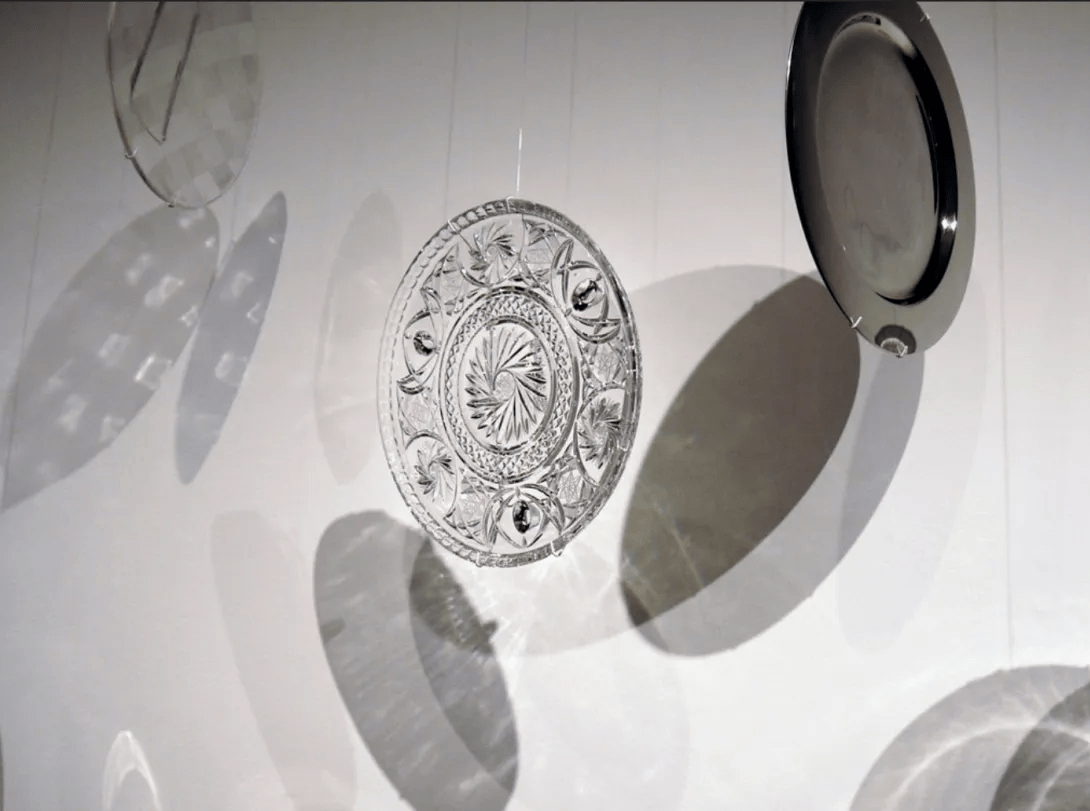
Installation view of Susan Fereday’s 1995/6 exhibition at Sutton Gallery
’80s graduates of Prahran (when it became Victoria College with Cato still at the helm) and reviewers of their shows in the 1990s, grappled with postmodern strategies, with women artists in the vanguard. Few reviewers however, other than Robert Schubert in Art & Text, and Freiberg in her 26 June 1996 article below, conveyed such insight (expressed more economically than Schubert’s) into the Susan Fereday (studied Victoria College, Prahran, 1986) exhibition of photography with few actual photographs (only photograms in fact):
At Sutton Gallery, Susan Fereday continues her exploration of the fascination of photographic images: images that are no more than – and yet more than – material traces, shadows and residue of the ephemeral and the fragile. In her current installation, glass dishes suspended from the ceiling cast dancing shadows on a white wall. On the wall, papier-mache boards made from the pulped residue of art world literature, indented with traces of the dishes and sparsely decorated with fragments of critical catchphrases, are interspersed with delicate black-and-white photographs of indefinable objects. This gentle, dreamlike scenario, suffused with a touch of melancholy, provides a rare example of a perfect conjunction between critical theory and personal expression.
Freda Freiberg ‘Life in the likeness of the Australian male’, The Age review 25 April 1995
Earlier, on 25 April 1995 (though she does not mention Anzac Day) Freiberg reviewed Likeness: 48 photographs from the Waverley City Gallery collection, curated by Susan Fereday, at the Centre for Contemporary Photography when Fereday was the CCP second director there (1992-1995) after Deborah Ely.
James McArdle (1990) Jeremy’s Stubborness. Selenium toned silver gelatin print
Each cluster of photographs forms one set of common photographic preoccupations. We find a set of urban and industrial sites reduced to formal grids; a larger set of aerial views of people, pebbles or grains of sand, viewed as a finely textured mass; a set of moody inner suburban streetscapes; a set of Ocker mateship ritual sites; an adjoining set of the bronzed backs and broad shoulders of Aussie males; a small set showing a solitary human figure dwarfed by a grandiose sublime setting; a set of similarly framed portraits; and a set of disconnected body parts, a limb or face looming in limbo.
The total absence of female bodies, clothed or unclothed; of children, at play or at school; and of family life, either celebrated or satirised; begs questions. What are the reasons for these absences? We could simply dispose of the question by pointing to the fact that all except one of the exhibited photographers are male, and therefore evince a masculinist outlook. But there are other, more insidious, historical, cultural and institutional factors at work here.
Those, Freiberg explains, include the need to distinguish ‘art’ photography, dominated at first by men, from commercial and portrait photography which so often served domestic (and supposedly women’s) interests.
Despite being in the company of those giants she mentions— David Moore, Grant Mudford, Wolfgang Sievers, John Cato, Max Dupain and Bill Henson—Freiberg’s review made me uneasy to be in the show unasked. Was my picture of my dear brother just “a solitary human figure dwarfed by a grandiose sublime setting,” or a “face looming in limbo”? How did the other exhibitors feel to be held up as ‘Australian males’? The same perhaps as women recruited for women-only shows?
More pictures, portraits, of male, and female subjects, ‘from famous Australians to singlet-clad garbos’ as Freiberg appeared at Waverley Gallery in Face Value: Portraits from the Collection, curated by Anna Clabburn. Freiberg writes in her 20 September 1996 review:
The classic celebrity portrait is strongly represented by David Moore’s, Brendan Hennessy’s and Geoffrey Smith’s depictions of Australian artists and writers. But they are varied: Hennessy stresses the character of Dorothy Hewitt by placing her between two corrugated iron roofs.
100 faces, 4 March–28 May 2023 at the Museum of Australian Photography, with Brendan Hennessy portrait of Patrick White bottom row, left.
Brendan Hennessy (born 25 May 1940) had been one of the ‘lost’ alumni until his youngest sister in Ireland contacted us through Andrew Chapman: “Brendan travelled a lot in his younger years and left Dublin to join the army to go to the Congo at 15. He forged his age to get out of Dublin as many did back then”, and “when he returned stayed only a couple of years before migrating to Australia, not returning for 30 years.”
Brendan was enrolled at Prahran College in 1974–75 but did not complete the course. While still a student he contributed, alongside several other Prahran students, to the book Woman 1975, and in the same year he photographed The Pram Factory’s production of Waiting for Godot. During the 1980s he made portraits of artist Elizabeth Jolley, poets Les Murray, Ania Walwicz and A. D (Alec Derwent) Hope, and novelists Marjorie Barnard and Patrick White, now held in the State library of Victoria, while the National Library holds a larger set of prints by Hennessy of A.D. Hope; Helen Garner; Patrick White; Olga Masters; Beverly Farmer; Peter Carey; Christopher Koch; Ania Walwicz; Andrew Taylor; Antigone Kefala; Janette Turner Hospital; Marjorie Barnard; Donald Home; John Morrison; Susan Johnson; Nicholas Jose; John Bryson; Peter Mathers; Elizabeth Jolley; and Germaine Greer. Several were published in The Australian literary calendar 1989 with texts and a bibliography by Kate Ahearne, and published by University of Queensland Press in 1988. The Patrick White portrait features in Australian Arts Review 16 April 2018 and at Inside Story 5 December 2025.
Brendan Hennessy (1984) Patrick White, printed 1987
Brendan’s Prahran co-aulumna Sandra Graham lost contact with Brendan in about 1980. He had then a son with Kate Ahearne who collaborated with Brendan by contributing interviews, including with Peter Carey and Jeffrey Smart, and wrote reviews and articles in the early 1980s for magazines Australian Book Review and Going Down Swinging. Australian writer Kevin Brophy writes that Going Down Swinging was a small literary journal he published from 1980 to 1994, with friends including Brendan Hennessy “and many others…the little magazine introduced me to some of Australia’s most exciting new writers.”
Sandra remembers that “Brendan seemed passionate about literature and writing, and was photographing some well-known authors. He was decidedly sceptical about photography as an art form and photographic art theory in my discussions with him back then, but clearly passionate about portraiture.” Brendan’s sister Liz remarks that “He was never into material stuff and lived a simple life but treasured his photos.” Brendan returned home to Ireland and Dublin only a few times before he lived there more continuously from 1989 and died there in 2016.
Hennessey’s work was included again recently in 100 Faces at the Museum of Australian Photography (previously Waverley Gallery) 4 March –28 May 2023, curated by Angela Connor, MAPh Senior Curator and Stella Loftus-Hills, MAPh Curator.
Freiberg also turned her attention to First Nations artists including Prahran alumna, another contributor to Face Value,Leah King-Smith, in a review Blended images evoke strong connections of land and spirit (22 November 1995 in The Age) at Gallery Gabrielle Pizzi in which she notes a distinctive style of photography which “speaks to us all”:
Leah KING-SMITH ‘Untitled’, 1991, from the earlier series Patterns of Connection, C-type photograph, 105 x 100cm. Horsham Regional Art Gallery Collection. Image courtesy of the artist.
As in her earlier work, and her contribution to another current exhibition at the Jewish Museum, she superimposes one image on another to produce a ghosting effect. “Ghosts” of sculpturesque Aboriginal faces are superimposed on rock faces, outback landscapes on gravestones, a dancing figure on an indigenous rights rally, a ground-level perspective on an aerial perspective, and negative images on positive ones. Her hitherto favored use of ghosting, involving the superimposition of people’s faces and figures on to the landscape, produced multiple metaphors. We could see them as potent and pointed reminders that the spirits of the ancestors live on in the here and now, that the land is haunted by a history of injustice and oppression against the indigenous people, that the shadows of the past persist in the present and that the people return to, and remain in the land to which they belong.
But, in this exhibition, King-Smith shows signs of moving beyond anger and sorrow, and beyond concern with a specific cultural heritage, to a search for transcendence of difference. Her fluid layering and blending of images evoke the now common experience of fluid identities and blended perceptions, in place of the rigid monocultural and monocular vision of colonial Australia [. . . ] It also shows a desire for connection, if not reconciliation, between black and white, the land and the people, the political and the spiritual, the living and the dead [ . . . ] let me assure you that you don’t have to be a nomad or a necrophiliac to enjoy this show. It speaks to us all.
Unknown photographer (c.2018) Leah King-Smith with her 2018 series Dreaming mum again. Courtesy National Portrait Gallery
As Barbara Creed, Freiberg’s collaborator and co-author on a number of publications notes in Camera Obscura: Feminism, Culture, and Media Studies, 1 December 1989: “Questions of spectatorship have been addressed in relation to photography, particularly in the journal Photofile and in various photographic exhibitions. Writers such as Helen Grace, Freda Freiberg, Lesley Stern and Lis Stoney, who also work in film studies, have brought an interesting perspective to bear in their articles on photography by drawing on debates about spectatorship in film theory.” That is the case in Freiberg’s review of Prahran 1980s alumna Rozalind Drummond‘s Peeping Tom, at Monash Gallery:
…everyone loves a surreptitious peep, if not a studied gaze, at the bodies and business of others. Rozalind Drummond…invites us to turn our gaze back on the professional peepers, to play their game. We are asked to play the sleuth, examining a motley collection of objects — a shelf of antique books; a library catalogue, a surveillance monitor (which shows us our own image), a woman’s dress, three glass cabinets containing “evidence” and bundles of old photographs, a vídeo of the film, a list of women’s names, a wall covered in photographic blow-up portraits of women and another series of B&W views of London streets and the interior of the Freud Museum.
Michael Powell’s Peeping Tom secured its cult status when in 1960, hostile reviewers and panicky distributors famously sank this film and it became mere rumour of ‘snuff porn’, a forbidden text.
Women in Drummond’s photographs in the cabinets and blown up on the walls “are posing, more or less seductively, more or less exhibitionistically, more or less clumsily, for the camera; some appear to be taken in studios, others in lounge-rooms,” leading to the assumption of a camera-man and curiosity about his presence in these homes:
What was his relationship to the women he photographed? Was he an amateur or a professional? The sinister possibilities are enhanced by the setting of the photographs alongside books on taxidermy, spying, morbid fears and compulsions, and mysterious psychic forces
Ultimately, as Freiberg concludes; “The exhibition raises the question of what it means when a woman assumes the role of peeping Tom” against debate about voyeurism and sadism as a pathology of the male gaze; “Drummond, as a female photographer, is uncomfortably positioned.”
Quite the contrast was the 1996 show of fashion photographs at the NGV by Athol Shmith. His work had previously been shown in a substantial survey 21 October 1989–25 February 1990, the year that he died and a decade after he had left his position as head of photography at Prahran to John Cato. Freiberg remarks on a token reshowing of that imagery as an adjunct to physical examples of couture:
The model’s pose in a Shmith photograph is so totally controlled and formally calibrated that the human figure can sometimes be reduced to abstract pattering or frozen stasis. But if his work lacks the movement of Avedon’s, it also lacks the sexy vulgarity of Helmut Newton, which would have been quite unacceptable to the society of his time. His work is never vulgar and is largely devoid of sexiness; it offers an aesthetic and glamorous vision of the feminine. (‘Classic chic shots’, The Age, 17 September 1996)
Bill Henson (1996) Melbourne International Festival of Art, Melbourne
Freiberg’s 22 October 1996 review of Bill Henson‘s reshowing in Melbourne of his Venice Biennale installation reveals a critic so confident in her mind as to be able to change it, but with conviction to write so that her hesitations about a big name carry weight:
Bill Henson has not had a good press from local critics. As the only Australian photographer to make a mark on the international scene, and to command high prices in the art market, he undoubtedly provokes the local tendency to pillory tall poppies. He has also provoked criticism from conscientious critics on moral grounds – for using the bare bodies of adolescent girls and emaciated drug addicts to service his self-expression.
I must admit to sharing such attitudes in the past and failing to respond enthusiastically to his work. He seemed to me to be too obviously straining towards acceptance by the international art world, to proclaim the desire to be a “Great Artist”, to situate himself outside of, above and beyond the history of photography. His faces in the street and opera audiences were painterly impressions rather than photographic portraits. His ambitious triptyches placing pathetic young druggies alongside high baroque European settings seemed less a grand statement than a gross gesture.
However, the installation he prepared for the Venice Biennale last year, which has since been exhibited in art galleries around Australia, finally seduced me.
The breaking up of the surface of the work, with jagged pieces of white photographic paper, seemed to signal a new humility. No longer seeking to transcend his medium through disavowal, he was now acknowledging it. The collage, too, produced a more complex configuration, a jarring jumble of scraps of landscape, urban debris and naked youth in postures of sexual abandon.
His new installation for the Melbourne Festival reworks this material, but with significant changes. The site, the abandoned power station in Spencer Street, has been used to magnificent, dramatic effect. All natural light has been blocked out; it is as dark as a tomb or underground vault. After a few minutes, when you adjust to the dark, you start to see the works on the walls, but still dimly, incompletely. Parts of the collages have been spotlit, making the white elements glow and stand out in the dark. In the background, you discern snow and mist-covered mountain peaks, and trees silhouetted against the sky; in the foreground, dark undergrowth, with figures of naked youths here and there.
The debris of the last show is less in evidence; the young bodies now tend to be erect and active, rather than prone and languid. All the scenes are bathed in the half-light of a brooding dusk, except for one russet sky.
Surveying 1996 on 1 January 1997 in The Age Freiberg noted that:
PHOTOGRAPHY enjoyed a high profile in 1996. Both the Sydney Biennale and the Melbourne Festival focused on it, while the Harbor City’s Museum of Contemporary Art almost upstaged both with a comprehensive celebration of contemporary Australian photography. Under a bold title, resounding with royalist and religious overtones, it proclaimed “Photography is Dead – Long Live Photography!” The Melbourne Festival promoted it as a theatrical event. It showcased Barbara Kruger’s street-smart billboards, [Prahran alumnus] Bill Henson‘s and Farrell & Parkin’s brooding and macabre Installations in dark, cavernous sites, Annie Leibovitz’s extravagantly staged celebrity portraits, and Yasumasa Morimura’s elaborately staged portraits of himself as celebrities.
However, 1996 was not all guns and roses. In particular, the new regime at the National Gallery of Victoria gave cause for concern. Apart from the Bill Henson Venice Biennale show, there was no contemporary Australian photography exhibited there this year; the only other Australlan work displayed was a small sample of Athol Shmith’s fashion photography, as an appendage to the Couture to Chaos fashion show.
International masters of photography, past and present, were likewise neglected, in favor of a focus on media celebrities-film and pop music stars.
The attitude to photography under Isobel Crombie the Senior Curator, Photography 1988–2012, by NGV management over 1996, Freiberg remarked, “seems to be less than serious,” it then being under the brief directorship, 1995–1998, of Timothy Potts, who was controversially, in 1997, to terminate an exhibition of Andres Serrano’s work (including Piss Christ) after it was violently attacked. Waverley City Gallery, she writes, was “host the most exciting exhibition of the year – a socially engaged, aesthetically challenging cross-section of contemporary International work, Beyond Recognition, from the ANG’s recent acquisitions.”
Vince Dziekan had barely completed his 1996 Master of Arts at Monash (where Freiberg was Lecturer in the Visual Arts Department until 1994) with his thesis Work-in-progress : the influence of photography on the production of representation in the age of mechanical reproduction (1912-1928), with a view towards the development of post-photographic practice and critique, when he was commissioned as guest curator to mount Archival Permanence: Time and Timelessness in 100 Years of Australian Photography for the centenary of the Geelong Art Gallery, with 88 works from its collection and that of other institutions. Susie Shears, Gael Newton, and Susan van Wyk (whose essay accompanies the current Women Photographers 1900–1975 at NGV) wrote also for the catalogue.
Freiberg reviewed the show when it was at Waverley City Gallery (now the Museum of Australian Photography) after it had already toured two other regional galleries, Albury Regional Art Centre (14 December 1996–18 January 1997) and Horsham Art Gallery (7 February–16 March 1997). The works ranged through the 1890s, and the modernists, to contemporaries including Prahran representatives John Cato, Robert Ashton, Bill Henson, Carol Jerrems, Leah King-Smith, and Athol Shmith.
Freda Freiberg (Friday, 11 April 1997) reviews of ‘100 Years of Australian Photography’; ‘John Cato Retrospective’; Julie Rrap. The Age, ‘Metro’ section p.C5
Freiberg is unsatisfied in her 11 April 1997 review of Dzekan’s curatorship:
…the works are not grouped according to period; [Dzeikan] has chosen instead to mix and match according to common themes (such as the beach), or formal similarities, or some idiosyncratic associational logic that is not always intelligible to the viewer. As an attempt to shake the dust off the archives, this was in principle a good idea. But the fracturing of the timeline is not accompanied by a questioning of the archive, for the photo selection favours established names and celebrated images, so seems merely to display a very prevalent disregard for historical specificity…
…adding, as a segue, that “veteran Victorian photographer John Cato is represented in the Waverley show by a single image, but a retrospective of his work is at the Photographers Gallery…”. It is one of the astonishingly few reviews that the longest-serving Prahran lecturer received for any of his exhibitions, and is an incisive and worthy recognition:
Cato has made an inestimable contribution to photography in this state as a teacher. As an artist, he has pursued an intense engagement with nature – with trees, rocks and skies. He studies, anatomises, magnifies and glorifies the manifold designs and patterns of creation.
The social world is absent – except in the Mantracks series, where graffiti on rocks and debris on trees signify the disfiguring effects of an imported culture. But even here, Cato is less social critic than contemplative observer. He finds perfect objective correlatives to his private inner states in the darkness and light, solidity and softness, and infinite variety of patterns in tree trunks, clouds and rock faces.
In an April 1997 tribute to Bernie O’Regan (1938-1996) in Photofile (repeated in the Age 11 December 1996), Freiberg and Deborah Ely describe his commitment and energy in being a major force behind the establishment of Melbourne’s Victorian Centre for Photography and its expansion as the Centre for Contemporary Photography: he also “produced a feasibility study which argued for a resource centre for local photographers and in this role he also initiated the first major survey of contemporary Victorian photography, The Thousand Mile Stare, curated by ]oyce Agee for the bicentennial in 1988.”
Janina Green (1996) Untitled, from the Plantation series. Hand coloured silver gelatin print, 84 x 104 cm, Latrobe Regional Gallery Collection, gift of the artist, 1997.
Alumna Janina Green’s June-July 1997 exhibition at Smyrnios Gallery documented her return to Gippsland after family loss and its industrial decline. There she photographed pine plantations in which she played as a child. Freiberg’s reaction is that:
The beauty and magic of the forest is suffused by the rose and gold-tinted skies and the dark luxuriant undergrowth: the inroads of industrial and post-industrial economies are underlined [ . . . ] but this exhibition is not a cold, clinical documentation of social change, for Green invests the pine plantation with personal memories and journeys, mystery and knowledge.
Freda Freiberg’s contributions to photography criticism in Australia were intellectually rigorous without being inaccessible, and refused to treat the photographic image as neutral or self-evident, emphasising their cultural, political, and ideological frameworks.
Through her reviews of leading figures in Australian photography who emerged from the dynamic environment of Prahran College into the contested arena of the 1990s, Freiberg provides valuable context.
Artist and recovering academic enlightened by the metaphoric potential of focal effects and the differences between human and camera vision. View all posts by jamesmmcardle
To follow this Blog click on the 3 horizontal lines at the top of the page, then click on the blue coloured link that reads Follow BrianRopePhotography
 Freda Freiberg (née Fink; 18 September 1933 – 26 April 2024), whose Wikipedia entry I have recently contributed, was an Australian academic, writer, and critic widely recognised for her contributions to cinema studies. Her frank and incisive voice also joined the critical discourse around photography in Australia.


 Brendan was enrolled at Prahran College in 1974–75 but did not complete the course. While still a student he contributed, alongside several other Prahran students, to the book Woman 1975, and in the same year he photographed The Pram Factory’s production of Waiting for Godot. During the 1980s he made portraits of artist Elizabeth Jolley, poets Les Murray, Ania Walwicz and A. D (Alec Derwent) Hope, and novelists Marjorie Barnard and Patrick White, now held in the State library of Victoria, while the National Library holds a larger set of prints by Hennessy of A.D. Hope; Helen Garner; Patrick White; Olga Masters; Beverly Farmer; Peter Carey; Christopher Koch; Ania Walwicz; Andrew Taylor; Antigone Kefala; Janette Turner Hospital; Marjorie Barnard; Donald Home; John Morrison; Susan Johnson; Nicholas Jose; John Bryson; Peter Mathers; Elizabeth Jolley; and Germaine Greer. Several were published in The Australian literary calendar 1989 with texts and a bibliography by Kate Ahearne, and published by University of Queensland Press in 1988. The Patrick White portrait features in Australian Arts Review 16 April 2018 and at Inside Story 5 December 2025.


 On This Date in Photography: by James Mcardle