 In Melbourne, Rennie Ellis‘ and Robert Ashton‘s Brummels gallery closed in January 1980, the month before the premature death of its inaugural exhibitor, Carol Jerrems, who was among the first cohort of Prahran College photography graduates.
Since opening in 1972, it had shown exhibitions by at least ten Prahran alumni including Carol, with more than one show in the case of several. Brummels demise—with the departure from the college of lecturers Paul Cox and Athol Shmith—marked the end of a distinct Prahran College era; the 1970s.
In December of 1981 came a major change; Prahran College of Advanced Education was amalgamated with three teacher training colleges (Toorak, Burwood, and Rusden) to form Victoria College.

That year a new photography gallery prepared to open when alumnus Robert Colvin donated use of a shop he had purchased at 642 Station St., North Carlton. It was named ‘Visibility’ gallery by the cooperative of other Prahran graduates who ran it; Stephen Henderson and Carolyn Lewens who later formed Working Pictures (1985–1989), Carol Wilson, Joan Harris, Rob Colvin, and artist Elizabeth Gertsakis (b.1954) who since 1976 had lectured in art history and Australian cultural studies and worked as a curator in Australian galleries. Notably, Visibility’s competitor was Gallery 18, launched a little earlier by a committee of three in June 1981 and which ran until December 1983. Among its exhibitions were showcases of work by students and graduates of the privately-run Photography Studies College.
In both 1982 and 1983 Visibility held end-of-year shows of samples of Prahran students’ graduate folios and as an indication of the numbers then emerging from the photography course, each of those shows were held in two parts to accomodate everyone. Geoff Strong in his review of the 1982 offering considers that:
“The Visibility directors’ links with their alma mater seem quite strong and their current show is selections from the folios of this year’s final-year students. Gallery 18 is a little more ecumenical and its two current exhibitors, Nigel Clarke and Gerald Gay, are also Prahran products. This exhibition is probably the best the gallery has had since it opened in June last year.”

Critic and art historian Susan McCulloch (The Age, 14 December 1982, p.19) recorded Rob explaining their motivation: “We thought that there was little opportunity for students to show work and decided to join together to open a gallery,” though that was moderated when “we found that in order to build the gallery’s credibility we had to show established photographers,” they being Fiona Hall, Ruth Maddison, Christine Comish and Melbourne architectural photographer John Gollings who guest-lectured at Prahran and showed his Death Valley series in December 1982.

Consequently, wrote McCulloch, “about one show in three is by a well-known photographer,” with exhibitions held one each calendar month, apart from its closure over two summer months. It was a not-for-profit enterprise and as the directorial team all worked in other occupations, it was open only on Wednesdays and weekends, and ‘by appointment’. McCulloch asked: “With so many directors, is the selection of work for exhibition difficult?” to which Colvin responded: “We’ve actually never had disagreement about a show yet…We haven’t got set rules about the sort of work to be shown except general ones, like we’d never show sexist or offensive photographs.”
That claim might have been disputed when in March 1982 Visibility opened its first show. Cryptic Cadavers was by Martin Lacis who studied, albeit briefly, at Prahran. It featured a series taken in the catacombs of Palermo, a subject previously covered by one of the most thoughtful and poetic of the French Réalités magazine photographers of the 1950s and 1960s, Gilles Ehrmann, who in 1960 started a series of photographs of mummified bodies in the catacombs of Palermo for an unpublished book, Œdipe Sphinx (Oedipus the Sphinx), with the poet Ghérasim Luca. Incidentally, Ehrmann’s series was belatedly exhibited at Galerie Agathe Gaillard, Paris, in 1981, the year before Lacis’s. In an interview with Hervé Guibert, Ehrmann explained:
“I wanted to tell a story about life, I sensed that death could very well advocate for life. Initially, while visiting the catacombs of Palermo, the subject intrigued me. I am not reporting, I am acting towards something.”
 Gilles Ehrmann (1960s) from Œdipe Sphinx

Lacis’s series was titled Cryptic Cadavers, not entirely ‘politically correct’ and rather too lighthearted to be taken as seriously as Ehrmmans’ contemplation of mortality. Lacis’ show was reviewed by another alumnus, Geoff Strong, who was then writing regular photography reviews for The Age. In a characteristically devilish remark Strong quipped that: “It is curious that [Visibility] have chosen to start their life with look at death.” Indeed, the gallery lasted just three years, from March 1982–March 1985, but that is a long time in amongst photography galleries, and especially one run by a cooperative.

A 1978 Lacis work acquired as part of the Philip Morris collection and held in the Australian National Gallery evinces a nascent, similarly sepulchral, fascination:

Strong himself, for his Adventures in Paradox at Visibility in October 1982 was reviewed by fellow Age critic Anthony Clarke:

Daniel Palmer notes of Visibility, in his essay ‘The gallery seen: Photography exhibitions in Melbourne 1960s–1980s’ in The Basement: Photography from Prahran College 1968–1982, that the gallery “started to engage with the political potential of critical photographic thinking,” in agreement with Anne-Marie Willis‘s assessment (Willis, Picturing Australia, p 247) of its ‘community photography projects’ and shows ‘with a socio-political flavour.’
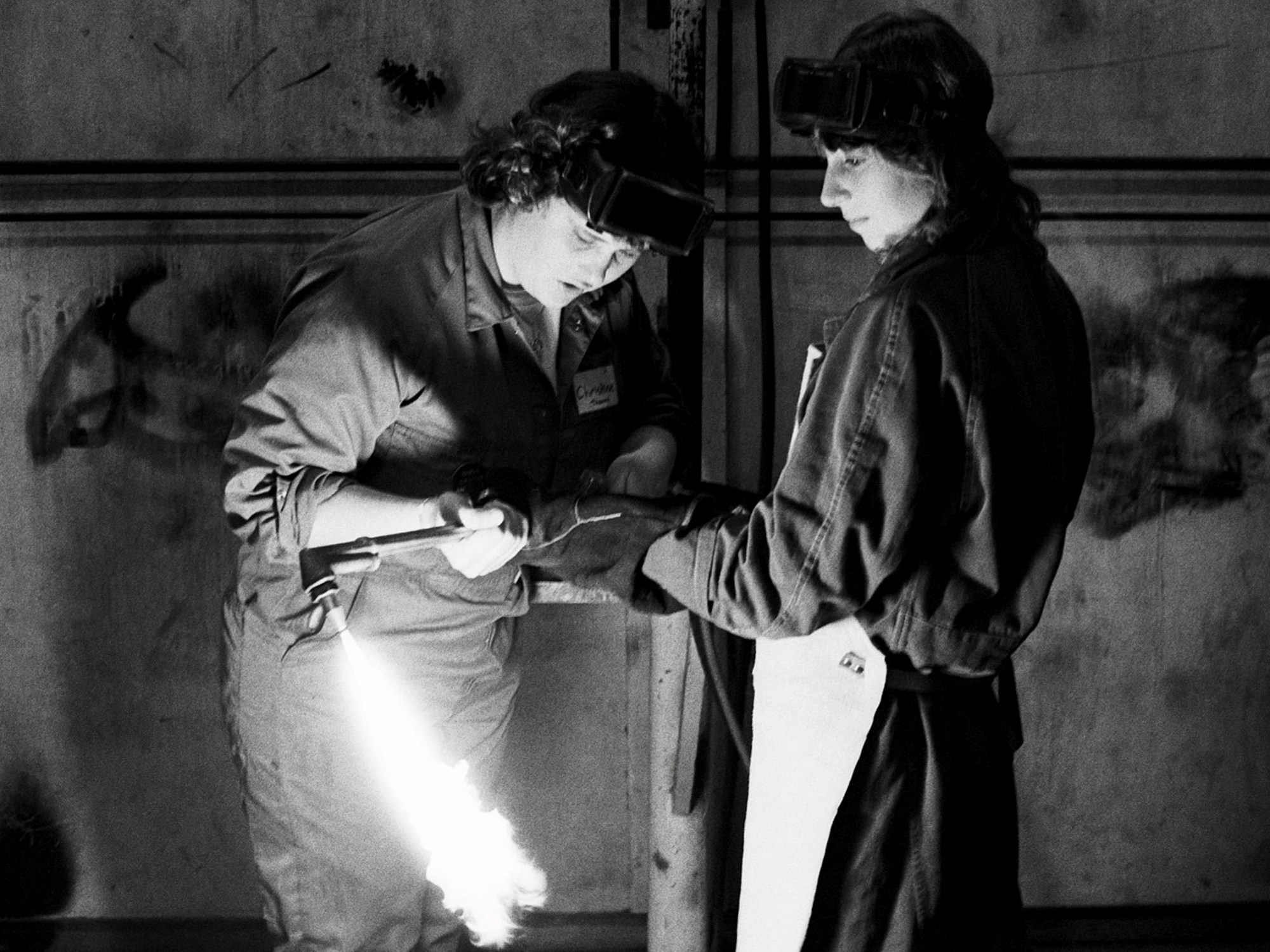
That emphasis is exemplified in the April 1983 group exhibition Industrial Woman, with posters and photographs by Vivienne Mehes, photomontagist Peter Lyssiotis and concrete poet and anarchist Jas Duke:


Of the value of this exhibition, Karen Cooke, in an extensive review in The Age notes how “female factory workers have a low profile in the media and in the art world. They have never been considered a romantic subject for the canvas or the camera,” and commends Industrial Woman, acknowledging the collective effort of the exhibitors Mehes, Lyssiotis and Duke “to make a statement,” its political nature being reflected in the prices—limited edition posters by Peter and Jas at $2, and $20 for Vivienne’s unframed prints. Cooke quotes Mehes:

“Vivienne says she wants to make a career of photographing work problems of women, especially migrants, in factories. She will not accept work that is “politically unacceptable” to her. “I suppose I’lI just remain poor,” she says, smiling.”
Industrial Woman later toured, and a book version was issued in 1986 (see; Johanna Drucker’s A Century of Artists’ Books pps. 289-90, 289, 291, 296). A similar commitment to socio-politcal issues is evident in other shows at Visibility. Stephen Henderson exhibited Being Old, a photographic essay on the community’s neglected people over October 1983.

Helen Casey, Sara Charlesworth, Jan Lalor and Ruth Maddison also showed at Visibility Gallery as part of the 1984 Melbourne Socialist Feminist Conference.


The Pine Gap Story, an exhibition of photographs taken at the Women for Survival peace camp at Pine Gap in November 1983 showed at Visibility Gallery through November 1984, with members of Melbourne Women for Survival be at the gallery to discuss the exhibition and forthcoming actions.
The gallery closed in March 1985 after a show intriguingly titled Not Negotiable; was it a call for a large life-saving crossed cheque in favour of Visibility, or a defiant assertion of their moral stance?
“[Among Visibility] specialities was work with a socio-political flavour. They showed a series on uranium mines, industrial women, photo-journalism from Afghanistan, and even ‘The Pine Gap Show’ by a group of women photographers.” (Geoff Strong, ‘The Melbourne Movement’ in David Bennett (ed.) The Thousand Mile Stare, catalogue of the exhibition at the Australian Centre for Photography 10 March–10 April 1988, curated by Joyce Agee)


 On This Date in Photography: by James Mcardle