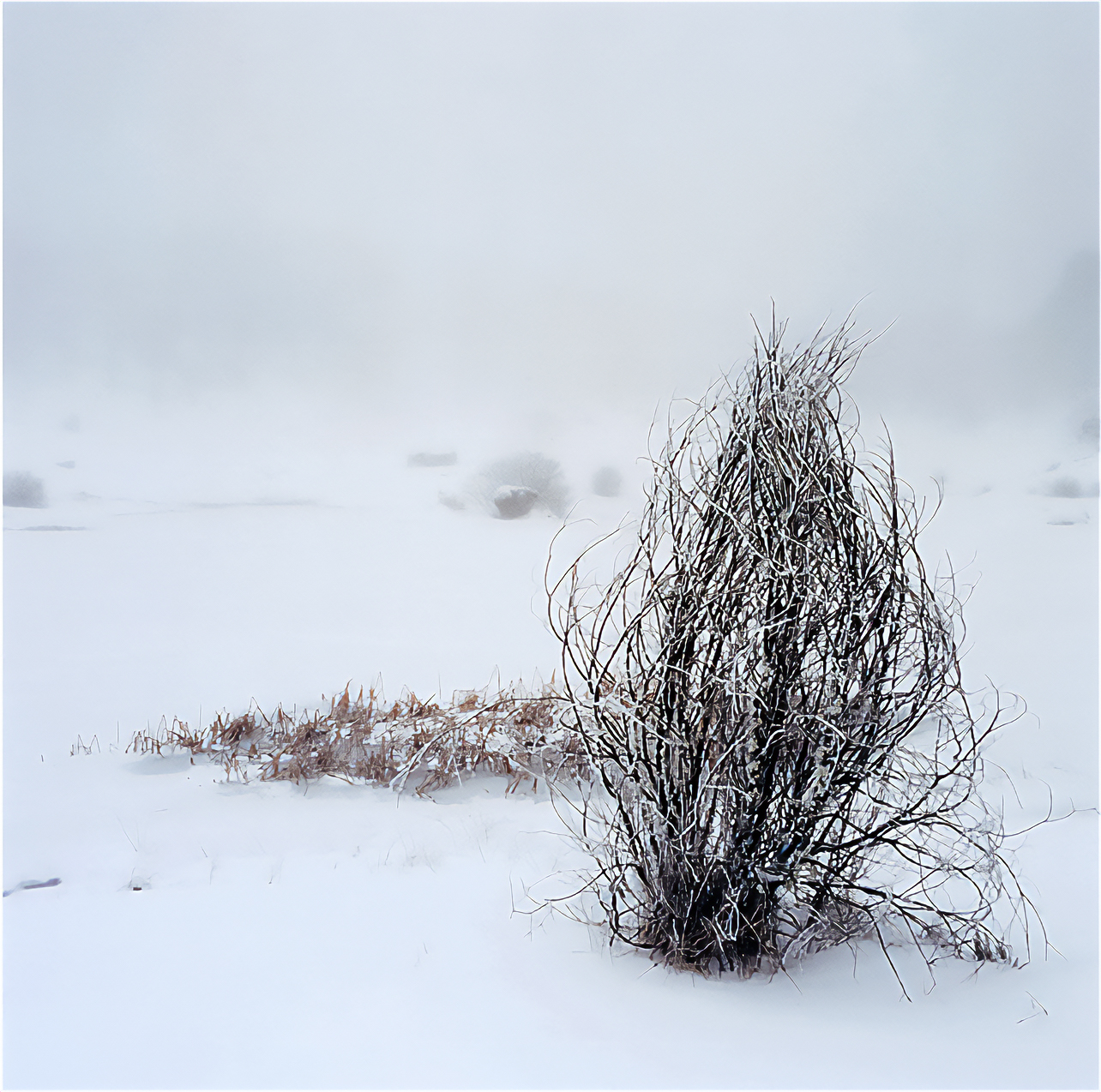
The trouble with photographing in the landscape, in the wilderness, is the trouble; it requires work, effort and perhaps some discomfort and danger, and that makes it wonderful to do.
Australia’s first curator of photography in a public gallery, Jennie Boddington, describes Australian artist Stephen Wickham‘s expeditions as
“spiritual and intellectual, no less than physical I imagine, in […] exploration and discovery of these unfrequented spots. In each journey there has emerged a different yet related body of work, which would indicate that the photographer sustains a bond and an understanding of some kind in his fascination with this subject […] Not one for taking things easily he endured the freezing of camera gear, blinding by sleet, swelling of finger joints and other discomforts of travel in the wilderness where no warm hostels are to be found […] the concerns of man are of no moment. In imagination we are transported to places where the shy animals go about their business, among aloof and renitent heights which are seasonally scarified by the catastrophic passage of fire and scoured by the movements of wind, ice, mist and snow, and rocks are exposed to the cracking heat of high summer.”

Wickham made his debut as an artistic photographer at the National Gallery of Victoria when he won its 1974 Special Jury Prize for Portraiture and in the 1975 show Recent Acquisitions when three of his portraits, made on the Kodak Recording Film. That material and a method of processing it was recommended to him by Jon Conte a fellow student at Prahran College where Wickham studied before moving to the VCA. They were were purchased for the Kodak Collection and Kodak’s data sheet for his film stock notes its characteristics:
“…high-speed, coarse-grain panchromatic film with extended red sensitivity for use in 35 mm cameras. It is intended for photography in low levels of existing light or when very fast shutter speeds coupled with small apertures must be used…especially useful for indoor sports photography, available-light press photography, surveillance photography…Size Available: 135-36 magazines and 35 mm long rolls (perforated). Speed: ISO 1000 to 7000”
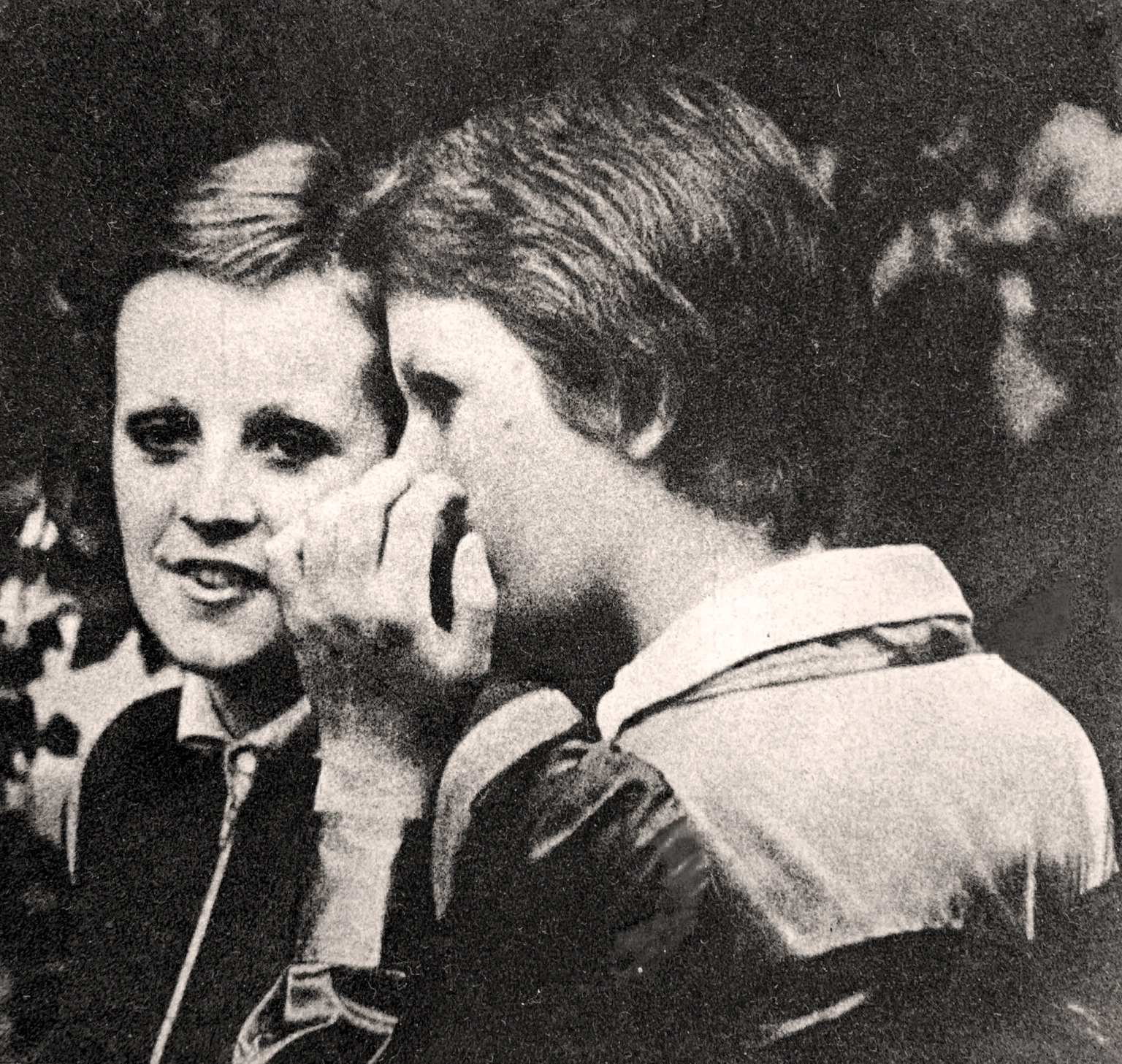
Its high sensitivity considered astounding in the 1970s and before the advent of digital imaging was useful, but it was the pronounced grain helped Wickham to emulate acquaint effects much admired in the printmaking that he had also adopted. He used the rather unpredictable hypo-alum toner to supply a warm sepia to the prints, but it is the film’s emulsion’s red-sensitivity that we see working in the bleached, anaemic skin-tones that reinforce a poetic Pre-Raphaelitism as much as do their titles, which Jennie Boddington was to declare “agonised.”
On the recommendation of lecturer Alan Mitelman she purchased Wickham’s portraits for the NGV and showed them in her 1976 Modern Australian photographs, among the illustrious company of Geoff Beeche, Anthony Browell, John Cato, Max Dupain, Sue Ford, Val Forman, Les Gray, Fiona Hall, Marion Hardman, Richard Harris, Melanie Le Guay, Shane McCarthy, Euan McGillivray, Grant Mudford, Geoff Parr, Bob Rhodes, Kurt Schwabauer, Roger Scott, Duncan Wade, John Walsh and John Williams.


For a year in 1977 Wickham travelled in Nepal, India, Europe, and then took up a position in 1981 as tutor in photography Caulfield Institute of T.A.F.E. while qualifying with a Diploma of Education at Melbourne State College of Education.
Following the 1979 NGV show Selected Works from The Mitchell Endowment and two group shows in Adelaide, Wickham had produced a new body of work that was displayed in Boddington’s survey from the collection, Landscape Australia at the NGV 6 November 1981 – 28 February 1982. Showcasing the diversity of styles and perspectives that emerged from Australia in 1981 Jennie Boddington’s selection of exhibitors aimed to move the medium beyond the idealised pictorial landscape. In the exhibition catalogue she wrote:

“Richard Woldendorp’s aerial pictures’ precise details of geographical observation related artistically to tales of creation […] Laurie Wilson’s monochrome prints of landscape were reworked during his final years when he was unable to go out with a camera concern the mysteries of death and evoke a sense of finality and raw disgust at the mess humans make upon the earth […] Greek-born photographer, Tommy Psomotragos, brought a fresh perspective to the Australian landscape through extreme close-ups that revealed the energy of growth; a daring visual approach that did not rely on manipulation or tricks […] Mark Johnson’s portrayals of Sydney’s waterfront are severe and eschew romantic lighting and atmospheric effects to capture the boom and bust of Sydney’s past and present as a document of Sydney’s growth over two centuries.”

Discussion around that exhibition and of Wickham’s works in subsequent shows provides contemporaneous perceptions of the status of photography as art in the new decade.
Wickham’s approach stands out for its informality, affection, and use of instant film. Unlike the aerial views of Richard Woldendorp he works in an intimate proximity to his subject, Mt. Buffalo National Park over its four seasons. Delicate, immediate and spontaneous colour images are presented in small gold frames as monuments in miniature. Boddington invites viewers to appreciate them as a poetic connection to, and love for, the landscape aside from conceptual thinking or intellectualisation, which in a following paragraph she decries:
“Wickham is a teacher and a product of our art training system [so] inclined to intellectualise or to theorise about visuals and this sometimes has the effect of chasing the meaning away […] Conversely […] the photographs are made with a simple foolproof camera. So it is a set of innocent views…arising from a complex net of theories and even to be explained by art jargon. I […] suggest that these preceptive and evocative visuals have a quality which owes nothing to Wickham’s didactic tendencies, however intelligent[…] and that they would look just as good in a personal album, to be thumbed through with pleasure. They need to be savoured for what they are, delicate and stringent pictures of a landscape the author knows and loves. They are visuals arising rather more from poetic appreciation than from conceptual thinking and they are a cogent argument for the language of photography best enjoyed without the language of words.”
Reviewing the show in The Age on 17 February 1982 not long before it closed, Geoff Strong, who attended Prahran five years after Wickham, frames Landscape Australia as a foil to the dominance in landscape photography of the Americans:
“…it is good to see a portfolio of contemporary work which owes nothing to the “purified print” inspired by Ansell [sic] Adams and the “zone system’ […] propagated with the kind of one-eyed zeal akin to deep south Christian fundamentalism and which almost deserves an export award from the US Government. What it seeks to do is produce an image of such tonal depth that it seduces the viewer’s eye with its richness. Its protagonists say it can be used for any sort of photography, once mastered. In practice it tends to be so cumbersome that most of the images produced are of rocks, trees or buildings (the only things that will stay still long enough).”
Selectively applying the term ‘artist’ in reference to the exhibiting photographers, Strong compares Woldendorp’s pictures to Pioneer and Voyager space craft images as providing novel views of a physical world rather than any insights into the mind of the artist as, he writes, does Stephen Wickham in…
“…instant camera pictures mounted on an elaborate map of the Mount Buffalo National Park and accompanied by a text which includes quotes from the Tantric scriptures, apparent love letters and other mumbo-jumbo. The intention of his work, which centres on a “magic” ring, is to define a kind or ritual and relate it to himself in the wilderness.” Strong concludes; “I hope he enjoyed his time in the bush.”

That year, 1982, Wickham held his first solo show Sites for A Contemporary Ritual at the Queensland College of Arts.
In March 1983, Boddington recommended for purchase nine of Wickham’s works. She prefaces her report in writing that Stephen graduated from the Victorian College of the Arts painting in 1974 and won the Hugh Ramsay Prize in 1973, that his work was in mixed media and increasingly included photography, that his small colour photographs shown in Landscape, Australia had been purchased and asks the Gallery to consider purchase of black and white prints made in Mount Buffalo National Park:
In these 9 pictures the artist has produced a lyrical song of winter: the cold and silence are intense; the presence of rocks, some rounded and others anvil or seal shaped, outlined with snow, sometimes in sharp geometric relief and sometimes obscured by mist or snowfall, has a strange quality not unlike the spirit feeling haunting the ancient sites where rocks have been placed by man for religious purposes. These of course have not. They have probably never been moved but lie where they were formed and weathered in ageless geological time. Stephen Wickham has produced in these images a poem which is perfectly compounded of an intense emotional response and the intellectual process of how to express and convey that response. Each picture is perfectly ordered unto itself, but added together the group is a delicate orchestration of parts, the shapes and tones bringing to the viewer an experience of place and season that is truly satisfying.
Like Strong, she goes on to distinguish Wickham’s landscape imagery from the predominant American style:
The work is subtle and unusually poetic for its period. Nearly all celebratory landscape work at present done in Australla is moulded in the West Coast American tradition. These photographs are original and have been made with intelligence. I recommend that the purchase be approved.
She then wrote an essay for his second solo exhibition at Visibility Gallery, Carlton, of a continuation of the series, part of which was displayed prominently in the Art Almanac listings as a profile.


Beatrice Faust, reviewing the show in an article ‘Landscape Art Flourishes In The Wilderness’, in The Age, 20 June 1984, is complimentary but uncomprehending. She lumps Wickham in with pictorialist “notables like Ansel Adams, Eliot Porter, and Olegas Truchanas”. While wasting words on description she hints at some ‘message’ being being surreptitiously conveyed “in the most delicate and amiable way,” and without using texts “to spell out impassioned but garbled comments on his scenes,” nowhere is it made clear what that meaning, nor what its heuristic might be.

For Kris Hemensley, writing in the Spring 1984 edition of Photofile, Faust’s recasting of Boddington’s opinion that the Visibility Gallery show was an advance because it did away with “the crutches of poetic texts” was mere prejudice. He declares that “Wickham is artist enough to elude that deadening conformity.”
“His 1980/81 representation in the National Gallery’s landscape show, his gold-framed colour snaps, proposed a complex strata: an interleaving of what is seen, who is seeing, and what it is comes through of that conjunction.”


In Art and Australia of Summer 1988, Charles Green notes how during the 1970s Wickham paintings incorporated photographs and found objects;
“They were distinguished by hermeticism and a highly literary, studied fixation on images of pain, loss and suffering. Ophelia, 1977, acrylic on jigsaw puzzle, was typical of these works. A psychedelic maze of colours, not unlike snakes-and-ladders, partly overlay the kitsch jigsaw puzzle replica of Miilais’s Ophelia that the artist had acquired at the Tate Gallery.”

Engaging with ideas around that bicentennial year of Australia, Green considers that given Wickham’s deliberate abandonment of meticulous photographic control in 1978 ( when Wickham started taking photographs with the plastic Kodak Colourburst) and also that since 1983 he is as much a printmaker as photographer, Wickham’s Mount Buffalo project should be seen as:
“self-conscious and ironic: his intention was to examine shadows underlying our culture’s conceptions of wildness and wildness. The choice of alpine landscapes, covered in snow or mist, was not intended to show another side of Australia. Nor did he mean to invent another new landscape aesthetic as a way beyond the bind that he, like many younger artists felt in the mid-1970s, when it was clear that modernist art had finally run its course.”
While acknowledging that a “problem here is that [his] works look considerably like latter-day modernist landscapes, participating in the transcendentalism of that photography,” there are several aspects of Wickham’s works noted by Green that can be seen as aligning with the postmodern impulse, including his self-consciousness in staging what he acknowledges is an artificially persevered ‘wilderness, selecting the point of view and using devices of classical landscape to create a formal construction to appropriate and mimic viewpoints, subjects, and techniques of earlier periods of art, such as nineteenth-century landscape photography to counterfeit the aesthetics of the past; an absence of the human, or the Rückenfigur as observer or mediator, challenges traditional notions of representation and shifts the discourse to the natural environment; and by working outside the American West Coast fine-print tradition in photography, Wickham located himself within the orbit of contemporary theory.

In ‘Nostalgic journey through the landscape’, his review of Wickham’s show at Stephen McLaughlan Gallery, Melbourne, Robert Nelson, writing in The Age on 16 June 2001, seizes on the title of the show “from Stefan Weisz for Elizabeth, Emil, Georg Weisz and Margaret Lasica” as referring to Central European refugees who came to Melbourne in the late 1930s, bringing with them an appreciaton of music, literature, and art, and delighting in a familiar landscape around Mount Buffalo Chalet, the first ski resort in the Victorian Alps.
In fact, more than being a “salutation of a pathetic old central European postcard,” the show’s title is more personal. Margaret Lasica, born Margaret Weiss in Vienna, migrated to Australia in 1939 where her family took the Anglo surname Wickham on arrival in Australia. She later married commercial lawyer William Lasica, first Chairperson of the Centre for Contemporary Photography. Margaret was a student of Ruth Bergner and performed in the Modern Ballet Group in Melbourne in the 1950s as an early pioneer of modern dance in Australia.
Knowing that enhances the poignancy that Nelson emphasises in the way Wickham’s photographs deviate from the traditional depiction of the Australian landscape, eschewing vibrant colours and, while using colour film, depicts in monochrome resemblance to remembered European scenery, and the longing, mystery, and sublime beauty of German romantic iconography, which for the reviewer introduces a sense of nostalgia and a deeper emotional connection to the landscape.
A more sombre note still, and an ecological one, is that close inspection reveals the aftermath of a bushfire; charred branches and the botanical injury caused by the fire, a perception that challenges the idealised notion of untouched and pristine landscapes of traditional landscape photography.
This realisation remains consistent throughout Wickham’s oeuvre.

While national holdings such as those in the Australian National Gallery are of Stephen Wickham’s painting and printmaking, his photography is in the Museum of Australian Photography, State of Library of Victoria, Deakin University, RACV Collection, Murray Art Museum Albury (MAMA), Counihan Gallery, La Trobe Regional Gallery, Arts Centre Gold Coast, Australian Embassy Washington DC, Ballarat Fine Art Gallery, State of Library of Victoria, National Library of Australia.


 On This Date in Photography: by James Mcardle