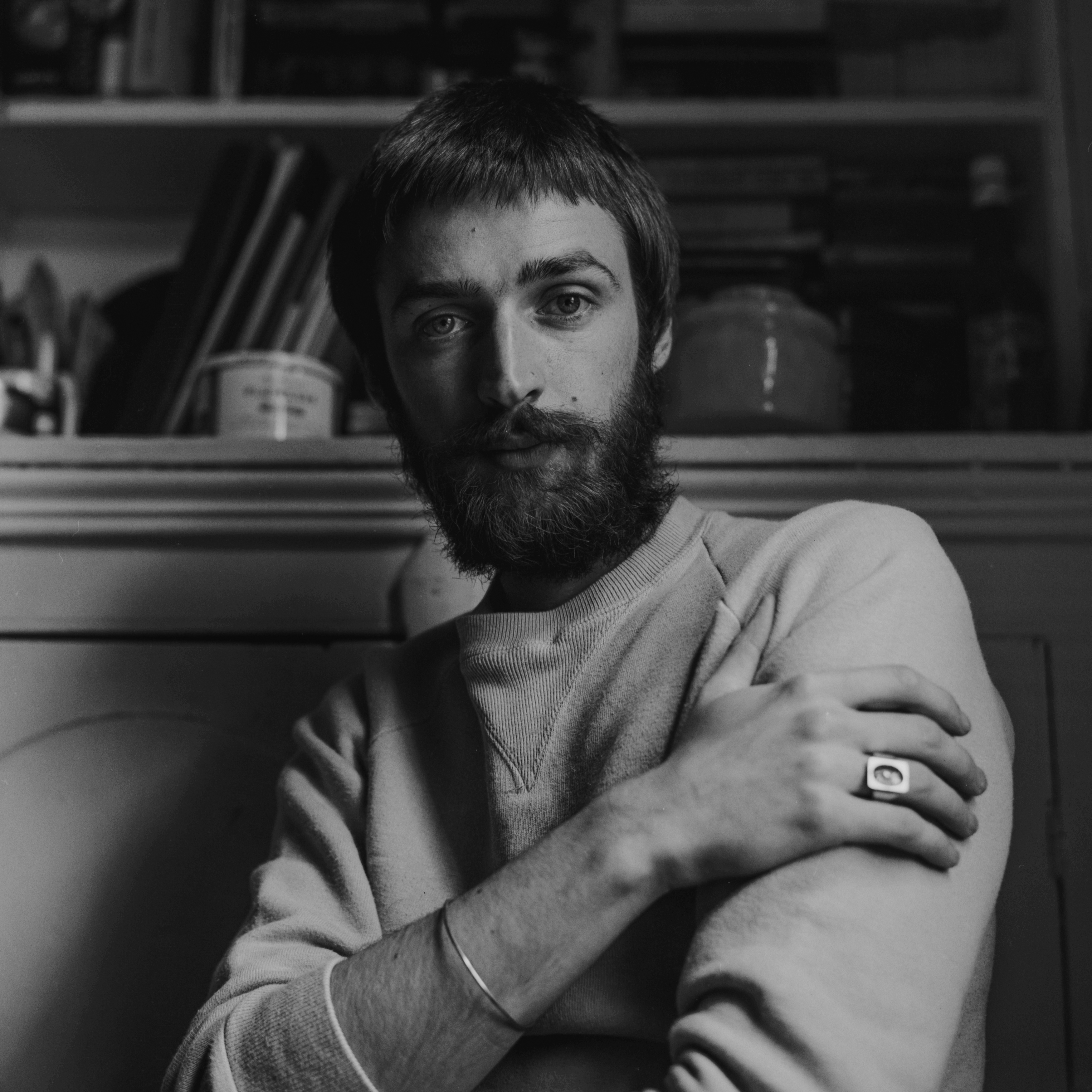
 The camera is an instrument with which some conduct a discrete and personal spatial inquiry. For Australian photographer and academic Steven Lojewski this is a solitary odyssey.
He was born on 23 June 1952 in London, and from 1956 spent his childhood in Canada before migrating to Perth, Australia in 1969. He remembers when;

“arriving in Melbourne in 1971, my photography was moving from a hobby to a more focussed exploration of the urban environment; its inhabitants, architecture, and general landscape. Working as a gardener in the Fitzroy Gardens I became interested in the interplay of people and the city. I found work in Anthony Teare’s studio as a printer and as a studio assistant with German-born fashion photographer Gerd Rosskamp.”
He began freelance work for weekly alternative newspapers the Nation Review and Ed Nimmervoll’s Melbourne-based rock music magazine JUKE established in 1975, covering street demonstrations and music concerts. He also began urban photo reportage projects and work with The Victorian Ballet Company (among these is his 1976 portrait of Pamela Buckman, stamped ‘Steve Lojewski Photography, North Carlton’ held in the National Library.)
He enrolled in the Prahran College photography diploma in 1974;
“Alongside my commercial work I was developing my own reportage projects of portraiture, people in the street and the urban environment. This resulted in a portfolio of images which I presented to Prahran College of Advanced Education to gain entrance to the Photography Diploma of Art and Design.
“After working for years in a relatively isolated manner I found the course illuminating in that I was immersed in a group of people exploring their own unique relationships with the photographic medium and the world. The class discussions and those outside on a more social level were very significant to my understanding and appreciation of the medium. The staff at Prahran, Athol Shmith, John Cato, Paul Cox, Bryan Gracey and Derrick Lee, were all inspirational in their own areas of expertise.
“I believe the early 70’s at Prahran provided a special experience for many young photographers who were part of an exciting and pivotable time in the development of fine art photography in Australia. It certainly was a vibrant cultural petri dish. Graduates found their work in exhibitions, many worked commercially in film and photography, some found careers in education and others moved onto different disciplines underpinned by their visual art experience from Prahran.”
Sydney photographer and one of the founders of The Photographers’ Gallery in Prahran, John Williams, in an article ‘Hope for the learners’ in The Australian in January 1976 comparing the availability of tertiary level courses in photography in America with the situation in Australia, complains that;
“in a city the size of Sydney we can at least expect something. By comparison, Melbourne’s not too badly served. Prahran College, uniquely in Australia, offers a three year diploma course about photography — not just technicalities. The college already has some significant photographic artists to their credit — Carroll [sic] Jerrems and Robert Ashton are both ex Prahran, Jon Conte, Phillip Quirk and more recently Steven Lojewski.”

Williams accounts for his approval of Lojewski in his review of the Prahran graduate show in The Australian:
…his display…is really the highlight of this exhibition. There is an almost terrifying maturity and sense of purpose about his work–a single-minded, intensely personal, almost Spartan vision of his world. The prime influence on Lojewski is clearly New York. Stripped-down, economical photography of this kind will never find much sympathy among the naked-lady-on-the- beach school of pictorialism. Yet it may be that these eerily peaceful lightly printed images of a still and lonely world are among the most personal and important images to come out of Prahran College.
Lojewski immediately launched his career in the medium…in October 1976, the year he graduated, he showed Slender is the Thread at the Photographers’ Gallery in South Yarra. Alongside her review of John Cato’s Sea Wind at Impact College (Photography Studies College) Beatrice Faust praised the show, noting a vast improvement from Lojewski’s previous work and admiring his skill in contrasting between man-made architecture and its natural settings in Melbourne. She highlights Lojewski’s adeptness in conveying intricate details and textures in monochrome prints. The teaching that he had started to undertake she felt had honed his self-critical skills, elevating his work beyond any pretentiousness to a complete artistic statement.
His technical knowledge was further refined in his printing for Peter Barr who then ran Shmith Cato Barr in Collins St. This assisted him in teaching the Zone System to advanced students at Bill Heimermann and Ian Lobb’s Photographers’ Gallery and Workshop. Funded by a $1,500 grant (worth more than $A10,000 today) from the Visual Arts Board for a Special Project to document the Australian environment—one of nine grants awarded to photographers by the Board in 1976—Lojewski embarked on a series devoted to the artificial landscape and unpeopled structures.

His work was acquired by the National Gallery of Victoria that year and also by the Horsham Regional Art Gallery which was the first regional art gallery to specialise in the medium on the advice of collector and gallerist Joyce Evans.
There is a consistent awareness in work from this period of how the medium-format camera ‘boxes’ the subject as the photographer views its image condensed on the crystalline ground-glass of his Rolleiflex.

His patience in composing architectural forms with this instrument in early work results in centred arrangements that invite the viewer to cross a threshold into a world made newly strange.

While the tiles receding into the deserted portico might be set firmly at our feet, we find, in another of this series, steps climbing to a window which, like that of the camera viewfinder, we can enter only with our eyes.

As a fellow student in the same year as Steven, I was envious of the quality, in particular, of this print of another threshold, which renders with powerful presence the full gamut of reflected sky in burnished brass which stands proud of the rich lustre of dark stone begrimed by city soot.

From 1976 to 1978 Lojewski worked with Jean Marc Le Pechoux as Associate Editor of Light Vision magazine, which involved discussions with contemporary Australian photographers about ideas underpinning their practice, their careers and the development of their projects.

In 1977, Steven taught photography at the Council of adult Education alongside fellow alumnus Peter Leiss and at the Preston Institute of Technology under Head of Department Henry Talbot and with Ian Lobb. He showed that year at Joyce Evans’ Church Street Photographic Centre in Richmond in its first exhibition The Australian Eye, and though a large collection was on view, Beatrice Faust’s review in The Age, which was critical of the uneven selection, mentions by name only exhibitors Lojewski, Venise Alstergren, David Moore, and Steven’s lecturer at Prahran, John Cato;
“Grouping is even more important with the work of younger people like Steven Lojewski who are just beginning to enliven technical competence with personal vision. Several of Lolewski’s pictures could seem inconsequential when seen in isolation. When seen as a group they reveal both competence and originality.”
The next year he moved to Sydney to teach in the recently established visual arts program at Sydney College of the Arts. Fellow photography department members were John Williams, Head of Department, and fellow lecturers Catherine Rogers, Lynn Silverman and Colin Beard.
The Australian Centre for Photography at the end of that year exhibited his work in Ten Photographers – Brisbane, Canberra, Hobart, Melbourne, Sydney, with Stan Ciccone, Sandy Edwards, Virginia Coventry, Gerrit Fokkema, Glen O’Malley, Stephen Crowfoot, Marion Hardman, Ashe Venn, and Paul Hopper.
His prints quickly found a place on walls further afield, at ‘Snaps – A Photographers’ Gallery’ in Auckland, New Zealand which during its short life 1975 – 1981 showed him in 5 Melbourne Photographers with another Prahran student Peter Leiss, and Robert Besanko, Jean-Marc LePechoux and Paul Watkins in October-November 1977


Lojewski had already shown in two of Melbourne’s three independent photography galleries and was about to exhibit also at Brummels in April 1978 when Peter Turner, editor of Colin Osman’s Creative Camera, and who later was a guest speaker at Joyce Evans’ Church Street Centre and showed at Brummels in November, devoted his March issue to six Australian photographers. The acceptance of photography as art in the UK was in fact less advanced than in Australia; as Turner remembered, “there were no photography galleries in England then, so Creative Camera was the only outlet.”


The Swiss magazine printletter (later merged with the German European Photography) published a report on Australian photography by Tony Perry (who was then teaching at Photography Studies College) which included Lojewski with fellow alumnus Geoff Strong, and Max Dupain, Ian Lobb, Tony Perry (whose photograph appears on the cover), David Blount, and Ron Starr.

Christine Godden, surveying ‘Photography in the Australian Art Scene’ in Art and Australia in summer 1980 placed Lojewski amongst recent Australian photographers who aspired to;
“…a conscious double ambition…both to discover and record the character of the subject, and, at the same time, to explore uniquely photographic values…both outward-looking and self-referential…a great deal of contemporary work, which is apparently documentary in nature is …more the result of a process of exploring. re-defining and extending photographic issues than an attempt to represent a person, place or event. The work of Mark Johnson, Steven Lojewski, John Williams, Douglas Holleley and John Delacour can be understood in this way.”
In April 1983 he exhibited his 34 black-and-white Sydney Photographs 1981-1983 at The Photographers Gallery, Melbourne, and and subsequently in October 1983, in Sydney Rooftops at the ACP in tandem with an exhibition of Diana camera images, Landscapes, by Christine Cornish, his partner since 1975. Anthony Clarke reviewing his Melbourne show in The Age remarked that by photographing rooftops Lojewski presented an unrecognisable Sydney, as a ‘universal city…bizarre and oddly humorous,’ in which people are absent, except in three of the prints, where they were reduced to ant-like scale. Recruiting an elliptical reference to the Zone System, Clarke comments on their technical achievement, praising;
“The tonal range, [which is] is wide, allowing lines to appear almost etched against their background, or shadows to carry immense detail with in their velvety depths. The depth of field allows foreground and background in every photograph to carry equal weight, seen to great effect in one shot showing the distant roofscape framed between a foreground of intricate wrought-iron work.”
Terence Maloon writing about the ACP showing in the Sydney Morning Herald, perceived a “feeling of deja-vu [that] quickly changes to amusement, and then to consternation” as a universal, sharply rendered;
“flattening effect draws the overlapping features of various buildings into strange conglomerations, which look as if they might be buildings in their own right – a grotesque and improbable fantasy architecture”…framing follies such as the “miniaturised mock-14th-century chapel [that] stands on the roof of Walton’s.”
The tightly constructed two-dimensional composition of each image, he writes, is collage-like, and “architectural” but paradoxically not “unified and not orderly” and, while amusing, they comment on society; “our competitiveness, self-interest, and general indifference to the environment.”
In October 1985 Lojewski was an entrant in the acquisitive Albury Regional Art Centre (now Murray Art Museum) National Photographic prize established in 1983, with Gael Newton and Helen Ennis jointly selecting the work for purchase. In the same month his work also appeared in the Australian National Gallery exhibition Recent Australian Photography: from the Kodak fund with other practitioners of the fine print Mark Johnson, lan Lobb and Les Walkling.

Three funded projects enabled Lojewski to expand on his interest in the constructed environment; in 1984 he joined the CSR Pyrmont Sugar Refinery Photography Project, a continuation of an initiative of the ACP set up in 1978; also the 1983-4 Newtown Photographic Project undertaken in the a suburb of Sydney’s inner west with twelve other artists including Judith Ahern, Susan Black, Matthew Cumming, Richard Hannah, Raya Litwak, and Catherine Rogers, resulting in an exhibition in January 1984 at the Newtown Neighbourhood Centre. The identity of Newtown allowed for interpretation; from the 1970s, as its post-war migrant population prospered and moved elsewhere, terrace houses and cottages became cheap for students to rent and to share households. In the ’80s Newtown was distinctly bohemian and attracted a gay and lesbian population.
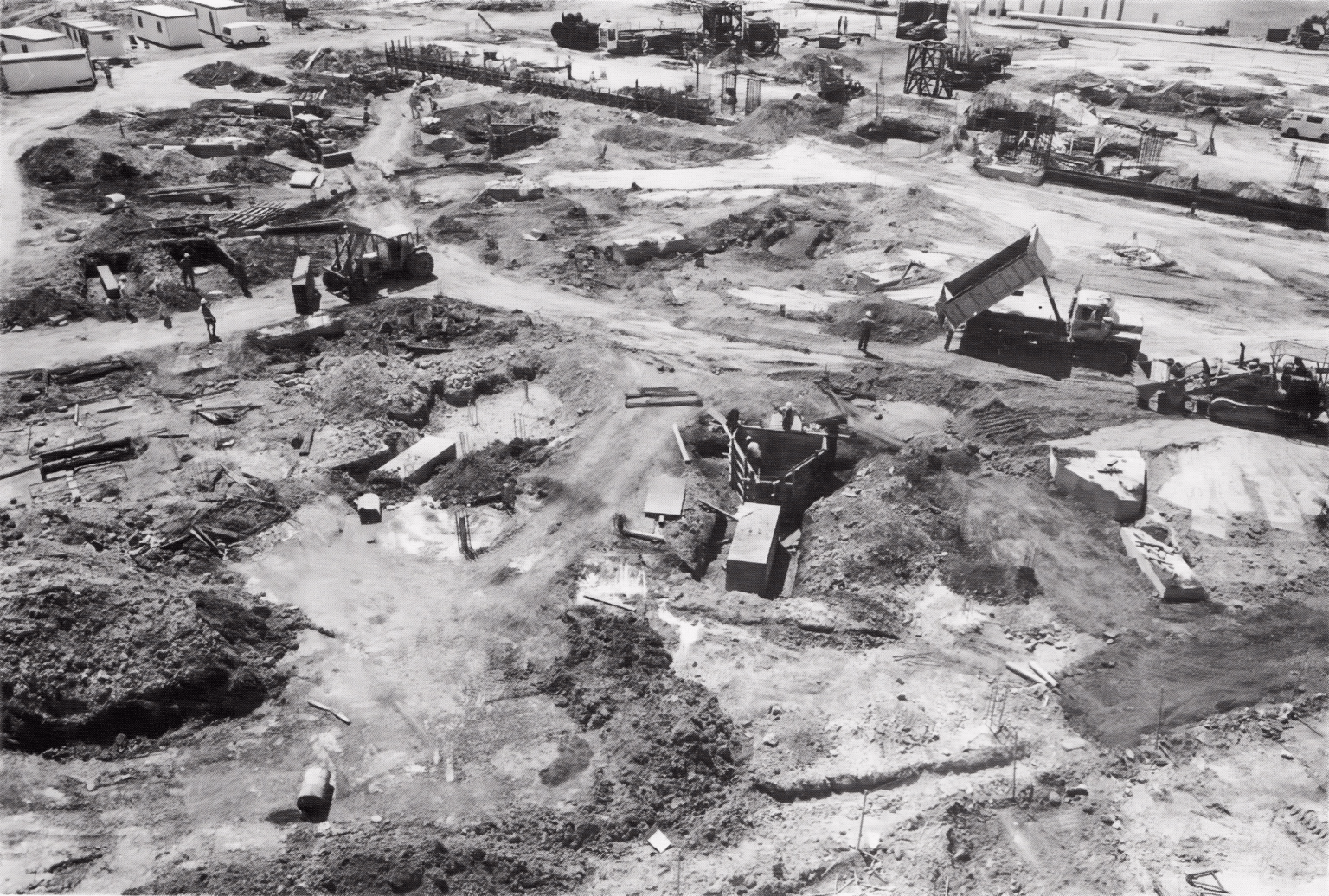
The Parliament House Construction Authority commissioned photographers including Lojewski to document the building of the new Parliament House between 1986 and 1988. Other participants included: Margot Charter, Grace Cochrane, Ed Douglas, Sandy Edwards, John Elliot, Gerrit Fokkema, Gillian Gibb, Anne Graham, Anthony Green, Fiona Hall, Douglas Holleley, Ian Howard, Merryle Johnson, Mark Kimber, Brent Nylon, Glen O’Malley, Charles Page, Tony Perry, Debra Phillips, David Stephenson, Richard Stringer and Richard Woldendorp. The Parliament commission allowed for individual interpretation, though as Martin Jolly notes, most of that was formalist, like Lojewski’s “flattening of space with on-camera flash and high horizon lines.”

The CSR Project was pivotal for two reasons. Firstly, with few constraints imposed by the company, it allowed contemporary photographers to continue the artistic evolution of industrial photography practiced by Dupain, Sievers and other modernists, from a commercial to an artistic focus. Secondly, it was key example of private sector support for the visual arts in Australia, indicating a significant moment in aligning private interests with artistic endeavours.
In 1986 the Australian Centre for Photography showed Work Sites (Darling Harbour images) by Lojewski alongside Good Weekend photographer Gerrit Fokkema’s Wilcannia. Max Dupain in his Sydney Morning Herald review saw Lojewski as revisiting Max’s own territory of the early thirties when he had “revolted against the sentimental thinking of the academy” to discover the “dynamism of industry,” but regards the younger photographer’s achievement as of lesser value, and solely in an historical sense. Then in his seventies, as are Lojewski and his Prahran colleagues now, and with perhaps a myopic glance at his own romanticist montages that also betrays unfamiliarity with Lojewski’s earlier lyric, or later surreal, representation of architecture, Dupain complained;
“They supply information and enlarge our parameters of societal behaviour. Emotionally they are negligible. I wish they enabled me to reach the stars as after a fine performance of Beethoven’s Ninth or as after the reading of the solemn and humble 23rd Psalm. But they don’t.”

From this interest in urban architectural environments, Lojewski collaborated with writer Mark Jackson at the Australian Centre for Photography in October 1988. Lojewski and Jackson had discovered negatives in the Mitchell Library, which Lojewski printed, by Arthur Foster: a commercial photographer who worked mainly on architectural commissions, recording the construction of the AWA tower and Sydney Harbour Bridge, during the first half of the twentieth century.

Jackson in the Summer 1986 edition of the ACP’s Photofile presents the previously unknown Foster’s visual record of projects by Anthony Hordern and Sons, James Hardie and other industrialists. Invoking Allan Sekula’s critiques, Jackson asserts a disruption of the history of photographic practice in a challenge to discursive limits that position certain photographers and their work. He also cautions on the linking of images with a particular biography to ‘invent’ a photographer, and so distinguishes what is different behind the apparently similar ‘realist aesthetic’ in Foster’s and Lojewski’s work in their divergent relationship with capital, particularly in relation to commercial and industrial interests, public relations, and advertising in Foster’s case against ‘pure’ documentary and artistic ambitions in Lojewski’s, and suggests how retrieval and examination of Foster’s archive might advance critical practice of inquiry into photography’s complicit relation to capital and the shifting discursive limits of photographic practice.


Also in 1988, Lojewski was featured in Australian Photography of the 1980s, at the National Gallery of Australia, which toured, and when it was at at the Art Gallery of NSW, curator Helen Ennis, remarked, in relation to the trend for ever larger images, that works included from the early 80s by Fiona Hall and Lojewski, being small, engage the viewer, and that Lojewski’s tight focus amplifies the photographic shift from a three-dimensional world to a two-dimensional rendition.
1989 marked an excursion out of galleries that showed exclusively photography when he showed images of the redevelopment of Sydney’s Darling Harbour in a newly established space, Syme Dodson, in Surry Hills, alongside paintings and sculpture, of which Bronwyn Watson describing “Lojewski’s nightmarish industrial landscapes and Sellu’s rare abstract works on the other wall” in the SMH wrote that it “sounds chaotic but surprisingly doesn’t appear so,” but in fact was “well-balanced,” and “vibrant.”
Though he again showed with Dodson he was taken up by Stills in May 1993 for a show with Suellen Symonds, Tom Hennemann (his co-exhibitor at Dodson), Danielle Thompson and Melita Dahl and continued to show there.

He participated in Sydney Photographed over December 1994 and January 1995 at the Museum of Contemporary Art—which issued a catalogue of the same title—with 21 other contemporary photographers; Judith Ahern, Micky Allen, Emmanuel Angelicas, Ellen Comiskey, Christine Cornish, Brenda Croft, Johnathon Delacour, Peter Elliston, Gerrit Fokkema, Fiona Hall, Tom Hennemann, Ken Heyes, Martyn Jolly, Jon Lewis, Peter MacKenzie, Ian Provest, Catherine Rogers, Bruce Searle, Peter Solness, John Williams, William Yang, and Anne Zahalka, promoted as images “that emerge from the photographers’ intimate knowledge of particular Sydney places, communities and histories.”
International exposure again came when Lojewski’s early work was included in the National Gallery of Australia’s On the edge : Australian photographers of the seventies (from the collection funded by the Philip Morris Arts Grant secured in 1973 by James Mollison) and in its catalogue by Gael Newton & Anne O’Hehir, when it was shown in San Diego Museum of Art, San Diego, USA, during for the first half of 1995.


Lojewski photographed only in monochrome for his exhibition Darling Harbour: selected photographs (shot in 1988) at Kodak Gallery, Sydney November 1989, for the series Rooftops, and Populace, shown at Stills Gallery in the year of its establishment, 1991, and also Steel Cities shot in Wollongong and Newcastle, exhibited in both locations (1994 and 1995).

Over six years Lojewski explored the urban, rural, and natural landscapes of the steel cities Wollongong and Newcastle, and the resultant series emphasises their resilience and endurance through juxtaposition of quotidian activities of the city’s inhabitants with the darker side of industrial life, its challenges and hardships.

In carefully composed panoramas, everyday life is set against industrial icons like distant smoke stacks or graffitied walls to evoke hidden associations, and childhood memories. By capturing these elements, he showcases the vitality and liveliness of these cities. Lojewski recognises that behind these visual landscapes are social and urban processes, of current social, economic, and political issues.


Exhibited at Stills in 1995 Steel Cities won a lengthy and positive response from Robert McFarlane (1942–2023) in his review in the SMH in which he considers Lojewski “a partial inheritor of the tradition of documentary eloquence pioneered more than two decades ago by American photographers such as Charles Harbutt and Burk Uzzle.”

Indeed, the black and white Populace and Steel Cities are a development of his urban architectural interest through the addition of human figures in the tradition of street photography; a parallel exploration he started in the 1970s and which would lead to further exploration of the presence and experience of fellow beings in the city. Lojewski’s fine prints represent the evidence of human presence in their urban milieu that were the material of photographers such as Eugene Atget, Henri Cartier Bresson, and Robert Frank. Like them he works like a modern-day flâneur, walking along the urban arteries on which most travel is done in vehicles. Acting as an observer rather than a participant, what he seeks in these surroundings are viewpoints that will generate an intensity and surreal edge, often with that species of British sensitivity to things being in the wrong place that tickles one’s sense of order.

Isobel Crombie in her essay accompanying A Decade of Australian Photography 1972-1982 funded by the Philip Morris Arts Grant at the Australian National Gallery in 1983 observes connections in this regard of Lojewski with with Gerrit Fokkema, Grant Mudford and Mark Johnson;
“…all in varying degrees [have] refined a sense of order within the conventions of the straight social landscape. Fokkema renders the life of the world; Mudford enhances it with technique and exploits its formal properties; Lojewski extols it. Lojewski’s early work is reminiscent of fin-de-siècle symbolism: in Untitled, 1975, a dog emerges from an inky pool as if from the Styx. Lojewski’s more recent photographs render his subjects with the care of a fine print approach, his lighter tones of grey suggesting a rapture with the play of light on forms, a sense of delight accentuated by the delicate precision of his composition.”

Recognition of a poetic realism that has always characterised his imagery came with his inclusion in the 1996 State Library of NSW show titled Photo Documentary – Recent images of Everyday Life, curated by Alan Davies and a publication edited by Judith Shumack.
At this time in Sydney when other galleries were opening to exhibit photography—including Byron Mapp, Celf Gallery in Enmore, Maudespace in Glee, Particle in Clovelly, the S. H. Ervin Gallery, and Toast and the Mori Gallery in the city—Stills continued to support Lojewski’s work when in 2000 he was part of its show Contemporary Australian and International Photography, and when after almost three decades photographing in black and white, he began using colour transparency film. As digital print technology improved, he was able to achieve quality colour prints in 2001 for Urban Dilemmas, and then Boulevard of Dreams (2003).

With the demise of Kodachrome film stock he embraced digital capture, which he now uses exclusively for both colour and black and white imaging. Some of the images in Urban Dilemmas were shown at Ivan Dougherty Gallery as part of Perspecta 1999.

In 2001 Lojewski was awarded the Leica/Centre for Contemporary Photography Documentary Photography prize, for which, rather than a single defining image, entrants submitted a series of up to seven recent photographs “demonstrating or developing an original and considered appreciation of the chosen subject.” The exhibition toured until 2003.
When the catalogue for the 2001 Leica/CCP Documentary Photography Exhibition and Award was published, the genre had for two decades been subject to a postmodern deconstruction of ‘the real’, of representation, authenticity, and agency. No longer revelatory was the realisation amongst documentary practitioners that it often perpetuated power dynamics inherent in representation; Helen Ennis, in her introductory essay exemplified such tendencies in colonial photographs of Indigenous people in which they are unnamed, thus obscuring any objective historical record.
Ethical and political dilemmas continued to challenge documentary photographers though, with self-awareness being crucial, acting accordingly was not straightforward. Evident in this award was the health of documentary photography as it continued to expand and inform diverse audiences, and catalyse social and political change through its emotional affect, as acknowledged in words of CCP Director Tessa Dwyer;
“Lojewski’s Urban Dilemmas presents an introspective view of contemporary society, in muted tones that suggest a passage or journey from night into day, public into private, memory into anticipation. This series conveys a sense of fragility and loneliness juxtaposing empty interiors with ambiguous groupings of figures, stark exteriors and private moments.”
Sandy Edwards remarked in RealTime that Lojewski, Narelle Autio, Trent Parke, Marzena Wazikowski, reject “the yoke of objectivity with which documentary (and all photography) has been associated [to] make more personal statements.” Judges Isobel Crombie (Curator of Photography at the NGV), artist Rosemary Laing and photographer Emmanuel Santos;
“chose Steven Lojewski’s Urban Dreams as this year’s winner of the Leica camera with Sam McQuillan, Tamara Voninski and Dean Sewell highly commended. Lojewski creates stylishly subtle Antonioni-like images in which the human is occasionally present but never crucial. His laconic still-lifes remind us how barren Australian cities can appear.”
In keen observations of the apparently insignificant detail of the urban environment Lojewski exercises his meticulous eye for off-beat compositions and colour chords, the emotional effect of which belie Dupain’s perception that such a dimension is lacking in this photographer’s work.


Urban Dilemmas and Boulevard of Dreams capture contemporary urban life with an anthropologist’s perspective, infusing images with a gentle humor and poetic compassion through vivid colour, delighting in the interplay of available light on colour film, whether it be the green cast of a fluoro light in a room, the luminosity of a red rose in the sun against a green garden, the nicotine tan of office chairs, or napkins on a table. Thus Lojewski uses a specifically photographic vision, and uses the lens for peculiar juxtapositions, subtle details, and the spatial ambiguity of the photographic plane. You still know where you stand on the threshold of a Lojewski photograph, and you might might step forward, but for the paradox. some impasse, that they stage.

Sandy Edwards, then co-director of Stills Gallery whose strong commitment to and involvement with documentary practice spans three decades, lectured in the context of the Leica/CCP Documentary Photography Award in 2001, showing slides of work by Steven Lojewski, Anne Zahalka, Ella Dreyfus, Glenn Sloggett, Lee-Anne Richards, Gayle Maddigan, Ricky Maynard, Cathy Laudenbach, Lorrie Graham, Peter Milne, Jason Davidson-Hampton and Max Creasy. In 2003 she delivered a ‘postscript’ which overwrote her earlier more;
“narrow and exclusive definition of documentary [devised] to somehow protect and enhance its identity. However, as I proceeded I became convinced of the need for a much broader and more inclusive umbrella of definition, since there are many signs that documentary practices are being adopted and adapted in a plethora of ways. These are signs of life, not death, of the form. Documentary is being embraced in a variety of ways – including the postmodern – by younger practitioners who are schooled in it. This is giving rise to new energy in the genre. [She hoped] the traditionalists [might] embrace this, since adaptation is necessary for its survival. At the same time, documentary is not being sidelined as much as it once was; new curatorial policies seem to be embracing its strengths and uniqueness, as demonstrated by its inclusion in exhibitions. This is happening internationally and within Australia”

Return to the Real: Contemporary Photo-media, which included Lojewski with Narelle Autio, Andrew Mclaughlin, Glenn Sloggett, Paul Knight, Lyndal Walker, and Michael Williams at Plimsoll Gallery of the Tasmanian School of Art in 2003, confirmed his role in this renaissance, as expressed in Andrew Curtis’ essay in its catalogue;
“Steven Lojewski [is] a veteran documentary photographer [with a] practised eye and enviable ability to find the beautiful and poetic in the most prosaic of scenes. He searches for the old, overgrown, and obsolete in the dusty and neglected corners of the metropolitan fringe. The photographs act as archaeological records, documenting the urban environment during its gradual but inexorable decay; for example the restaurant with its empty tables, garish pink napkins and the ‘sorry closed’ sign leaning against the street window – there is a hint of optimism in this photograph but it is overwhelmed by a feeling of isolation and loneliness. Beneath Lojewski’s apparent voyeuristic objectivity there is an undertone of personal commentary, an agenda that sensitively reveals the decaying yet still functioning sites of the urban landscape.”
In 2011 MGA (now Museum of Australian Photography) remembered Brummels; First Australian art gallery of photography with work by Lojewski and Ian Dodd, Sue Ford, George Gittoes, Ponch Hawkes, Carol Jerrems and others who showed there in the 1970s heyday of edgy, straight documentary, and Stills, before it closed in 2017, featured him in its final exhibition Curtain Call, while Horsham Regional Art Gallery paid tribute to his devotion to the fine print in A Kind of Alchemy. Silver gelatin prints from the collection in 2021.

As a graduate of Prahran Lojewski made a major contribution to education in the field after he undertook a Master of Arts at the Sydney College of the Arts and was appointed there as a Senior Lecturer in Photography;
“My studies at Prahran informed my resulting art practice and my teaching base. My understanding of how to think about the medium and talk about photography and its place in society were tied to my experiences in the school’s program. I am grateful for my time in Prahran’s photography program and for my ongoing contact with its senior staff. Those experiences were instrumental in my development as an artist and educator.”
He taught alongside other senior staff, Merilyn Fairskye and Anne Ferran, and was Associate Dean of Undergraduate Studies. There, as early as 1997 he was joined by lecturers in new fields overlapping with photography such as Electronic Arts. He continued to teach documentary photography in his newly introduced Master of Documentary Photography Degree. His Sydney College of the Arts profile from 2002 might be read as a statement of intent;
“Steven Lojewski’s photographic practice focuses on an exploration of cultural and geographic environments, attempting, through photography, to make sense of his surroundings. He deals with cultural aspects of Australian society, often depicting the mundane and ordinary in an approach which brings together an anthropological interest and an exploration of visual language. His photographic practice is not fixed on fine art expression, but equally sees its role as archiving and recording issues of historical and cultural significance..”
Since retiring from Sydney College of The Arts in 2012 Lojewski continues to photograph his surroundings both urban and rural…
“committing to my self inflicted duty to record my time in this world. It may seem ironic that while recording life around me I feel less need to present this imagery to the public. I currently balance image making with my practice of blues guitar — at times feeling I am shouting into the wind with both.”
Lojewski’s work is held in many private and public collections including the Australian National Gallery, National Gallery of Victoria, Art Gallery of NSW, Art Gallery of South Australia, Art Bank and Griffith University, Queensland.


 On This Date in Photography: by James Mcardle
2 thoughts on “April 2: Construction”